Conditioning
Malic acid helps preserve strawberry quality after harvest
A study shows that postharvest application of malic acid at 2 mM reduces weight loss and decay, maintains firmness and strengthens antioxidant defenses in strawberries during ambient storage
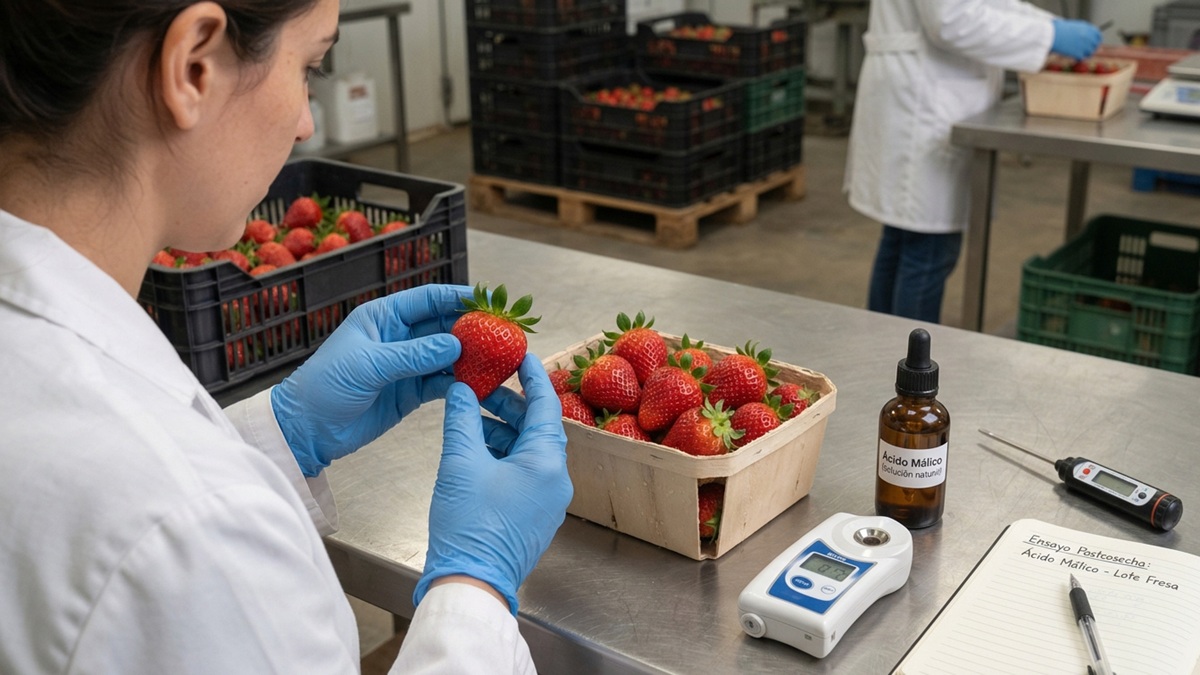
Rapid loss of firmness, oxidative stress and quality deterioration limit the marketability and shelf life of strawberries after harvest. To address these issues, a research team has evaluated the application of malic acid as a postharvest treatment, obtaining favourable results in preserving Chandler strawberry fruits.
The study, published on 18 November 2026 in the New Zealand Journal of Crop and Horticultural Science, analyses the effects of different concentrations of this organic acid on physicochemical quality, oxidative stress indicators and the activity of antioxidant systems during storage.
The researchers Shafa Nayab, Sami Ullah, Ishtiaq A. Rajwana, Umar Farooq and Shoaib Ur Rehman examined four treatments: an untreated control and malic acid concentrations of 0.5, 1 and 2 mM. The fruits were stored at 23 ± 2 °C and a relative humidity of 55–60%.
The 2 mM concentration delivers the best results
Among the concentrations tested, the 2 mM malic acid treatment was the most effective in maintaining strawberry quality. Treated fruits showed lower weight loss and decay, while also retaining greater firmness compared with the control group.
Significantly higher levels of vitamin C and titratable acidity were also observed. At the same time, the treatment maintained a lower ripening index than that recorded in untreated fruits, indicating better preservation of their characteristics during storage.
These findings highlight the potential of malic acid as a tool for reducing quality losses associated with the storage of highly perishable products such as strawberries.
Enhanced antioxidant activity and reduced oxidative stress
The study also examines the biochemical mechanisms involved in the fruit's response to oxidative stress. In particular, the researchers analysed total antioxidant activity, phenolic compound content and various indicators associated with oxidative damage.
The application of 2 mM malic acid helped maintain higher total antioxidant activity and greater total phenolic content. In addition, treated fruits accumulated lower amounts of malondialdehyde (MDA) and hydrogen peroxide (H₂O₂), two indicators associated with cellular oxidation processes.
Regarding enzymatic activity, higher levels of superoxide dismutase (SOD) and catalase (CAT) were recorded. These enzymes play a role in antioxidant defence mechanisms. By contrast, peroxidase (POD) activity was lower than in the control group.
Taken together, these changes indicate that the treatment helps maintain the fruit's antioxidant protection mechanisms and limit the accumulation of substances associated with oxidative stress.
Malic acid as an alternative for postharvest preservation
The study's findings show that postharvest application of malic acid, particularly at a concentration of 2 mM, may help preserve strawberry quality during storage at room temperature.
The combination of reduced weight loss and deterioration, maintenance of firmness and preservation of antioxidant compounds makes this treatment an interesting option for research into postharvest preservation technologies.
The authors conclude that its positive effects are related both to the reduction of oxidative stress indicators and to the maintenance of the fruit's antioxidant system activity.
Source
Nayab, S., Ullah, S., Rajwana, I. A., Farooq, U., & Rehman, S. U. (2026). Postharvest malic acid treatment retain fruit quality and alleviates oxidative stress in strawberry (Fragaria × ananassa Duch. cv. Chandler) during shelf by enhancing antioxidant defense. New Zealand Journal of Crop and Horticultural Science, 54(4), e70279. https://doi.org/10.1002/nzc2.70279