Measurements
Microbiome-informed artificial intelligence for proactive postharvest decay management
A scientific review analyzes how combining microbial ecology with machine learning enables early prediction of latent infections before visible symptoms appear in fresh produce
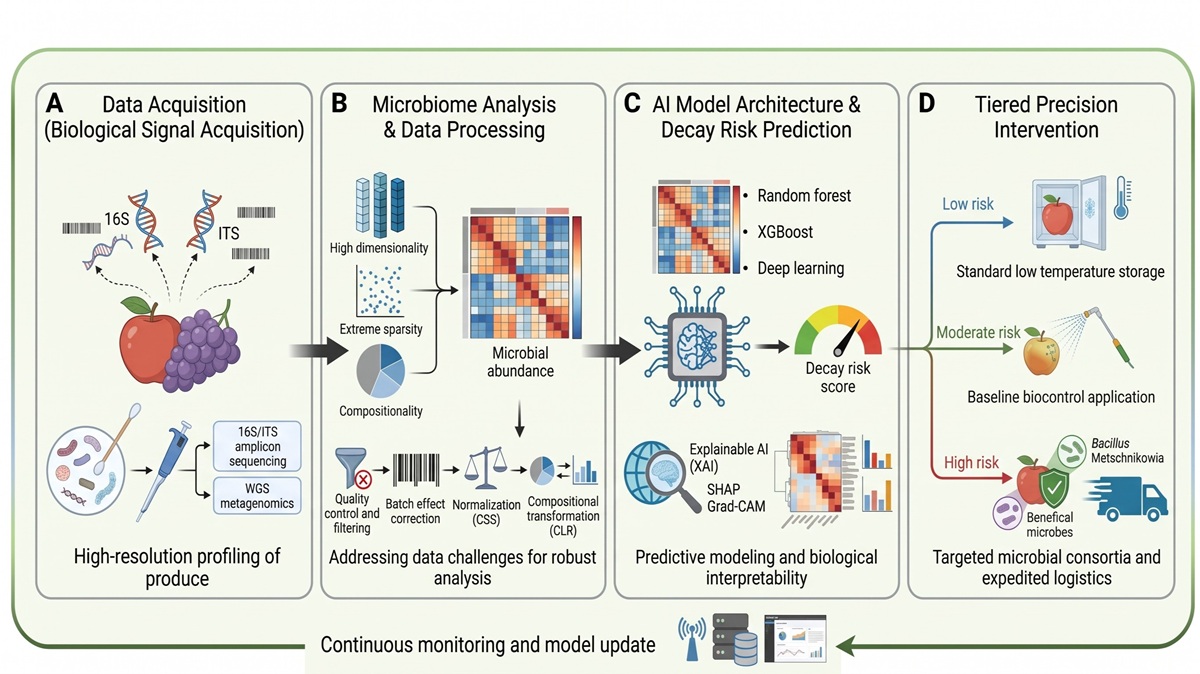
Postharvest decay pathogens account for approximately 50% of horticultural losses, equivalent to 38% of total global food losses. While artificial intelligence (AI) systems based on computer vision, RGB, and hyperspectral imaging routinely exceed 90% accuracy in defect detection, they remain fundamentally constrained by their reliance on visible symptoms. This creates a critical monitoring blind spot for latent infections, where pathogens have already colonized fruit tissues prior to macroscopic lesion development during storage or transit.
The fruit microbiome as an early-warning biological system
The review highlights that epiphytic and endophytic microbial communities inhabiting fruit surfaces and internal tissues act as an active frontline defense. Beneficial microbes suppress pathogens through nutrient and niche competition, antimicrobial metabolite production—such as lipopeptides synthesized by Bacillus velezensis—and systemic induction of host defense responses.
Ecological shifts, including declining alpha diversity, pathobiome enrichment, and disrupted antagonist-to-pathogen ratios, serve as quantifiable pre-symptomatic indicators of dysbiosis. Because these biological signals precede visible decay by days or weeks, they provide a crucial window for proactive intervention.
Predictive modeling and tiered precision interventions
To translate complex community data into actionable tools, the proposed workflow integrates high-throughput sequencing (16S rRNA, ITS, and shotgun metagenomics) with machine learning architectures such as Random Forest, XGBoost, and deep learning, supported by Explainable AI (SHAP and Grad-CAM) to identify key biomarkers.
Based on predicted risk scores, the authors outline a tiered decision framework: low-risk fruit is directed to standard cold storage; medium-risk batches receive baseline biocontrol applications; and high-risk fruit triggers targeted microbial consortia deployment alongside expedited logistics.
Barriers to industrial deployment
Realizing closed-loop intelligent postharvest management requires overcoming four interconnected challenges: establishing standardized microbiome data protocols, advancing from correlative to causal multi-omic modeling, closing the generalization gap across diverse cultivars and supply chains, and enabling real-time integration through rapid surrogate sensing (such as hyperspectral imaging, E-nose arrays, and real-time PCR).
Source: Leng, J., Wang, Z., Zhimo, V. Y., Wang, Y., Sui, Y., & Liu, J. (2026). Microbiome-Informed Artificial Intelligence for Proactive Postharvest Decay Management: A Critical Review. Journal of Future Foods. https://doi.org/10.1016/j.jfutfo.2026.11.022
Related news