Packaging
AI and robotics to design antimicrobial biobased packaging
An integrated workflow analyzes one billion formulations to create sustainable plastic alternatives that extend the shelf life of cucumbers and avocados
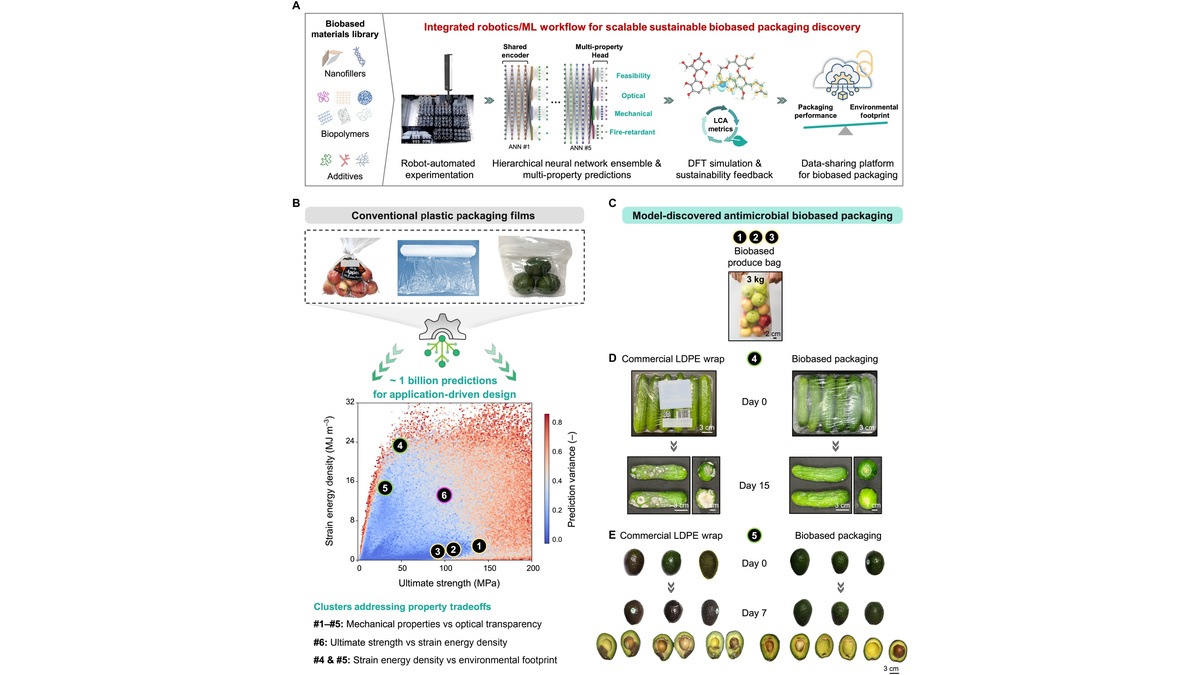
The food packaging industry's heavy reliance on petroleum-derived plastics—such as PVC, polystyrene, and polyethylene—continues to exacerbate environmental burdens and microplastic pollution. To accelerate the transition to sustainable alternatives, a research team has developed an innovative workflow combining robotic automation, machine learning (ML) predictions, density functional theory (DFT), and life cycle assessment (LCA).
Massive prediction and property optimization
Designing biobased packaging traditionally faces the challenge of balancing multiple properties (transparency, mechanical resilience, and sustainability) through extensive and costly trial-and-error. However, thanks to this new integrated framework, researchers successfully trained a hierarchical neural network capable of predicting the performance of approximately one billion candidate formulations.
Using an automated pipetting robot to generate the initial dataset, the artificial intelligence algorithm identified the optimal combinations that achieved the perfect balance between ultimate tensile strength (σ), strain energy density (SED), and a low environmental footprint.
Antimicrobial action and shelf-life extension
In addition to superior physical properties, the design incorporated cross-linking agents such as copper ions (Cu2+) at food-safe levels, providing the film with high hydrostability and active antimicrobial efficacy. In real-world trials, the biobased films demonstrated a superior capacity to regulate moisture and block the growth of mold and pathogenic bacteria, significantly outperforming commercial LDPE wraps and successfully extending the shelf life of high-value produce like cucumbers and avocados.
To facilitate adoption by the industry and the research community, the team has launched a data-sharing platform that enables forward predictions and custom packaging design based on specific mechanical and environmental impact requirements.
Source
Science Advances (2026). An integrated robotics/ML workflow accelerates the scalable discovery of sustainable biobased packaging for enhanced postharvest preservation with reduced environmental footprint.
Related news