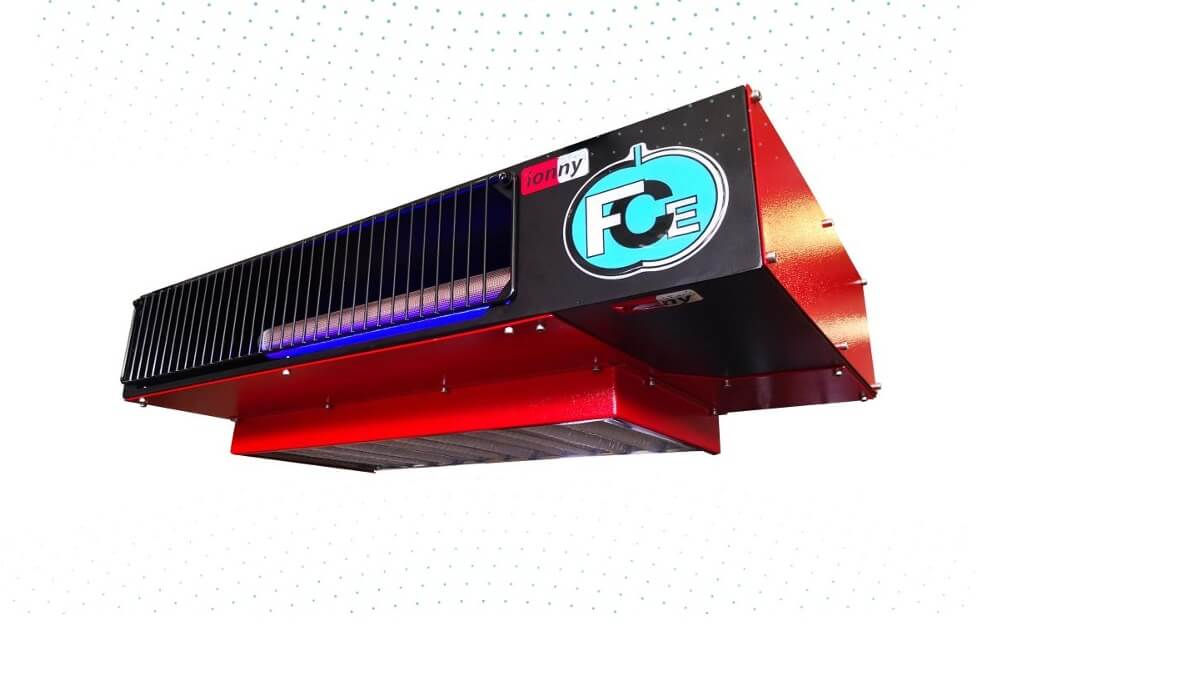
Fruit Control Equipments has released commercial information about a system designed to reduce ambient ethylene and sanitize air in postharvest facilities, including cold rooms and areas for sorting, packing, and shipping. The documentation places its use both in conventional refrigerated rooms and in controlled atmosphere rooms, positioning it as a complementary measure alongside oxygen and carbon dioxide management. The approach targets lower risk of accelerated ripening and a better storage and working environment, especially where high emitting products and ethylene sensitive commodities are handled in the same facility.
Technical points stated by the manufacturer
According to the commercial material, the system is based on industrial ionization to act on the room air and on certain compounds present in that air. The manufacturer states that the unit does not use chemicals and does not generate ozone or odors, and presents it as compatible with people being present in working areas.
In the same documentation, the manufacturer attributes to the unit an effect on ethylene and on microorganisms, including bacteria, yeasts, and fungi, with additional references to viruses and volatile organic compounds. The document also mentions design improvements, including a lighter and more compact format, modularity, and remote control options, along with an efficiency improvement stated as one hundred and forty percent linked to a new ventilation system. That sheet does not describe test conditions, verification methodology, or comparison parameters, so the claims should be interpreted with technical caution.
Practical implications for packinghouses and cold storage operations
From an operational perspective, ethylene and air quality focused solutions typically deliver more value when lots of different maturity are handled, when commodities with different climacteric behavior are mixed, or when logistics require long waiting times. In these scenarios, reducing ambient ethylene can help stabilize product evolution, while improving room air conditions can support internal sanitation programs in handling and storage areas.
To assess real fit, it is advisable to define a measurable target before implementation, such as fewer overripening incidents, better firmness at room exit, or fewer complaints linked to shelf life. It is also advisable to agree with the supplier on sizing based on the actual room volume and operating conditions, since the reviewed commercial information does not provide treated airflow, electrical consumption, temperature limits, or operating relative humidity ranges for continuous use.
The key point to watch will be on site monitoring of ambient ethylene and quality evolution, to determine whether air control delivers a meaningful improvement for the lots handled and the typical storage durations of each facility.