News
News in artichoke postharvest knowledge
The post summarizes results in research related to postharvest of artichoke, both fresh and minimally processed, based on papers published during 2025

Artichoke (Cynara scolymus L.) is an appreciated vegetable with the vast majority of the world’s artichokes being grown in the Mediterranean basin. Egypt, Italy, and Spain alone account for more than half of the world's total supply.
Egypt is the world´s current leading producer (460.000 t), followed by Italy (378.000 t), “the cultural heart of artichokes; highest per capita consumption”, and Spain (200.000 t), them major exporter, especially of canned and jarred hearts.
Algeria (124,000 t) is a significant North African producer; Perú (97.000 t) is a "counter-seasonal" producer for the Northern Hemisphere; China (81.000 t) is a growing producer, largely for the processed food market, and in the USA (33.000 t), nearly 100% is grown in California, with Castroville being the "Artichoke Capital".
The leader in consumption is Italy, with 8 to 10 kg/capita/year, followed by Spain, 3 to 3.4 kg/capita/year; Turkey is emerging as a large consumer, with almost 0.5 kg/capita/year.
Drivers of the artichoke market
Beside culinary heritage (artichoke is delicious for a majority of people), health is one of the main focus for consumption. High levels of cynarin (good for liver health) and inulin (a prebiotic fiber) are driving demand in the wellness and nutraceutical industries.
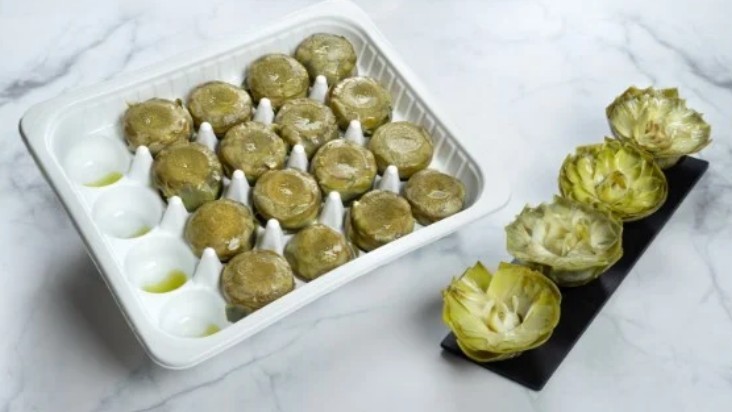
There is a massive growth in the "ready-to-eat" segment, such as vacuum-sealed steamed hearts and frozen quarters, catering to consumers who find fresh artichokes intimidating to prep.
During 2025 several scientific meetings were the showcase to explain the advances in artichoke research; Italian researchers were, by far, the more active, and the improvement of minimally processed artichokes the main focus.
Developement
The study by Giménez-Berengue by aimed to characterize the developmental progression of ‘Blanca de Tudela’ artichokes by evaluating growth patterns across the three flower head orders throughout the harvest season. In parallel, a specific focus was placed on secondary heads, which constitute a substantial proportion of commercial yield. These were classified into five internal developmental stages (S1 to S5) to assess how their development level influences postharvest quality during cold storage.
The findings provide a comprehensive understanding of flower head emergence dynamics and highlight the importance of harvest timing and physiological development for ensuring optimal postharvest behaviour. This work offers practical implications for growers and suppliers aiming to enhance the quality and shelf-life of artichokes, supporting better selection criteria and handling protocols during the commercial postharvest phase.
Packaging
Macro-perforated film, the best solution for fresh artichokes
‘Spinoso sardo’ artichoke is a specialty vegetable with a unique taste and rich in nutraceutical compounds, particularly suitable for early season production, with a short shelf-life even when marketed in modified atmosphere packaging. A survey at local Italian retailers revealed that the short shelf-life is in part due to poor handling procedures, and packaging solutions not based on a rationale design of the packaging which frequently lead to restricted gas exchange and asphyxiating condition.
The study by Palma, A. et al. showed that a package made with a macroperforated film able to maintain a high level of humidity without significantly altering the gas composition tested on ‘Spinoso sardo’ artichokes grown under conventional (CONV) or organic (ORG) protocols, effectively prolonged the shelf-life and the chemical properties of samples of both growing systems for at least 10 d at 5 °C plus 3 d of simulated marketing conditions at 18 °C.
Molds developed after 15 d, but no physiological disorder occurred. At harvest ORG artichokes showed levels of phenols and antioxidant activity slightly but significantly higher than CONV samples, but the rate of physio-chemical changes over storage did not differ between the two growing systems.
Processing
Browning
Artichoke is considered a healthy food because of its phytochemical and nutritional composition. However, the high polyphenol content makes artichoke difficult to commercialize as a fresh-cut product due to intense enzymatic browning. The objective of the work by Fatchurrahman D. et al. was to apply a combined treatment with an antibrowning agent (1.5% lactic acid for 1 hour) and a minimum microwave power (675 J/g) to inactivate the polyphenol oxidase (PPO) and extend the shelf life of different green and purple varieties of artichoke stored under modified atmosphere packaging (CO2 10% and N2 90%).
Of the eight varieties studied, the two green varieties (Madrigal and Green Triump) showed good results in terms of color, firmness and sensory appreciation. Within the purple varieties, Brindisino and Spinoso Sardo showed the best results of firmness, however, Brindisino and Violetto di Manfredonia showed better results of color, also with good sensory scores.
The weight losses were less than 1% for all varieties after 28 days at 5ºC. The gas composition in the bags remained at the initial settings but there was a slight increase in O2 (up to 0.6%) after 13 days at 5ºC. Total phenolic content decreased by 20-50% and antioxidants by 10-58% after MW treatment.
In conclusion, treatment with 1.5% lactic acid + microwave was effective to inactivate the PPO enzyme in all varieties studied and maintain the quality of artichoke in a ready-to-eat format.
Browning and phenolic profile
Another study, by Pati et al. refers to the evaluation of productive characteristics and the adaptability to be processed as a fresh cut product of twelve artichoke cultivars, including local varieties and commercial hybrids.
Artichokes were harvested at maturity, cut into halves, packed in microperforated bags (polypropylene + polyammide) and stored at 5°C for 6 days.
Four cultivars with varying susceptibility to browning (Green Triumph, Madrigal – low susceptibility, Spinoso Sardo, Troianella - high susceptibility) were selected for further identification and semi-quantitative comparison of their phenolic derivatives using liquid chromatography coupled to mass spectrometry (LC-MS), both at initial and final storage time.
All the cultivars, whether fresh or browned, exhibited a distinctive and complex phenolic profile, including several caffeoylquinic acid derivatives. The behaviour of these compounds during storage varied depending on the specific phenolic compound.
These findings highlighted that the differing attitude of artichoke cultivars for fresh-cut processing is linked to the relative proportions of individual phenolic compounds and their derivatives.
The authors suggest the need for further investigation into the role of specific caffeoylquinic acid derivatives in the browning process following cutting.
Improvement of fresh cut artichokes with bergamote juice extract
In the work by Palumbo, M. et al., for the first time, fresh-cut artichoke heads were dipped in a bergamot juice extract (BE 0.05 % w/v) containing flavonoids with antimicrobial and antioxidant properties (neoeriocitrin, naringin, neohesperidin, peripolin, melitidin and brutieridin), and stored for 9 d at 5 °C.
Compared to the controls, and ethanol (1 %) dipped samples, BE-dipped fresh-cut artichokes, showed improved sensory attributes, lower respiration rate and a reduction of Pseudomonas spoilers by 1 log CFU g−1 up to 6 d of storage.
Moreover, an increase in antioxidant activity was also observed in BE-dipped samples throughout the storage, putatively related to the added flavonoids (naringin, melitidin, brutieridin), which were retained up to 6 d of storage.
The dipping in BE also preserved the organoleptic properties of these samples; indeed, volatile organic compounds (VOCs) profiles of artichoke dipped in BE solution showed a higher content of “green leaves” volatiles.
Among these, 1-hexanol, 2-hexen-1-ol, cis-3-hexen-1-ol, hexanal, cis-2-hexenal, were correlated with the sensory attributes of freshness.
In conclusion, in this work, a sustainable and innovative strategy based on the dipping of fresh-cut artichokes in BE proposed for the first time has showed to improve the antioxidant value and the shelf-life of the samples, preserving their sensory attributes.
Publications
During 2025 the International Society for Horticultural Science published the proceedings of the International Symposium on Artichoke, Cardoon, and Their Wild Relatives, held in Molfetta, Italy, from April 18-21, 2023 (Colelli, G.C., A. Elia).
The editors, D. Fatchurrahman, A. Elia and G. Colelli, explain that five distinguished speakers delivered keynote addresses on recent breakthroughs in various aspects of the field.
The symposium featured six sessions, with 31 oral presentations covering
topics such as pre-and post-harvest aspects in artichoke production, the ICARUS project, genetics, and the non-food applications of Cynara species and their wild relatives.
Additionally, 19 posters were displayed throughout the conference. The
event also included a business meeting, two cultural activities, and two technical
tours that engaged all participants. The technical tours took attendees to artichoke fields in Foggia and processing plants in Brindisi.
A roundtable discussion with Italian stakeholders on the artichoke market's current state and future prospects was also held.
The symposium attracted over 90 in-person participants (and 10 online participants) from seven countries. Six early-career scientists competed for the "Young Minds Award," which was awarded to Dr. Matteo Martina from the University of Turin, Italy, for his oral presentation titled "Application of Bulked-Segregant Analysis Coupled with Whole Genome Sequencing (BSA-seq) for the Identification of Male Sterility-Related Genes in Globe Artichoke.
Sources
Colelli, G.C., A. Elia
XI International Symposium on Artichoke, Cardoon and Their Wild Relatives
https://www.actahort.org/members/showpdf?booknrarnr=1424_0
Fatchurrahman D., Castillejo N., Fathi-Najafabadi A., Amodio M. L., Colelli G.
Combined immersion and microwave treatment to extend the shelf life of different varieties of Artichokes
PostharvestMED, 9th National Conference of the SOI Working Group on Postharvest Management of Mediterranean Crops, 17-19 September 2025, Palermo, Italy, https://www.postharvestmed.com
Gemini - Artichoke in the world, Artichoke consumption in the world
https://gemini.google.com/app/400e0fa288b69a5b?utm_source=app_launcher&utm_medium=owned&utm_campaign=base_all (29th January 2026)
Giménez-Berenguer, Marina, Giménez M., J., Serna-Escolano V., Castillo S., Zapata P.J.
Development patterns of ‘Blanca de Tudela’ artichokes and their postharvest implications
PostharvestMED, 9th National Conference of the SOI Working Group on Postharvest Management of Mediterranean Crops, 17-19 September 2025, Palermo, Italy, https://www.postharvestmed.com
Palma, A., L. Ledda, P.A. Deligios, M.T. Tiloca, M.M. Sassu, S. D’Aquino
Impact of packaging on physiological properties, chemical composition, and bioactive compounds in organic and conventional artichokes during cold storage and in simulated market condition
Postharvest Biology and Technology Volume 227, September 2025, 113622
https://doi.org/10.1016/j.postharvbio.2025.113622
Palumbo, Michela, Laura Quintieri, Lucia Bartella, Leonardo Di Donna, Ilaria Santoro, Anna Luparelli, Leonardo Caputo, Bernardo Pace, Rosaria Cozzolino, Cristina Matarazzo, Maria Cefola
Improvement of antioxidant activity and postharvest quality of fresh-cut artichoke by dipping in flavonoid-rich bergamot juice
Postharvest Biology and Technology, Volume 232, February 2026, 113986
https://doi.org/10.1016/j.postharvbio.2025.113986
Pati S., Macolino Fti, Fatchurrahman D., Amodio M.L., Stea D., Ruta C., De Mastro G., Colelli G.
Quality and phenolic profile of various artichoke cultivars processed as fresh-cut products
PostharvestMED, 9th National Conference of the SOI Working Group on Postharvest Management of Mediterranean Crops, 17-19 September 2025, Palermo, Italy, https://www.postharvestmed.com
Picture
Chefs Warehouse, https://www.chefswarehouse.com/about-us/premier-brands/ultimate-artichoke/