News
Effect of gas treatments to eliminate insects on the quality of almonds
Ahmed S. Hashem et al. analyze efficacy, lipid oxidation and practical implications for quality preservation; results support prioritization of PH3 or CO2-based approaches over ozone for high-oil commodities unless oxidative impacts can be mitigated
Postharvest management of high-oil nuts such as almonds must reconcile disinfestation with preservation of lipid quality.
Rigorous, life-stage–resolved comparisons that quantify both insect control and almond quality remain scarce.
An integrated benchmark was conducted on shelled almonds infested with Tribolium castaneum (Herbst, 1797; Coleoptera: Tenebrionidae) and Oryzaephilus surinamensis (Linnaeus, 1758; Coleoptera: Silvanidae) (larvae and adults), evaluating three gaseous treatments: ozone (O3; 500 ppm, 6 h), phosphine (PH3; 1 g m−3, 7 d), and an ECO2Fume CO2-based treatment (50 g m−3, 3 d).
Across five independent replicates, biological endpoints (mortality, fecundity, nutritional indices, energy conversion index, and almond weight loss) were quantified alongside a chemical quality panel (proteins, Thiobarbituric acid reactive substances, free fatty acids, proximate composition, minerals, total phenolics, oil).
PH3 achieved the highest and most consistent mortality (≈89–99%) and markedly suppressed feeding and progeny while inducing only minor immediate changes in lipid-oxidation indices.
The CO2-based treatment delivered comparable control (≈86–94%) with modest chemical shifts and pronounced reductions in consumption and weight loss.
By contrast, O3 produced only moderate insecticidal effects (≈55–66% mortality) but caused clear oxidative deterioration (ΔPV = +2.31; ΔTBARS = +0.90; ΔFFA = +0.145; total phenolics ≈ −15.9%).
Multivariate synthesis of Principal component analysis (PCA) and Canonical variate analysis (CVA) indicated that a primary axis dominated by oxidation markers explained ∼88% of treatment variance (Can1; P < 0.001), whereas a secondary axis captured insect-response variation (∼11%; Can2; P < 0.001).
Findings delineate a practical trade-off between pest suppression and lipid-quality preservation and support prioritization of PH3 or CO2-based approaches over ozone for high-oil commodities unless oxidative impacts can be mitigated.
Highlights
- PH3 and CO2-based fumigation gave the highest mortality across stages
- Ozone delivered intermediate control but the largest lipid-oxidation shifts
- PH3/CO2 sharply reduced kernel weight loss in larval-driven damage assays
- CVA showed oxidation markers dominate treatment separation (∼88% variance)
- Proximate nutrients stayed stable; phenolics declined most under ozone.
Introduction
Stored-product arthropods are among the principal agents of quantitative and qualitative loss in postharvest supply chains (Gerken and Morrison, 2022; Longchar and Siraj, 2025).
Beyond direct consumption of commodities, insect infestation initiates complex cascades of physical and biochemical alterations in kernels and seeds that compromise nutritional value, sensory attributes and marketability (Yaseen et al., 2019).
In lipid-rich commodities such as almonds, the interplay between insect activity, insect control interventions, and lipid oxidation is particularly consequential: oxidative deterioration reduces oil quality, elevates peroxide and secondary oxidation markers, and may accelerate off-flavour development and textural degradation, thereby shortening shelf life and reducing commercial value (Johnson et al., 2009; Phillips and Throne, 2010; Navarro and Navarro, 2018).
Historically, chemical fumigants — most notably phosphine (PH3) — and contact insecticides have been the mainstay of large-scale stored-product pest management because of their rapid efficacy and low immediate cost (Nayak et al., 2020; Mariadoss et al., 2025).
However, concerns over human and environmental safety, the emergence of resistance in pest populations, and regulatory restrictions have galvanised interest in alternative or integrated technologies (Nayak and Jagadeesan, 2024).
Among these, gaseous oxidative treatments (notably ozone), elevated-carbon dioxide atmospheres and commercial CO2-enriched fumigation products (for example, CO2 blends marketed under proprietary names such as ECO2Fume) have received growing attention as non-residual, penetrative options for postharvest disinfestation (Dong et al., 2025; Wang et al., 2025).
Each approach presents distinct modes of action and potential trade-offs:
- ozone is a powerful oxidant capable of damaging insect cuticle and internal physiology but may concurrently oxidise kernel lipids (Ghazawy et al., 2021);
- phosphine targets mitochondrial processes, eliciting rapid insect mortality with minimal thermal input yet raises concerns regarding residues and worker/operator safety when used improperly (Oppert et al., 2015);
- CO2-based strategies act principally through respiratory suppression and altered metabolic state, often yielding effective control with low chemical reactivity toward kernel constituents, though efficacy is sensitive to exposure time, concentration and commodity porosity (Jain et al., 2025).
To exterminate insects... and also to maintain the quality of the almonds
Although numerous studies have evaluated single-technology efficacy against particular pests or commodities (Navarro, 2012; Jian et al., 2013; Constantin et al., 2020), comparatively few have conducted side-by-side assessments that integrate both entomological outcomes and comprehensive measures of commodity quality on high-value, lipid-rich kernels.
This integrative perspective is essential: focusing solely on mortality and population suppression risks adopting protocols that, while entomologically effective, accelerate oxidative rancidity, reduce phenolic antioxidant content, alter proximate composition, or otherwise degrade sensory or nutritional quality (Rana et al., 2021).
Conversely, approaches that preserve kernel chemistry but fail to suppress key stored-product pests are operationally unviable.
To inform evidence-based choice of postharvest disinfestation strategies it is therefore essential to evaluate both insecticidal performance and collateral effects on kernel chemistry and quality under experimentally controlled, replicable conditions.
The present study addresses that need through a comparative evaluation of three representative gas-based disinfestation regimes — ozone (defined exposure concentration and duration), phosphine (standard fumigation regime) and an ECO2Fume CO2-based product — applied to shelled almonds.
Tribolium castaneum y Oryzaephilus surinamensis, target pests
The target pests, Tribolium castaneum (red flour beetle) (Herbst, 1797; Coleoptera: Tenebrionidae) and Oryzaephilus surinamensis (sawtoothed grain beetle) (Linnaeus, 1758; Coleoptera: Silvanidae), were chosen for their proven global relevance to stored commodities and for their contrasting biology and tolerance profiles in both larval and adult stages.
Both species can cause direct feeding damage and contamination (frass, fragments), leading to measurable commodity losses and potentially accelerating quality deterioration in lipid-rich nuts through increased exposure and handling-associated oxidative processes (Mbata et al., 2024).
The essays
Experimental design emphasized statistical robustness and ecological relevance by deploying multiple independent replicates per treatment and by monitoring responses at both life-stage and species levels. Biological endpoints include acute mortality, fecundity (progeny production), developmental and growth metrics (relative growth rate, RGR), feeding metrics (relative consumption rate, RCR; feeding deterrence index, FDI), and food conversion efficiency (efficiency of conversion of ingested food, ECI).
Quality and chemical endpoints encompass proximate composition (moisture, protein, lipid, ash, fibre, carbohydrate), mineral content (P, K, Ca, Mg, Fe, Zn), total phenolic content, and established lipid deterioration indices (peroxide value, PV; thiobarbituric acid-reactive substances, TBARS; free fatty acids, FFA).
Assessing this suite of responses permits an integrated evaluation of both short-term insect control and longer-term quality consequences for the kernel.
The working hypotheses are threefold.
- First, it is hypothesised that phosphine will produce the most rapid and highest acute mortality across life stages while minimising direct oxidative alterations to kernel lipid indices relative to ozone (Sciuto et al., 2016).
- Second, ozone treatment is hypothesised to provide substantive insect suppression but to induce measurable increases in PV, TBARS and FFA, reflecting oxidative modification of kernel lipid constituents; these oxidative changes are expected to be dose- and exposure-duration dependent (Çelebi et al., 2024).
- Third, ECO2Fume (CO2-based, (*)) treatment is hypothesised to offer an intermediate outcome, with reasonable insecticidal efficacy and comparatively limited direct oxidative impact on kernel chemistry (Ciesla and Ducom, 2009), but with possible effects on insect feeding behaviour and associated weight loss outcomes.
Importantly, life-stage differences are anticipated: larvae and adults may differ in susceptibility and in their contributions to almond loss and progeny production, thereby differentially affecting overall commodity damage and quality parameters.
To test these hypotheses, the experimental approach couples univariate and multivariate statistical analyses (the original paper explains in more detail the statistic tools employed).
The practical significance of this work is twofold. From an applied perspective, providing empirically grounded guidance on gas-based disinfestation protocols for almonds will assist growers, packers and storage operators in selecting interventions that balance insect control and product quality — a critical concern for export-oriented supply chains where both phytosanitary compliance and organoleptic qualities determine market access and price.
From a scientific perspective, integrating insect life-history responses with kernel biochemistry under controlled fumigation scenarios advances mechanistic understanding of how treatment modalities modulate both biological and chemical dynamics in stored, lipid-rich commodities.
In summary, this investigation offers a rigorous, comparative assessment of ozone, phosphine and ECO2Fume treatments for shelled almonds by combining detailed entomological assays with comprehensive chemical quality analyses and multivariate data synthesis.
The results aim to inform both practical decision-making and the broader scientific discourse on sustainable, quality-preserving postharvest pest management strategies for high-value nuts and oilseeds.
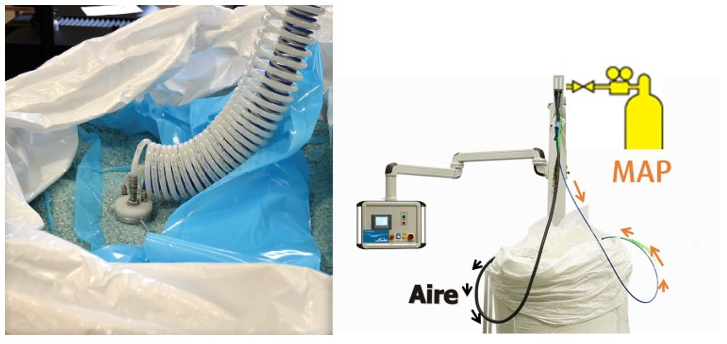
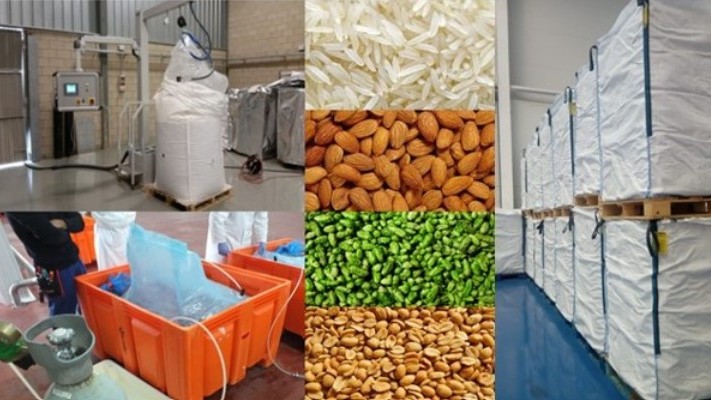
MAPAX system
(*) ECO2Fume is a product by Synesqo, https://www.syensqo.com/en/brands/eco2fume
Sources
Postharvest gas treatments for almonds: Efficacy, lipid oxidation and practical implications for quality preservation
Ahmed S. Hashem, Fatma M.A. Khalil, Jenan S. Alharbi, Abdulrahman J.S.F. Alajmi, Hanan M. Alharbi, Khairiah Mubarak Alwutayd, Tariq Saeed Alghamdi, Akram S. Alghamdi, Jazem A. Mahyoub
Journal of Stored Products Research, Volume 116, March 2026, 102969
https://doi.org/10.1016/j.jspr.2026.102969
https://www.sciencedirect.com/science/article/abs/pii/S0022474X26000226
Pictures, MAPAX by Linde, Integrated system for the biopreservation of nuts (Spanish language)
Related news