
IRTA
Services
The 24th IRTA postharvest technical conference addresses how to adapt fruit storage to a scenario with fewer tools and higher demands
The withdrawal of active substances, new varieties, regulatory pressure, international markets, and digitalization highlighted a conference focused on integrated strategies to maintain quality and competitiveness in postharvest.
The fruit sector gathered in Lleida at the 24th IRTA Postharvest Technical Conference, held under the slogan "New scenarios, new strategies: keys to the competitiveness of the postharvest sector". This year's edition focused on a fundamental change for packinghouses and operators: fruit storage must adapt to a context with fewer available tools, higher regulatory demands, new varieties, climatic pressure, and a growing need to make data-driven decisions.
The conference was introduced by Neus Teixidó, director of the IRTA Postharvest Program, who placed the meeting in a scenario marked by climate, regulatory evolution, the incorporation of digital technologies, and changes in commercialization.
Teixidó stated during the presentation:
"We are in a scenario of change, marked by the climate, regulatory evolution, the incorporation of digital technologies, and commercialization issues."
The program was structured around several technical blocks: product availability, harvest management, storage of new varieties, regulations and markets, nutrition, automation, and artificial intelligence.
Integrated strategies in the face of the loss of postharvest tools
One of the central topics was the sector's concern over the possible loss of widely used active substances in postharvest. Charo Torres, a researcher at the IRTA Postharvest Program, addressed the case of fludioxonil and suggested that its eventual withdrawal cannot be faced solely by looking for a direct substitute.
Torres explained:
"We have possible alternatives ahead, but with variability. There is a clear need for integration and even a paradigm shift: moving from product to system, to strategy, and to management."
The line of work presented by IRTA points towards integrated strategies, combining measures in the field and postharvest, reduction of inoculum load, thermotherapy, low-toxicity products, and solutions adapted to each fruit and working system. Among the alternatives presented, trials with hot water, combination with essential oils, and the progress towards tests in conditions closer to commercial reality stood out.
This approach reflects a paradigm shift: moving from relying on a single tool to building more complex control programs, where each intervention contributes to reducing the risk of rots and losses during storage.
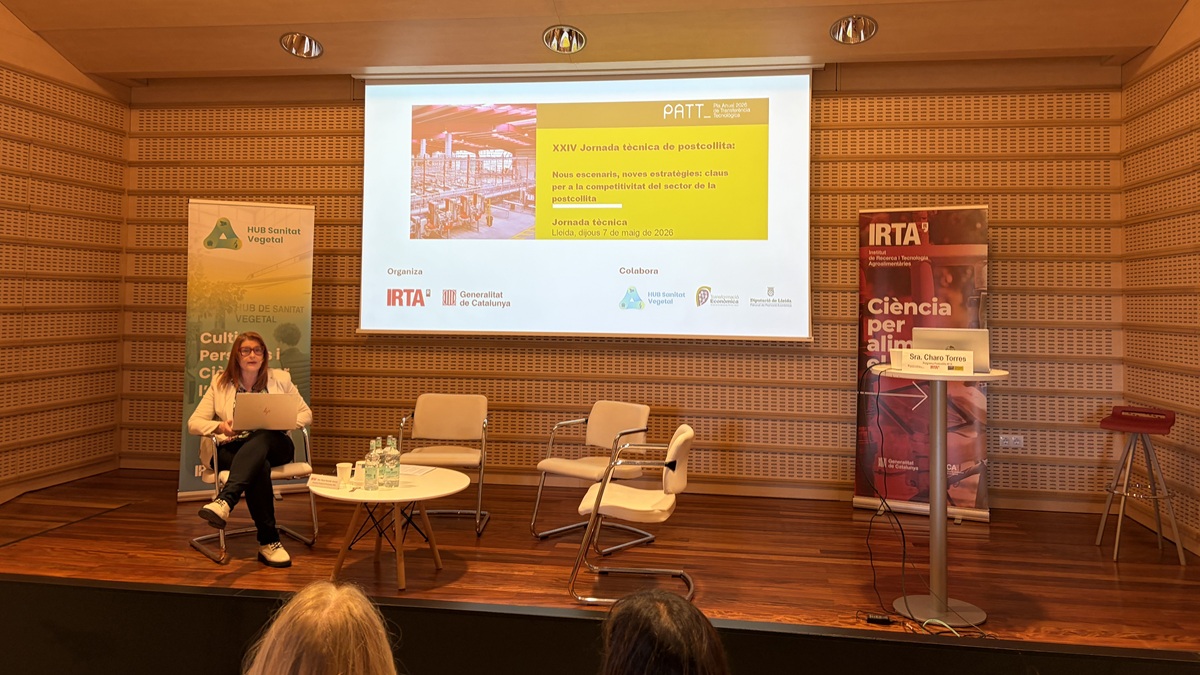
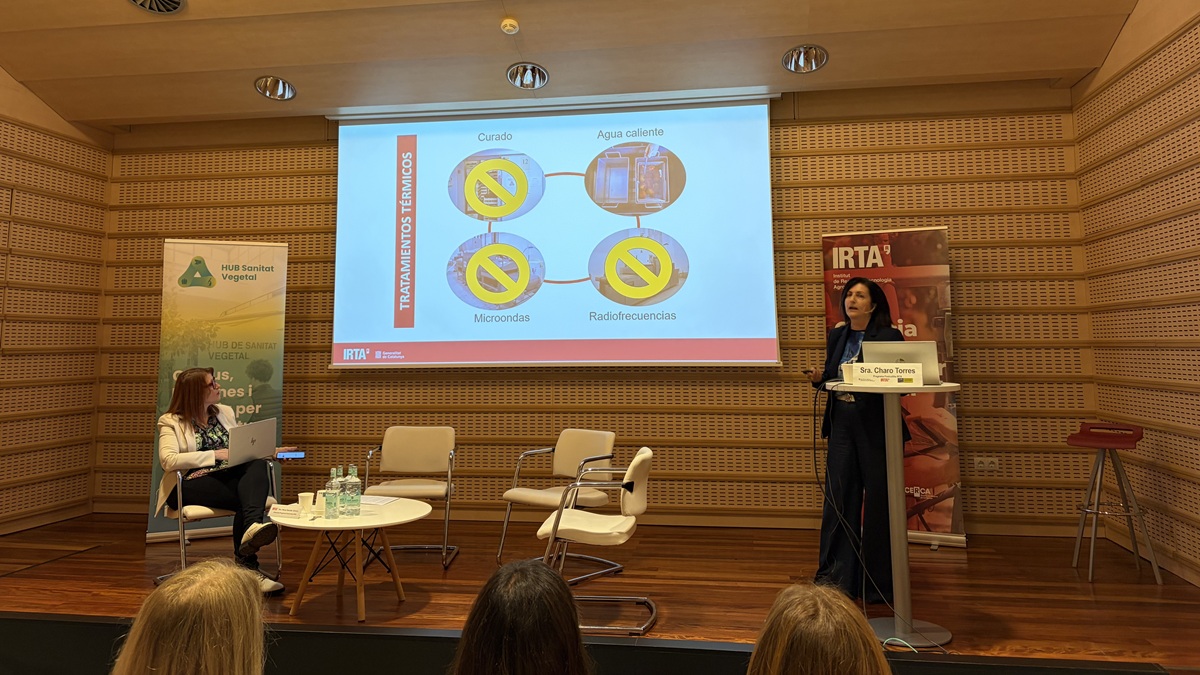 Charo Torres, researcher at IRTA’s Postharvest Programme, during her presentation on alternatives in view of the possible loss of key postharvest tools
Harvest management and new varieties
Harvest management was another of the main axes of the conference. Clara Isabel Mata, a researcher at the IRTA Postharvest Program, presented results of trials with Harvista, a 1-MCP-based tool applied in the field to delay ripening and extend the harvesting window. In apples, trials showed the ability to lengthen the harvest window in certain varieties, while in pears the benefits were especially observed after storage, with better maintenance of firmness and green color in the Conference variety.
The presentation highlighted that this type of solution can help organize the entry of fruit into the packinghouse, reduce the pressure of campaign peaks, and improve labor management. However, it was also noted that its effectiveness depends on the variety, the time of application, and the overall harvest strategy.
Along the same lines, Elena Costa, director of the IRTA Postharvest Technical Service, addressed the storage challenges posed by new apple and pear varieties. Many of them reach the market with greater firmness, better coloring, and high commercial value, but they cannot always be stored using the same criteria as traditional varieties.
Costa pointed out:
"With these new varieties, we are starting to use commercial cold rooms and we are learning. We apply logical criteria, but there are still behaviors that need to be better understood."
In late varieties, for example, the importance of avoiding sudden temperature drops, working with gradual decreases, better CO2 control, and paying attention to physiopathies such as soft scald, lenticelosis, greasiness, or internal browning was highlighted. The message was clear: new varieties offer opportunities, but they also require adjusting protocols and learning from their behavior under commercial conditions.
Regulations, residues, and international markets
The conference also devoted space to regulatory and commercial pressure. Adolfo Marín, from Reactiva, explained the calculation of the ARfD (Acute Reference Dose) and the doubts it generates in the sector. His intervention served to differentiate this parameter from MRLs (Maximum Residue Limits) and to show why the same residue can have different implications depending on the active substance, the fruit, and the consumption data used in the European model.
For his part, Manel Simón, general director of Afrucat, analyzed the possible impact of the Mercosur-European Union agreement and other agreements with third countries. His intervention pointed out that, in the short term, the impact on pome and stone fruit may be limited, but he warned of possible risks in the medium and long term if there is no equality in productive, phytosanitary, environmental, and social conditions between the different production areas.
In this block, it became clear that the competitiveness of postharvest does not depend solely on storage technology, but also on the regulatory framework, export protocols, the availability of plant defense tools, and the sector's ability to defend the value of European production.
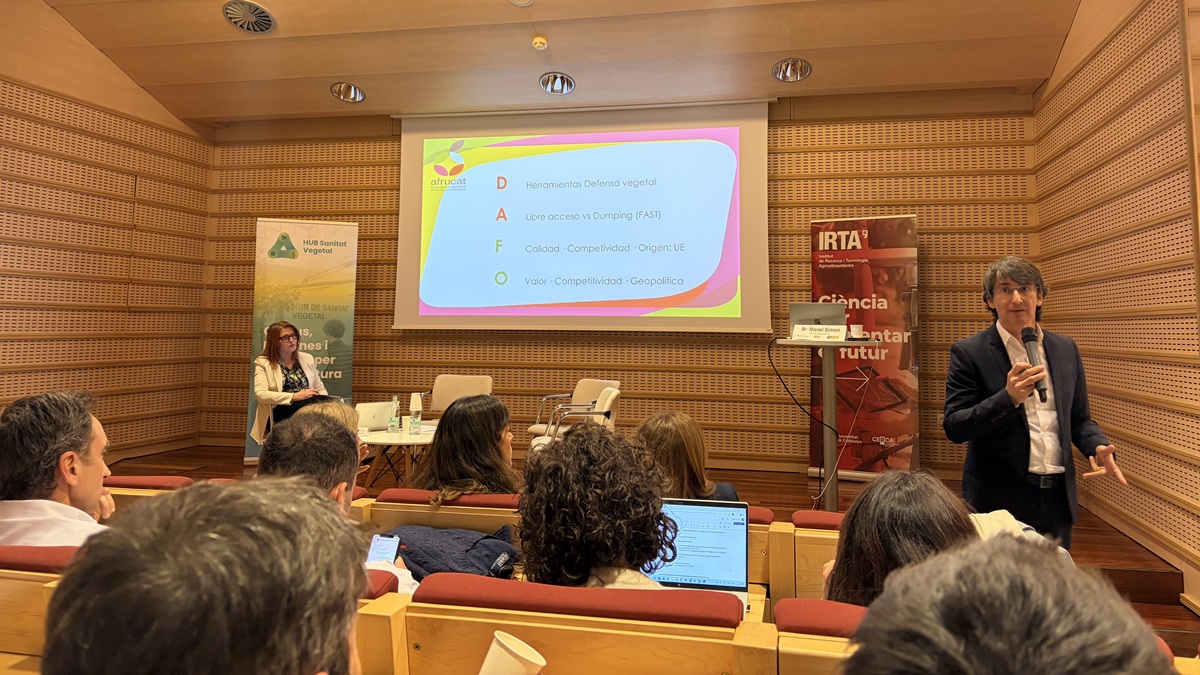 Manel Simón, General Manager of Afrucat, during his presentation on new markets and agreements with third countries
Calcium, quality, and fruit resilience
Fruit quality was also addressed from a nutritional perspective. Francisco Montes, Biologicals Specialist at Yara, proposed a rereading of the role of calcium in firmness, cellular integrity, and postharvest life. His intervention emphasized that it is not enough to talk about the total amount of calcium, but rather it is necessary to consider its availability, distribution in the fruit, interaction with other nutrients, and actual assimilation capacity.
In a context of climatic stress and new commercial demands, nutrition was presented as a key tool to strengthen the fruit's resilience from the field and reduce subsequent problems during storage.
AI enters the packinghouse, but the challenge remains in the data
The final part of the conference was dedicated to digitalization and artificial intelligence. Tomás Alvarado, from Hectre, presented solutions to automate fruit sampling (escandallos) using cameras and AI, with the aim of obtaining more representative information on sizing and color, reducing subjectivity, and improving decision-making in purchasing, packing, and sales.
Subsequently, a round table with Xavier Domingo, Jordi Gené, and Sergi Santos addressed the real role of artificial intelligence in the sector. The debate left a clear idea: many packinghouses already generate data, but the challenge lies in cleaning it, connecting it, and using it to make better decisions. AI was presented as a tool to support technicians, managers, and operators, not as an automatic solution disconnected from industry knowledge.
During the round table, Sergi Santos added:
"Many packinghouses already have data, but it is not always connected nor is it being used for an efficiency strategy."
The participants agreed that digitalization must respond to specific business objectives and not be limited to accumulating information. In this sense, they spoke of the need to integrate data from the field, the packinghouse, quality, costs, clients, and markets to move from management based on past information to more agile and predictive decision-making.
Practical demonstrations and knowledge transfer to the sector
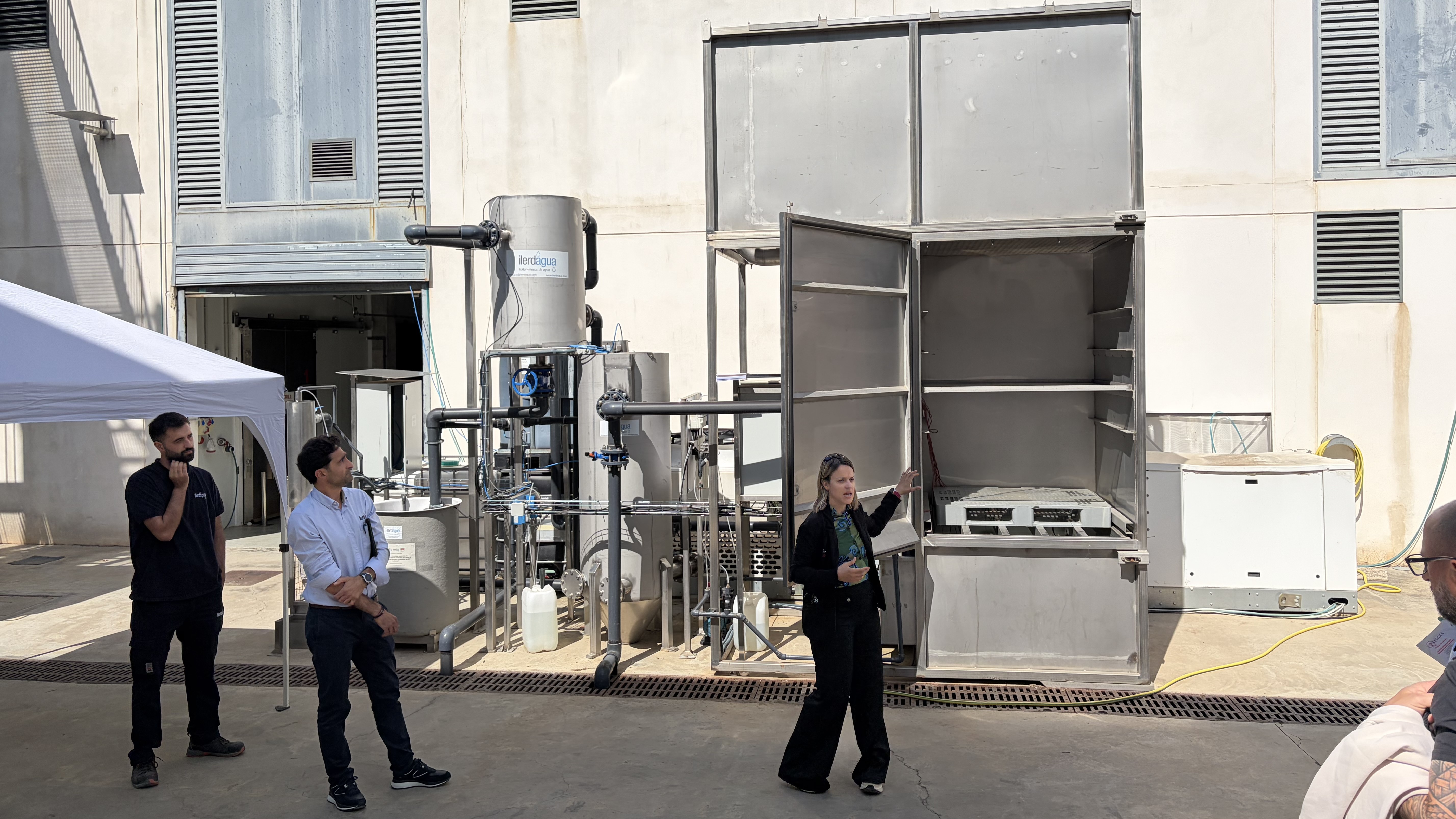
The conference concluded with a practical demonstration session of equipment at the IRTA Fruitcentre.
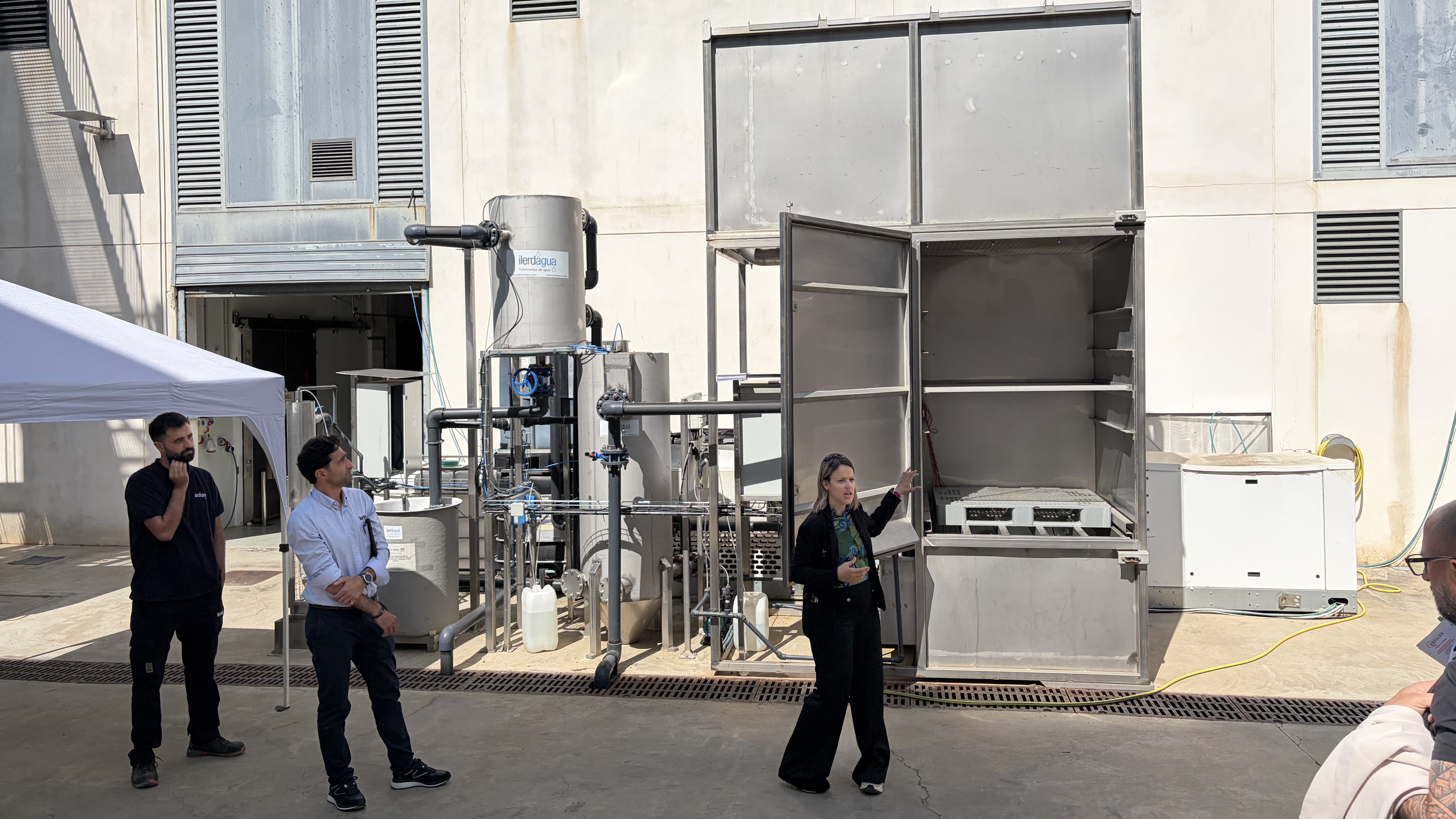 Practical demonstration session of Ilerfred’s commercial equipment during the meeting
Main image: Neus Teixidó, Director of IRTA’s Postharvest Programme, during the opening presentation of the XXIV Technical Postharvest Meeting.
News of IRTA