News
LED lighting as a new key to more efficient, uniform and sustainable agriculture
How the alliance between Buresinnova and Valoya is transforming indoor growing through light engineering and plant biotechnology
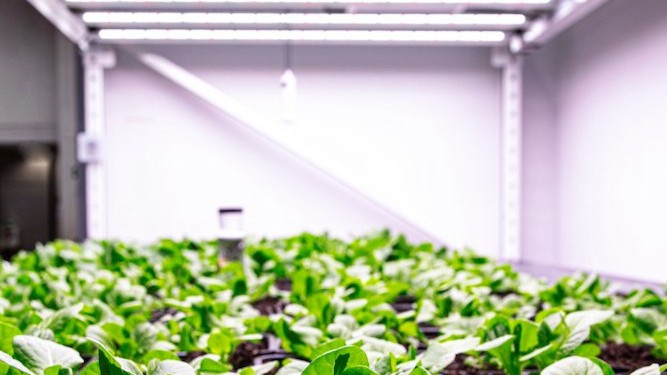
The growth of the global population, the reduction of available arable land, climate change, and the need to produce food closer to urban consumption centers are driving the creation of new types of cultivation. Indoor farming has emerged as one of the most promising solutions to guarantee sustainable, efficient, and predictable agricultural production.
In these facilities, where the crop depends entirely on a controlled environment, lighting becomes an absolutely strategic element. It is no longer just about "giving light" to the plant, but about providing the right intensity, the correct spectrum, and the precise timing, uniformly across the entire cultivation surface.
When properly implemented, the result is a more homogeneous, productive, and higher-quality crop.
The Importance of Light for Plants
Light quality directly affects fundamental processes such as photosynthesis, vegetative growth, flowering, plant morphology, and the production of bioactive compounds. While it was initially thought that plants only required red and blue light, recent years have proven that full-spectrum or broad-range lighting improves all these processes and delivers superior results.
Higher Uniformity and Better Yield
When light is not distributed equitably, differences in size, appearance, and biomass occur between different cultivation zones.
Achieving uniformity is one of the greatest challenges in indoor agriculture; a proper light distribution is the answer.
Plants do not respond the same way to all wavelengths. Depending on the spectral composition, it is possible to control aspects such as vegetative growth, plant compactness, leaf expansion, and the synthesis of specific compounds of interest. Furthermore, the ability of this technology to offer high performance with a much more favorable thermal management than traditional methods reduces excess heat on the canopy, maintaining a more stable environment and minimizing plant stress.
Beyond Production
Light also influences parameters such as visual appearance, flavor, texture, aroma, and nutritional profile. This is crucial for leaf crops, baby leaf, aromatics, and high-value plants where the goal is not just to produce more, but to produce better.
Buresinnova, Valoya, and Advanced Technology
Buresinnova’s core strategy is to optimize cultivation and horticultural lighting. To achieve this, they work with professional lighting solutions for indoor agriculture that allow each project to be tailored to the specific needs of the crop and the facility.
In partnership with Valoya—one of the companies that has contributed most to the scientific development of plant lighting—they form the perfect synergy between light engineering and plant biotechnology. This alliance allows growers to move away from climate uncertainty and transition toward a precision model where every photon counts.
Sources
Buresinnova, La iluminación LED: la clave de la agricultura del mañana, Buresinnova Blog, n.d., https://www.buresinnova.com/blog/la-iluminacion-led-la-clave-de-la-agricultura-del-manana
Buresinnova, Iluminación Valoya en agricultura de interior: claves, Buresinnova Blog, n.d., https://www.buresinnova.com/blog/iluminacion-valoya-en-agricultura-de-interior-claves