Measurements
Infrared and AI detect nematode galls in sweet potatoes
Infrared and AI detected nematode galls in sweet potatoes with 97.5% accuracy in the trial
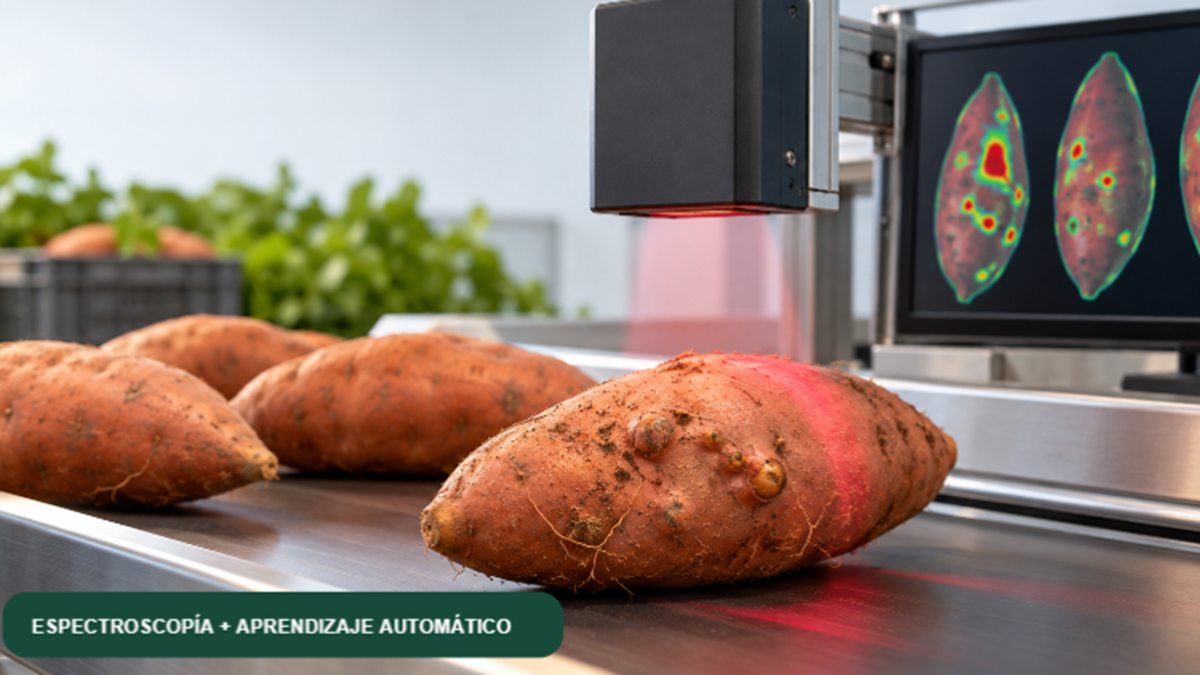
The combination of reflectance and interactance imagery with artificial intelligence achieved 97.5% accuracy in an experimental evaluation of nematode galls.
-
False positive rate: 1.46%
-
Approximately 95.7% for each individual modality
-
97.5% accuracy using a hybrid signal
Best result:
Reflectance + interactance and ResNet 101 neural network.
The percentages describe the model's performance in the study; they do not equate to commercial validation in garment production lines.
Seeing the damage without cutting the root
Root-knot nematodes (*Meloidogyne* spp.) can cause damage beneath the surface of sweet potatoes that is difficult to detect during a visual inspection. Given that laboratory analyses are time consuming and require handling, a study published in *Postharvest Biology and Technology* evaluated a non-contact, optical alternative for examining harvested roots.

The advantage of combining signals
The research team compared reflectance and interactance images at three near-infrared wavelengths. Areas with galls exhibited spectral ratios that differed from those of healthy tissue. Interactance tended to provide greater absolute contrast, although the spatial features in the reflectance images offered a similar level of classification capability.
The best results were achieved by combining both modalities using a ResNet-101 network, yielding 97.5% accuracy and a false-positive rate of 1.46%. Each modality on its own achieved an accuracy of approximately 95.7%. The economic analysis included by the authors suggests that the most suitable model depends on the relative costs of misclassifying a healthy root as affected versus failing to detect a damaged root.
A promising result, with clear limitations
The evaluation was conducted using a single variety of sweet potato, employed a simplified cost model, and did not account for other surface or internal defects. Consequently, while the data point to the potential of this technique, further testing involving a wider range of varieties, defects, and operating conditions is required before it can be extrapolated to a commercial production line.
Source:
“Reflectance and interactance spectroscopy for detecting root knot nematode galls in harvested sweetpotatoes”.
Postharvest Biology and Technology, 240, 114398.