News
Nanotechnology may revolutionize food preservation and packaging
The paper by Divya Nagarajan et al. review the utilization of nanoparticules, nanoclay and nanochitosan as well as nanoencapsulation techniques in food systems, including how nanotechnology can revolutionize food packaging and preservation
Nanotechnology, a rapidly evolving discipline, shows remarkable promises for revolutionizing a wide range of industries, offering innovative solutions to long-lasting challenges.
In the research within the food sector, packaging and preservation, the application of nanoparticles (NPs) represents a significant breakthrough, enhancing product freshness, safety and reducing waste.
Widely studied NPs such as following have demonstrated remarkable potential in extending product’s freshness and reduce safety risks by inhibiting microbial growth and lowering spoilage in tomato, broccoli, spinach and other green vegetables:
- copper oxide (CuO),
- silver (Ag),
- magnesium oxide (MgO),
- titanium dioxide (TiO2),
- silicon dioxide (SiO2),
- zinc oxide (ZnO),
- carbon dots, graphene,
- chitosan and
- mesoporous particles.
This review highlights the utilization of NPs, including Ag, ZnO, TiO2, SiO2, nanoclay and nanochitosan as well as nanoencapsulation techniques, in food systems.
Furthermore, it explores how nanotechnology can revolutionize food packaging and preservation by enabling more effective, efficient and environmentally sustainable practices, ultimately contributing to a greener and more secure global food supply chain.
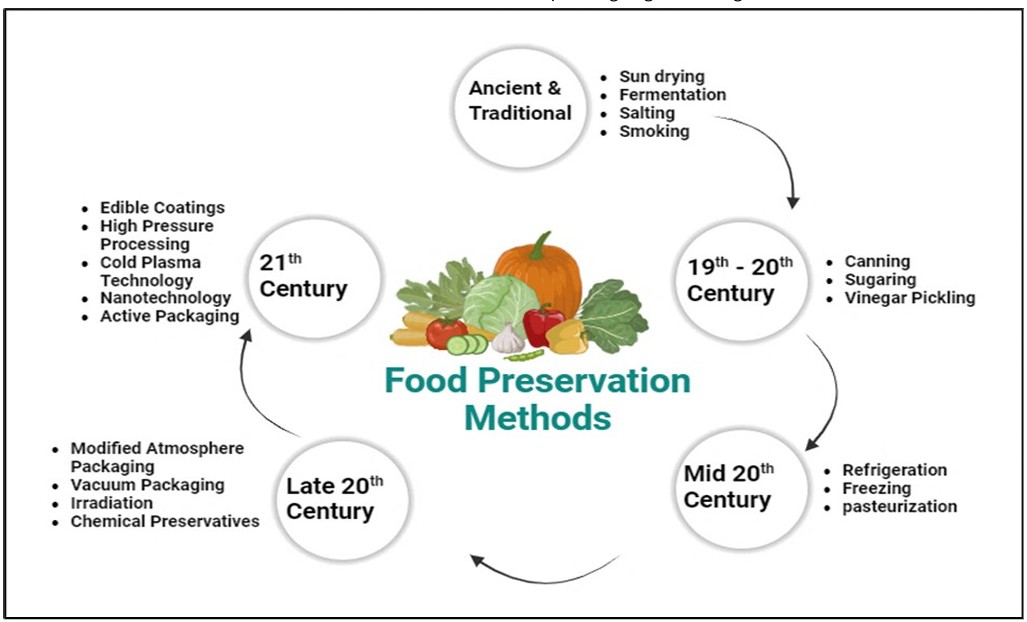
Food preservation techniques evolved over time from sun drying to active packaging (Fig. 1 of the original paper)
Introduction
The impact of population increases on the demand for high-quality food, as well as the issues it poses for food preservation. The estimates suggest that between 30 and 40 % of food globally, produced is never actually consumed and ends up discarded (1).
The FAO has found that each year, nearly 1.3 billion tons of food produced for human consumption is either lost or wasted worldwide (2). Reducing post-harvest losses would enhance the availability of food suitable for human consumption and improve the global food supply, hence reducing the demand for intensive production that affects the environment (3).
Postharvest losses include the degradation of food in terms of both quantity (volume or amount of product) and quality (nutrient value, colour, acceptability and edibility) between harvest and consumption. Quantity losses are more prevalent in developing countries (4), while quality losses are more common in developed countries.
FAO reports that developing countries waste 20-30 % of their horticultural produce. Food waste has become a major problem in many industrial sectors. In Turkey's smallholder processed fruit business, post-harvest handling and storage losses range from 30 to 20 % (5). Improper post-harvest management practices can cause more than 40 % of vegetable losses in developing and underdeveloped nations (6).
Post-harvest food losses are influenced by several factors, including the type of food, harvest timing, harvesting and post harvest handling methods, packaging materials, processing techniques and storage conditions and the distance to food distribution. Other factors that affect post-harvest food losses include poor transportation, a lack of infrastructure and limited market accessibility.
Addressing postharvest losses is imperative in reducing food waste globally. Research is needed to explore the impact of food storage practices on reducing both quantity and quality losses in industrialized and developing nations.
Implementing effective food storage techniques directly reduces postharvest losses and ensures a more sustainable food production network, ultimately contributing to global food security efforts.
All across the world, there is a need for effective preservation techniques. The primary focus of food preservation is to reduce waste and extend the storing capacity of food (7).
Several techniques have been used to preserve the food since ancient times.
The evolution of preservation techniques is illustrated in Fig. 1. In the last few years, the focus on sustainable food storage solutions by implementing smart packaging and monitoring systems to enhance the quality and shelf life of food products increased.
It not only benefits the environment, but also contributes to a more resilient and adaptable food distribution chain.
Moreover, this can help reduce food waste and ensure that food reaches those in need more efficiently. Furthermore, these innovative storage solutions can also help address challenges such as food decay and potential safety hazards.
Generally, highly degradable food products including fruits and vegetables go through multiple phases before reaching the consumer. Some are sold in adjacent village markets, while others must pass through a complex network of aggregators, transporters, storage operators, processors and merchants before arriving in small towns and cities.
Fruits and vegetables can deteriorate rapidly after harvesting due to various biochemical processes, which raises serious concerns about product stability during transit and storage as well. Using effective postharvest preservation strategies, particularly for highly perishable foods is critical for safe transportation.
In fact, they must be maintained cool and clean throughout its supply chain to avoid contamination and deterioration. Any disturbance in the cold chain or mishandling of food can jeopardise its safety and nutritional value. Botrytis cinerea, or grey mould disease, is a prominent postharvest pathogen that
causes rot in many commercially important fruits and vegetables throughout both the growing season and storage (8).
Managing this disease during storage is essential, as it can survive at low temperatures (-0.5 °C) and rapidly infect fruits and vegetables.
Packaging and nanotechnology: synergies to improve preservation
Packaging is an important component of the food supply chain, protecting products from contamination by pollutants, dirt, microbes and chemicals.
Effective packaging materials should be safe, lightweight, non-reactive and durable enough to withstand physical and environmental stresses. Conventional plastics used in food packaging are difficult to break down, resulting in environmental problems.
Food packaging has improved in response to changing consumer demands as material science and technology have advanced.
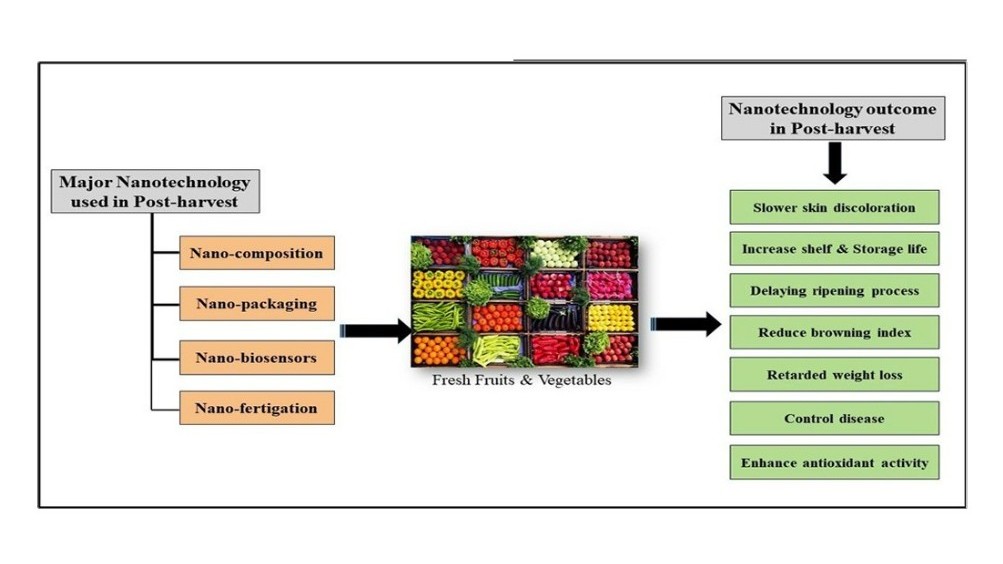
The use of nanotechnology, also known as nanoscience, in agricultural production and post-production handling is gaining popularity these days because it can reduce post-harvest losses, increase food quality and production efficiency and control microbial growth and development.
What does nanotechnology offer?
Nanotechnology is a new generation of packaging that increases strength, quality and packaging beauty by reducing the influence of gases and damaging UV radiation (9). Nanoparticles (NPs) in post-harvest packaging reduce waste, improve package performance and enhance thermal stability, preserving food freshness and reheatability.
They also provide stronger barriers against gases, UV rays, moisture and volatile compounds, while enabling antimicrobial and nano biodegradable materials (10).
Nanotechnology focuses on materials under 100 nm in size with a high surface-to-volume ratio, offering notable industrial and scientific potential (11). Nano packing is one of the new approaches used in food packaging to ensure safety. It can help prevent rotting and physical damage to fruits and vegetables during transportation (12).
Many studies suggest that employing nano-packing material enhances physicochemical and physiological quality when compared to standard packing material (9, 11).
Moreover, the NPs, for instance, silver (Ag) NPs, protect the packaging materials and are very effective against different types of infections, germs, viruses and fungi (13). The use of nano-packing provides a viable approach for increasing the shelf life of fruits, vegetables and other horticulture crops during long-term storage.
Now-a-days, nanotechnology is utilized to coat food, food wrap and packaging to provide additional protection. Examples of nanotechnology used in post-harvest packaging include nano sensors, nanocomposites, nano capsulation and nano emulsions (14).
Due to its crucial role in the efficient transportation and preservation of food to end consumers, food packaging has grown to be the world’s third largest sector (11).
The main process of packaging systems is to give containment for easy handling, transportation and distribution; protect and preserve the quality of food against adverse internal and external conditions; deliver on time information about the product's quality and ensure convenience for consumers (14, 15).
The review article examines the global scenario in food preservation, analyses the reasons for the food deterioration, particularly fruits and vegetables and summarizes the utilization of nanotechnology-based solutions to improve packaging and preserve fruits and vegetables more effectively.
Contents
Reasons for the food deterioration
Chemical changes
Taste changes
Nutritional changes
Physical changes
Microbial changes
Microbiological changes
Macrobiological changes
Various technologies and methods used in food preservation and packaging
Conventional methodologies and their impact on food preservation
Radiation usage
Applying chemical substances
Utilizing biological agents
Nanotechnology: A developing technology for reducing food deterioration
Techniques using nanotechnology to enhance the post-harvest longevity of fruits and vegetables
Nanostructure development in food preservation
Sol-Gel Synthesis
Electrospinning
Nanoprecipitation
Emulsion Polymerization
Advanced nanoparticles in food systems
Carbon dots
Mesoporous silica materials
Gra`hene
Improved packaging
Carbon nanotubes
Clay and silicate nanosheets
Polyvinyl - ZnO Powder
Low-density polyethylene
Chitosan-based nano silica film
Gaphene-coated copper oxide (CuO) nanotechnology
Active packaging
Nanocellulose
Nano starch
Nano protein
Nano chitosan
Rapid killing by Zn, CuO NPs
Silver NPs
Gold NPs
Zinc oxide NPs
Titanium dioxide NPs
Enzyme immobilization system
O2 scavengers
Intelligent/smart packaging
Nano sensors
Nano indicators
Nanocomposite
Nano emulsions
Nanoencapsulation
Benefits of nanoencapsulation
Gold (AU)-based immunosensor NPs
Detection of food structure
Environmental sustainability of nanotechnology in food preservation
Nanotechnology regulations and safety standards
Microbiome disruption by packaging nanoparticles
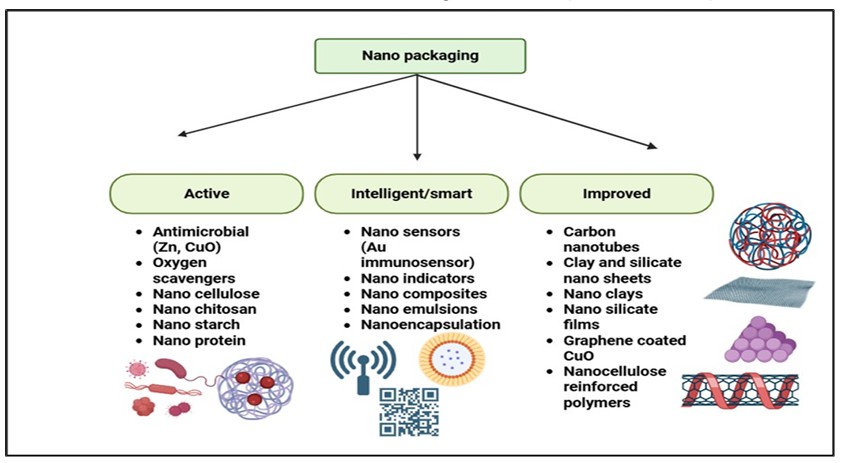
Classification of nano packaging (Fig. 3 of the original paper)
Conclusion
NPs are extremely reactive and mobile because of their nano size. These characteristics may increase the risk of toxicity. Therefore, it is important to address the harmful impacts of these particles while dealing with them. They have the potential to alter the body's natural microbiome.
Their bulk, size, chemical makeup, and features are all essential considerations when determining their effect on the target.
Nanotechnology is currently the most potential solution in the food preservation and packaging units. It has numerous benefits for prolonging shelf life, enhancing the physiochemical properties of food packaging materials, detecting microbial action on food, and reducing contamination of food
products compared to conventional approaches.
Nanocomposites impregnated with silver or zinc oxide nanoparticles can reduce bacterial proliferation on perishable goods such as spinach, lettuce, and broccoli, hence prolonging their freshness during storage and transportation. Ag NPs, which are well-recognized for their extensive antibacterial efficacy,
would extend the shelf life of strawberries and mushrooms by inhibiting microbial proliferation.
Though the use of nano-based technology in the food business, such as nanocomposites and NPs, has numerous benefits, it also has a significant disadvantage in terms of toxicity, which may be integrated into the food and create adverse effects on humans.
Many nations have developed particular legislation and guidelines for assessing the danger of utilizing nanomaterials in food packaging, such as REACH in the European Union, which protects the safety of food packaging materials. In the near future, numerous experiments, research, knowledge of nanomaterial toxicity, and risk assessment and management should be carried out.
Eventually, the food packaging sector will replace its current limitations with the use of nanotechnology, which has enormous potential. Because of their enhanced effectiveness and targeted delivery, iron and zinc oxide NPs would have been mostly employed in the agricultural sector.
Further, FDA engineered nanomaterials, depending on its nature (organic, inorganic, or mixed), would be designed to utilize biotechnological or synthetic methods to address specific agricultural or postharvest requirements.
These optimized nanostructures demonstrated significant efficacy in prolonging the shelf life and preserving the nutritional integrity of leafy green crops, including spinach, kale, and cabbage, by mitigating microbial deterioration and maintaining chlorophyll levels throughout the storage.
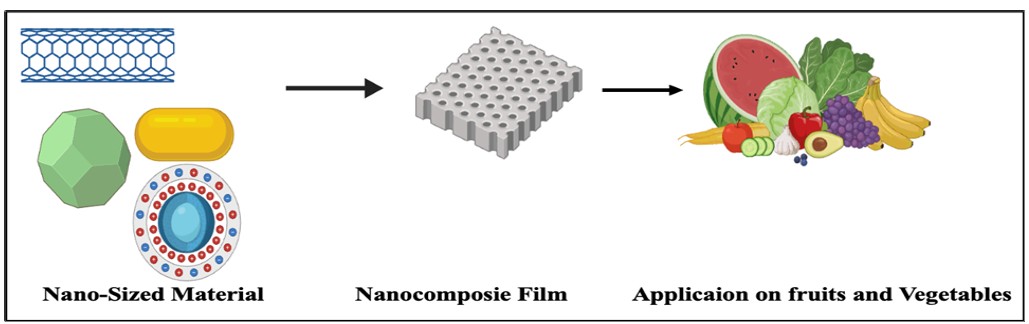
Application of nanomaterials for packaging fruits and vegetables (Fig 4. of the original paper)
Sources
Nanotechnology in post-harvest and shelf life enhancing: Revolutionizing food preservation (*)
Divya Nagarajan, Karthika Rajendran, Ayman El Sabagh, Vijayalakshmi Shankar, Jothika Manokaran, Agalya Jasmin, Chukwuma Ogbaga, Waqas Liaqat, Muhammad Tanveer Altaf, Sharif Ahmed, Muhammad Irfan, Aziz Ur Rehman, Nadia Bhatti, Ayesha Aslam, Javeed Iqbal
Plant Science Today, Vol. 12 No. 4 (2025)
https://doi.org/10.14719/pst.6503
Main figure is nr. 2 of the original paper.
(*) Full article is available on the Internet searching for the title
Related news