News
Optimum harvest data for three peach cultivars
The research by Belén Velardo-Micharet et al. determines the storage capacity of commercial and delayed harvest in ‘Rich Lady’, ‘Summer Lady’, and ‘Merryl O’Henry’
Peach consumers demand good quality fruit, but premature harvests result in fruit that does not ripen properly and does not reach the required organoleptic quality, so consumers stop buying this product that does not meet their expectations.
In our region, South West of Spain, peaches are exported long distances, and it is required that when they reach the destination market their quality is adequate.
Therefore, the objective of this study was to determine the storage capacity of commercial and delayed harvest in three peach cultivars.
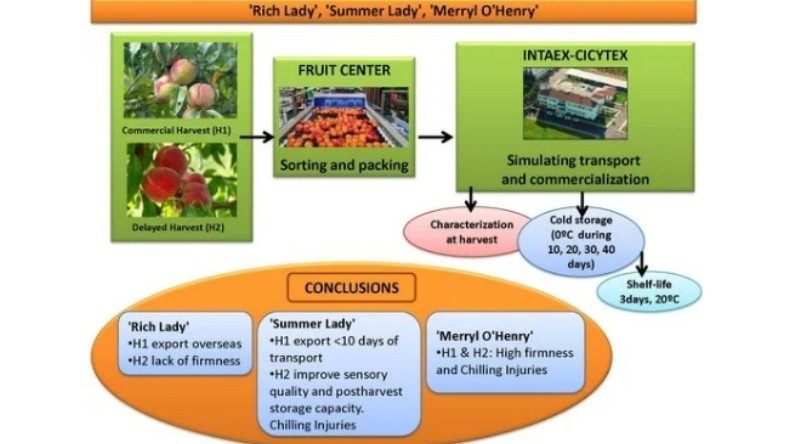
‘Rich Lady’, ‘Summer Lady’, and ‘Merryl O’Henry’ were harvested at commercial maturity (H1) and, a few days later (H2), packed in passive modified atmosphere (PMA), and stored under refrigeration for up to 40 days to simulate marketing to distant markets.
During storage and after three days of shelf-life, the physico-chemical characteristics, damage, and sensory quality of the fruit were analyzed.
In general, after cold storage, peaches improve their sensory characteristics after three days at room temperature.
PMA with refrigeration was suitable for exporting ‘Rich Lady’ peaches overseas for H1.
The late harvest, H2, is recommended for ‘Summer Lady’, as it improves sensory quality without losing storability.
‘Summer Lady’ was the best-rated cultivar by the tasters, and ‘Merryl O’Henry’ the worst, due to its lack of ripening and high incidence of chilling injury.
Introduction
Peach [Prunus persica (L.) Batsch] is native to western and central China, where the species still shows the greatest diversity [1], and currently this country is the main peach producer, with more than 64% of the world total.
It is a very important crop in the European Union, with around 27 million tons being produced annually, with Spain being the second largest producer of peaches and nectarines, with 1382 thousand tons produced in 2023 [2].
In Spain, it is grown in different regions, which allows for a wide harvest calendar, and it is a strategic sector that has undergone an important varietal renewal of plantations.
In recent years, much of the stone fruit production in Spain is destined for export, so it is of great economic interest [3]. Therefore, it is necessary to know the ability of cultivars for marketing over long distances, maintaining their quality.
Harvest data and quality parameters
Peach is a climacteric, soft-fleshed, highly perishable fruit, so it is essential to determine the harvest date, to collect the fruit at the optimum point of maturity, and thus to achieve its proper conservation and long-distance shipping.
A previous study conducted with Japanese plums determined that the harvest date has a significant influence on quality parameters and post-harvest damage, and therefore on long-distance marketability [4]. This will ensure that their organoleptic characteristics are optimal for consumption when fruits arrive at their destination [5].
In early harvests, peaches can not complete the climacteric evolution during storage, and the fruits will have poor organoleptic quality, which leads to frequent consumer complaints [6]; immature fruits are also more susceptible to dehydration and internal damage [7].
On the other hand, in late harvests, fruits are less firm and more susceptible to decay [4,8].
Storage conditions and quality
In commercial practice, peaches are pre-cooled and kept refrigerated at a constant temperature when they arrive at the fruit facility to extend their commercial life.
Variations in storage temperature, or temperatures within the range of 2.2 to 7.6 °C, favor the development of physiological disorders, known as chilling injuries (CIs) [9].
Susceptibility to CI depends on the cultivar, but there are other factors such as storage time, fruit size, tree load, or season that are not yet well understood [10,11]. CI often manifests itself after refrigeration, during shelf-life, and usually results in texture problems such as mealiness, leatheriness, and internal browning, among others, which reduce commercial quality, and negatively affect consumer perception [11,12,13].
Passive modified atmosphere (PMA) is used as a complementary technique of refrigeration for peach exports to distant markets [7,14,15], which allows for maintaining quality for a longer time, slowing respiration rate, and has an inhibitory effect on post-harvest pathogens [16,17,18].
Lara et al. [19] observed in peaches subjected to a low-oxygen atmosphere that ripening is delayed, and that changes in different metabolic pathways are important but generally reversible.
During marketing at room temperature, the fruit completes its organoleptic ripening, but this is when chilling injury and other damages are revealed [11,13,20].
Pre-storage at room temperature, from 24 to 48 h, prior to the application of PMA, has been shown to be effective in reducing chilling injury in ‘Douradão’ peaches, maintaining other quality traits during the simulated marketing period of the fruit [20].
A good consumer experience is basic for purchasing loyalty
Consumers appreciate peaches for their flavor and aroma, sweetness, firmness, juiciness, color, and damage absence, which are now considered relevant issues in breeding programs [8,12,21].
Initial purchases are related to appearance, while repeated purchases are based on good eating quality; so sensory properties play a relevant role in consumer preference and purchasing loyalty [22,23,24].
Long-term storage and post-harvest studies must take into account the evaluation of consumers, for whom the product is destined [25].
The most frequent consumer complaints are hard fruit and a lack of flavor at consumption, caused by too early harvesting [8]. Peach quality is not always homogeneous, as there is a wide diversity of cultivars with different organoleptic characteristics, and sometimes, attractive fruits are of low eating quality, so these problems can lead to decreased consumer acceptance and a reduction in sales and consumption [24,26].
Aim of the study
The aim of this study was to determine the effect of two harvest dates, commercial and slightly delayed, on the marketability to distant destinations of three peach cultivars of high export interest. For this purpose, long-distance commercialization was simulated using refrigeration and PMA.
The effect on physico-chemical parameters, damage incidence, and sensory quality were studied throughout refrigerated storage and subsequent shelf-life.
Source
Effect of Harvest Date on Fruit Quality and Post-Harvest Storability of Three Different Peach Cultivars
Belén Velardo-Micharet, Marisol Duarte-Maya, Ana Cristina Agulheiro-Santos, María Concepción Ayuso-Yuste and María Josefa Bernalte-García
Foods 2026, 15(3), 421
https://doi.org/10.3390/foods15030421
https://www.mdpi.com/2304-8158/15/3/421
Main picture is the graphical abstract
Related news


.jpg)