News
Chitosan-gelatin photothermal films for the controlled release of tea tree oil and the preservation of berries
The technology incorporates a Pickering emulsion containing tea tree oil and uses near-infrared light to trigger a controlled release with an antimicrobial effect.
Strawberries and grapes are particularly prone to spoilage during storage and transport due to their high moisture content, delicate skin, and sugar levels. To address the environmental and functional limitations of conventional petroleum-based packaging, a research team has developed a bio-based active film.
Active packaging is a type of packaging that, in addition to covering and protecting food, releases substances that help preserve it; in this instance, it releases an antimicrobial compound. The film is designed to improve the preservation of these fruits.
The approach combines chitosan and gelatin—biodegradable, non-toxic materials—with a Pickering emulsion, which is a mixture of oil and water stabilized by very small solid particles. In this emulsion, nanoparticles composed of soy protein isolate, tannic acid, and Fe3+ ions (STF) stabilize tea tree oil (TTO), a compound with antibacterial, antifungal, antioxidant, and insecticidal properties.
Design of the active material
The first step involved preparing various formulations of STF nanoparticles made from soy protein, tannic acid, and iron. STF4 is simply the name the researchers gave to the formulation that demonstrated the best performance.
STFE4—a Pickering emulsion containing tea tree oil—was prepared using STF4. Subsequently, this emulsion was incorporated into a chitosan and gelatin film. The resulting films were designated STFEF; the final number indicates the amount of emulsion incorporated. Thus, STFEF10 is the film containing 10% STFE4.
Key results
Among the formulations studied, STFE4 exhibited the best structural stability and a TTO encapsulation efficiency of 84.2%. Incorporating this emulsion into the chitosan-gelatin matrix yielded films with good mechanical and barrier properties, as well as antioxidant and antimicrobial activity.
The STFEF10 formulation achieved over 98% bactericidal activity against *Staphylococcus aureus* and *Escherichia coli* under NIR stimulation. Preservation tests showed that the films extended the shelf life of berries by 3 to 8 days, depending on the fruit type.
The response against microorganisms depended on the presence of the emulsion and the irradiation. Without NIR light, STFEF10 achieved inhibition rates of 58.48% against *S. aureus* and 55.46% against *E. coli*. With photothermal stimulation, the STFEF10 and STFEF15 formulations exhibited the highest antibacterial activity. This effect is attributed to the combination of thermal damage caused by the nanoparticles and the accelerated release of TTO.
Incorporating the emulsion also enhanced the antioxidant capacity of the films. This improvement is linked to the tannic acid and the active components of the tea tree oil.
How the film works
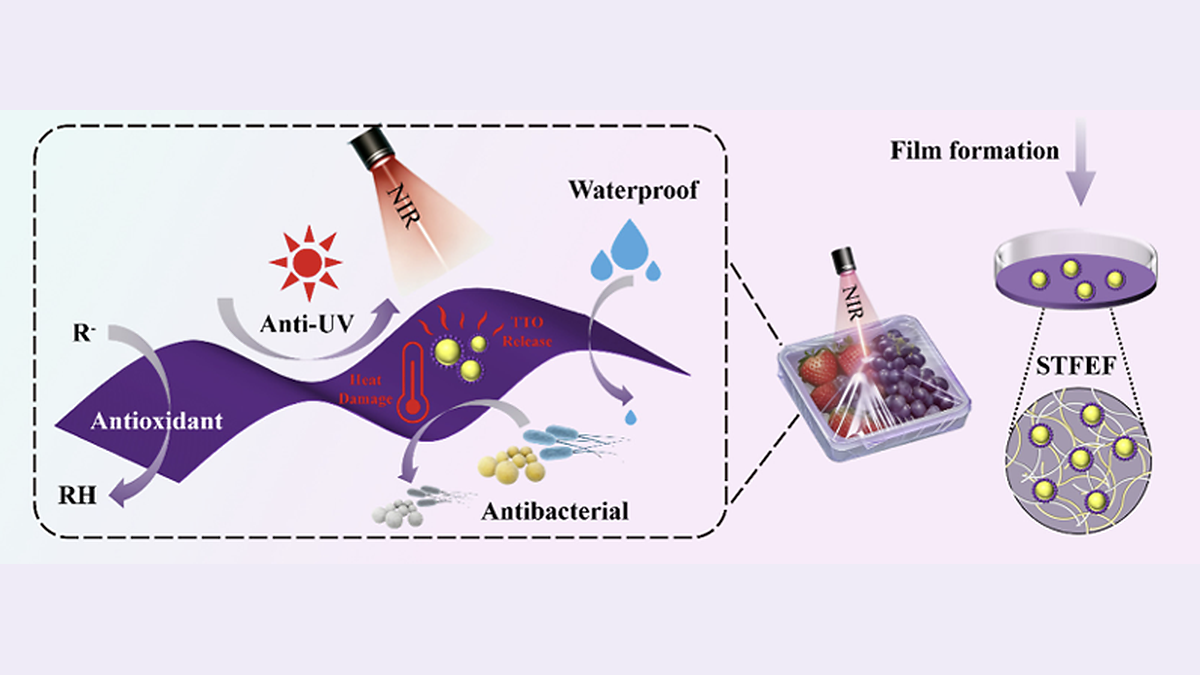
STF nanoparticles convert near-infrared (NIR) light energy into thermal energy.
Localized heating of the film acts as a stimulus that promotes the controlled release of tea tree oil (TTO). Thus, the system combines two mechanisms: the thermal effect and the antimicrobial action of the essential oil.
It is important to note that the study did not apply the formulation directly onto the fruit as an edible coating. Strawberries and grapes were placed in plastic cups, which were covered with the film and secured with a rubber band, serving as an active lid. In this instance, it is termed an active packaging material because, in addition to covering the fruit, it releases an antimicrobial compound that helps preserve it. Therefore, the authors evaluated an active packaging material, not a complete commercial package.
Biodegradability and outlook
Soil biodegradation tests showed that STFEF films progressively disintegrated and lost weight over a 14-day period, whereas the polyethylene film remained virtually unchanged. STFEF15 exhibited the fastest degradation, with a 58% weight loss by the end of the trial.
A formulation with postharvest potential
The results indicate that NIR light can serve as a flexible switch to trigger film heating and modulate the release of the antimicrobial compound as needed. According to the authors, this strategy overcomes certain limitations of traditional materials—specifically their single functionality and the passive, poorly controlled release of active agents.
This work expands the potential of Pickering emulsions for the postharvest preservation of perishable agricultural products and provides a technical foundation for developing photothermal materials for food packaging. Further studies will be required to evaluate scalability, application in commercial formats, and conditions for using NIR radiation outside the laboratory.
Source:
Yang, W., Liang, Q., Zeng, Z., Yang, K., Shao, W., Tan, X., Liu, S., Su, R., & Yan, J. (2026).
Photothermal controlled-release packaging films based on chitosan-gelatin incorporated with Pickering emulsions for tea tree oil delivery and their application in freshness preservation of berries. International Journal of Biological Macromolecules, 381, 154174.
https://doi.org/10.1016/j.ijbiomac.2026.154174