News
Postharvest handling of edible flowers
Abstract of the chapters by V. Scariot et al., and E.F.A. Almeida et al. about available technologies to preserve edible flowers from the book "Advances in Research on Edible Flowers"
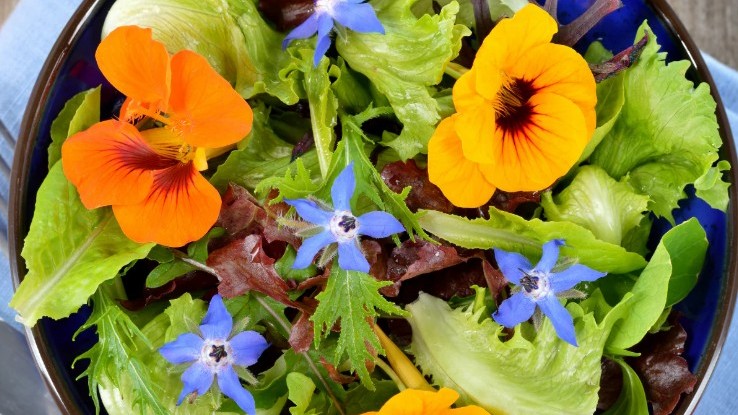
After a few days from harvest, varying according to the species, edible flowers begin to wither, dehydrate, and discolour. Along with the decrease in visual appearance, a loss of nutraceutical contents occurs, causing an overall loss of quality.
Therefore, it becomes necessary to adopt pre- and post-harvest strategies to prolong their shelf life, both preserving the organoleptic and nutraceutical characteristics.
Before harvesting, good agricultural practices such as adequate mineral nutrition and irrigation, and pest and disease control need to be applied as they can greatly influence both produce quality and longevity.
The harvesting procedure itself is also a fundamental aspect to be considered.
After harvesting, external factors, among which mainly temperature, can induce changes in edible flowers’ senescence.
How to preserve edible flowers
The main strategies used to delay the metabolism of edible flowers are preservation at low temperatures through refrigeration and freezing.
Other opportunities to delay quality loss are represented by controlled and modified atmosphere packaging, and edible films and coatings, which act as a barrier against gas exchange and the growth of microorganisms.
This chapter deals with the most recent knowledge that has been developed to maintain all the properties and quality of fresh edible flowers for a long time, extending their marketability.
Technology for large and small growers
The chapter by E.F.A. Almeida et al. covers the following main techniques for delaying the senescence of edible flowers: refrigeration, preservatives, irradiation, edible films, and drying methods.
Some techniques, such as dehydration by freeze drying, fluidized bed drying, or spray drying, require sophisticated equipment and, as a result, are used on an industrial scale, mainly for extraction of bioactive compounds and dyes.
Other post-harvest preservation methods are simpler, such as refrigeration, natural drying, or oven drying, and can be used by small farmers for marketing fresh products. These techniques can be applied separately or in combination, providing different responses according to the species, cultivar, and product use.
Sources
Almeida, E.F.A., de Lima, J.P., Castricini, A., Lourenço, G.S. (2026). Postharvest Technologies Applied to Edible Flowers.
https://doi.org/10.1007/978-3-032-04561-4_9
Scariot, V., Caser, M., Falla, N.M., Pistelli, L. (2026). Postharvest Handling and Shelf Life of Edible Flowers.
https://doi.org/10.1007/978-3-032-04561-4_8
Both above chapters in: Jowkar, M.M., Duarte de Oliveira Paiva, P., Nicola, S. (eds) Advances in Research on Edible Flowers. Advances in Olericulture. Springer, Cham.
Picture, https://enjoyjustdate.com/blogs/research/9-edible-flowers-that-actually-taste-good?srsltid=AfmBOor_BGZ0oshJ9NSh-cycC9vRJfjG1AZVirvNNvoDB35dn_YX70jx