News
Advances related to the integrated management of blueberry, including field and postharvest practices
David Alejandro Pinzon et al. analyze field and postharvest practices in the blueberry industry, including propagation, physiology, agronomy, harvest, and postharvest management
The cultivation of blueberry (Vaccinium spp.) has undergone an unprecedented global expansion, driven by its nutraceutical value and the diversification of production zones across the Americas, Europe, and Asia.
Its consolidation as a strategic crop has prompted intensive scientific activity aimed at optimizing every stage of management from propagation and physiology to harvest, postharvest, and environmental sustainability.
However, the available evidence remains fragmented, limiting the integration of results and the formulation of knowledge-based, comparative production strategies.
Objective of the review
The objective of this systematic review was to synthesize scientific and technological advances related to the integrated management of blueberry cultivation, incorporating physiological, agronomic, technological, and environmental dimensions.
The PRISMA 2020 methodology (Preferred Reporting Items for Systematic Reviews and Meta-Analyses) was applied to ensure transparency and reproducibility in the search, selection, and analysis of scientific literature indexed in the Scopus database.
After screening, 367 articles met the inclusion criteria and were analyzed comparatively and thematically.
Results
The results reveal significant progress
- in propagation using hydrogel and micropropagation techniques,
- efficient fertigation practices, and
- the integration of climate control operations within greenhouses,
leading to improved yield and fruit quality.
Likewise,
- non-thermal technologies,
- edible coatings, and
- harvest automation
enhance postharvest quality and reduce losses.
In terms of sustainability,
- the incorporation of water reuse and
- waste biorefinery
has emerged as key strategies to reduce the environmental footprint and promote circular systems.
Among the main limitations are
- the lack of methodological standardization,
- the scarce economic evaluation of innovations, and
- the weak linkage between experimental and commercial scales.
It is concluded that integrating physiology, technology, and sustainability within a unified management framework is essential to consolidate a resilient, low-carbon, and technologically advanced fruit-growing system.
1. Introduction
The cultivation of blueberries (Vaccinium spp.) has become one of the most rapidly expanding fruit crops worldwide in recent decades, driven by both its high economic value and its nutritional and functional importance [1].
Increasing international market demand has encouraged varietal diversification and the adoption of new cultivation technologies in nontraditional regions, ranging from temperate to subtropical climates [2].
This process has transformed global fruit growing, stimulating knowledge generation on physiology, agronomic management, technological innovation, and environmental sustainability.
Currently, countries such as the United States, Peru, Chile, Spain, and China lead global production, while new regions in Latin America and Eastern Europe are emerging with competitive potential [3].
The integrated management of blueberries encompasses all stages of the production system from plant propagation and crop establishment to harvest, postharvest, and industrial processing.
Recent scientific literature reports significant advances in
- in vitro and cutting propagation [4],
- nutritional control and fertigation management [5],
- phenological regulation through physiological compounds [6],
- the use of protected structures [7],
- integrated pest management, and
- harvest mechanization [8,9].
Likewise, postharvest stages have benefited from emerging technologies such as
- high hydrostatic pressure,
- pulsed light,
- thermosonication, and
- edible coatings,
all aimed at extending shelf life and preserving the fruit’s bioactive compounds [10].
This holistic approach has enabled an understanding of blueberry as a complex biological system in which technological innovation and sustainability must operate synergistically.
Systematic reviews have become essential tools for integrating the broad and fragmented scientific evidence available on blueberry management. Unlike narrative reviews, this methodological approach allows for the identification of patterns, knowledge gaps, and emerging trends based on rigorous search, selection, and analytical criteria [11,12].
Its application in the agricultural field is particularly relevant, as it connects dispersed experimental results with real innovation needs in production systems, thus facilitating technology transfer to growers, nurseries, and agro-industries.
Within this context, systematic review provides a solid scientific foundation to guide policy design, research programs, and investment decisions in sustainable and technology-driven agriculture [13].
The objective of this systematic review was to analyze the main scientific and technological approaches associated with the integrated management of blueberry cultivation, covering physiological, agronomic, technological, and environmental dimensions. To achieve this goal, the following research questions (RQ) were formulated:
- RQ1. What are the most efficient and sustainable plant propagation and establishment techniques that ensure uniformity, vigor, and adaptability under different agroclimatic conditions?
- RQ2. How do nutrition, fertigation, and eco-physiological regulation strategies influence productivity, fruit quality, and the efficient use of water and energy resources?
- RQ3. What role do controlled-environment production technologies play in optimizing microclimate and mitigating abiotic stress?
- RQ4. In what ways do sustainability and circular economy strategies (water reuse, renewable energy, life cycle assessment LCA, and biorefinery) contribute to reducing environmental impact and strengthening production system resilience?
- RQ5. Which innovations in mechanization, harvesting, and postharvest handling ensure the preservation of bioactive compounds, food safety, and competitiveness of blueberries in demanding global markets?
To address these questions, the PRISMA 2020 methodology (Preferred Reporting Items for Systematic Reviews and Meta-Analyses) was applied to ensure transparency and reproducibility throughout the search, selection, coding, and analysis processes.
The review was based on documents indexed in the Scopus database, excluding grey literature and prioritizing experimental studies and specialized reviews.
This integrative approach made it possible to connect the most relevant scientific evidence around technological innovation, environmental sustainability, and blueberry physiology, providing a comprehensive understanding of the current state and future challenges of this crop.
2. Global Context of Blueberry (Vaccinium spp.) Production Systems
Global blueberry production relies on a limited number of species and interspecific hybrid groups within the genus Vaccinium, whose chilling requirements and stress tolerance largely determine their geographic distribution and production systems.
Northern highbush blueberry (Vaccinium corymbosum) is the dominant species in temperate regions, particularly in North America and Europe, where winter chilling requirements range from 800 to 1200 h, supporting stable production of cultivars such as ‘Duke’, ‘Bluecrop’, ‘Liberty’, ‘Aurora’, and ‘Legacy’.
Rabbiteye blueberry (Vaccinium ashei), characterized by intermediate chilling requirements (500–600 h) and greater tolerance to adverse conditions, is widely used in warmer environments, including the southeastern United States and parts of South America.
Southern highbush blueberries, derived from interspecific breeding programs, exhibit lower chilling requirements and higher heat tolerance, enabling commercial production in subtropical and Mediterranean regions with cultivars such as ‘Ventura’, ‘Star’, ‘Alixblue’, and ‘Gupton’.
In contrast, lowbush blueberry species (Vaccinium angustifolium and Vaccinium myrtilloides) are mainly associated with cold climates and processing-oriented systems.
These genetic groups underpin regional differences in production strategies, technology adoption, and research priorities across the global blueberry industry.
In line with the expansion of these genetic groups, the global area dedicated to blueberry cultivation has increased markedly over recent years (Figure 1a of the original paper, access below, in Source).
By 2024, worldwide blueberry area reached approximately 282,192 hectares, with the Americas accounting for the largest share of established plantations. Between 2018 and 2024, global cultivated areas increased by 58.4%, reflecting sustained investment and market-driven expansion.
The most pronounced growth occurred in the Asia–Pacific (APAC) region, which added nearly 44,687 hectares during this period, driven largely by the rapid adoption of southern highbush cultivars, intensive production systems, and protected cultivation technologies.
Although area expansion continued across all regions, the annual rate of new plantation establishment slowed slightly between 2022 and 2024 in both the Americas and EMEA, suggesting a gradual transition from extensive expansion toward consolidation, intensification, and productivity-oriented strategies in more mature production systems.
The expansion in cultivated area has been accompanied by a substantial increase in global blueberry production, which grew by approximately 112% between 2018 and 2024 (Figure 1b).
APAC exhibited the most pronounced relative growth, with production rising from 182,380 tonnes in 2018 to 752,160 tonnes in 2024, highlighting the rapid scaling of intensive systems in the region.
Nevertheless, the Americas remain the dominant contributor to cumulative global production, with an estimated total output of 5.95 million tonnes over the same period.
From 2018 to 2021, global production increased steadily, supported by strong growth in APAC; however, between 2021 and 2023, production levels stabilized, reflecting contrasting regional dynamics.
In 2023, a 12% decline in production in the Americas—associated with the effects of El Niño, including elevated temperatures, altered rainfall patterns, and shifts in harvest calendars was partially offset by production gains in EMEA and APAC.
In 2024, global production reached record levels, with increases of 22% in APAC and 12% in EMEA, while production in the Americas returned to levels comparable to those observed in 2021.
These trends, reported by the International Blueberry Organization (IBO), underscore both the resilience and vulnerability of global blueberry production systems and highlight the growing importance of region-specific adaptation strategies under increasing climatic variability.
Contents
3. Materials and Methods
3.1. Selection and Evaluation Process
3.2. Eligibility Criteria
3.3. Inclusion and Exclusion Criteria
4. Results and Discussion
4.1. Conceptual Framework for Integrated Blueberry Production Systems
4.2. Innovations in Propagation, Plant Material Acquisition, and Genetic Improvement
4.3. Advances in Agronomic Practices and Cultural Management Strategies for Optimizing Blueberry (Vaccinium spp.) Cultivation
4.4. Integrated Irrigation, Fertigation, and Mineral Nutrition Strategies in Blueberry (Vaccinium spp.) Cultivation
4.5. Integrated Approaches for the Sanitary and Phytosanitary Management of Blueberries (Vaccinium spp.)
4.6. Crop Physiology and Eco-Physiological Regulation Under Controlled Environments
4.7. Blueberry Harvesting: Transition to Mechanized and Assisted Systems
4.8. Post-Harvest Technologies and Dynamics of Blueberry (Vaccinium spp.) Storage and Marketing
- (i) Preservation of texture, color, and aroma with minimal degradation of anthocyanins/phenols
- (ii) Microbiological control using low-impact physical/chemical treatments
- (iii) Pigment stabilization: copigmentation, encapsulation, and protein/biopolymer matrices
- (iv) Valorization of by-products into functional ingredients and active packaging
4.9. Modeling, Computer Vision, and Precision Agriculture in Blueberry Cultivation
4.10. Environmental Sustainability and Efficiency in Production Systems
4.11. Human Health and Nutraceutical Value of Blueberry
4.12. Production in Controlled Environments and Greenhouse Innovation
5. Study Limitations
6. Practical Use of Evidence-Based Recommendations
7. Economic and Regional Aspects of Technology Adoption in Blueberry Production
The adoption of agricultural technologies in blueberry (Vaccinium spp.) production is increasingly shaped by economic feasibility and regional market dynamics, particularly under a global scenario of rapid supply expansion [115].
Historically, blueberries have maintained relatively high and stable prices compared to other fruit crops, largely due to a sustained growth in global demand that outpaced production increases [250].
However, medium-term market outlooks indicate that this balance is likely to become more fragile toward 2030 as global blueberry production continues to expand rapidly, increasing the risk of market saturation and value erosion.
In this context, technological adoption is no longer driven solely by yield enhancement, but by the capacity to deliver consistent quality, precise harvest timing, and market differentiation, as fruit that fails to meet these standards is increasingly excluded from premium supply chains regardless of price [251].
This evolving economic pressure is closely linked to a transformation of the global blueberry production map.
While the Americas remain a central pillar of global supply, their relative contribution has declined below 50% of total world production [252].
Peru has emerged as a dominant actor due to its “flattened production curve” strategy, enabled by advanced varietal genetics, irrigation management, and data-driven scheduling, allowing year-round or extended supply windows and improved price stability [253]. However, this leadership faces growing constraints related to water availability, social pressures, and environmental sustainability [254].
In contrast, Chile confronts structural challenges associated with aging orchards and declining competitiveness in both price and quality, while Mexico must improve production efficiency and reduce its heavy dependence on the U.S. market to sustain profitability.
Economic incentives for technology adoption vary markedly across regions and market orientations.
In export-driven systems supplying North America, Europe, and increasingly Asia, investments in precision irrigation, fertigation control, postharvest monitoring, and cold-chain technologies are often economically justified by the need to meet strict quality, shelf-life, and traceability requirements [255,256,257].
Conversely, in domestic or regional markets, particularly in emerging producing countries, growers tend to favor incremental, low-cost innovations such as improved irrigation scheduling or passive greenhouse structures over capital-intensive digital or automated systems [258,259].
This divergence aligns with broader evidence showing that the economic returns of digital and precision agriculture are highly context-dependent, influenced by scale, access to credit, and growers’ ability to integrate new technologies into existing management systems.
Africa and Asia are increasingly shaping the future geography of blueberry production and technology adoption [260].
According to assessments released by the International Blueberry Organization (IBO), Africa has emerged as the fastest-growing blueberry production frontier globally over the last decade, with a rapid expansion of cultivated areas across multiple countries.
Countries such as Morocco exemplify this shift, combining high yields, proximity to European markets, efficient logistics, and rapid adoption of advanced genetics [261]. Neighboring countries including Zimbabwe, Zambia, Kenya, and Namibia represent a new wave of expansion, benefiting from land availability and competitive labor costs, yet facing critical challenges related to water planning, infrastructure development, and strategic market positioning.
In Asia, and particularly in China, the dual role as both a major producer and a rapidly expanding consumer market reinforces the need for technologies that ensure uniform quality, efficient logistics, and brand differentiation [262,263].
Infrastructure and climate constitute additional bottlenecks that condition technology adoption.
As global blueberry volumes increase, pressure on postharvest infrastructure intensifies, given the crop’s high perishability and dependence on uninterrupted cold chains and efficient logistics [264]. Regions that fail to invest in postharvest handling, storage, and transport technologies risk losing competitiveness despite agronomic potential.
At the same time, climate change is reshaping production zones, enabling successful cultivation in new high-altitude or temperate regions while increasing climatic risks elsewhere. These shifts further reinforce the importance of adaptive technologies, including controlled-environment systems, improved water-use efficiency, and climate-resilient production models.
Controlled-environment agriculture illustrates the strong interaction between economics and regional context in blueberry systems. While high-tech greenhouses with active climate control can substantially reduce environmental variability and enhance fruit quality, their high capital and energy costs limit adoption to regions with favorable market access, energy prices, or policy support [265].
In contrast, low-cost passive greenhouses and tunnel systems, which dominate blueberry production in many countries, offer a more accessible pathway to technological intensification [3]. These systems provide partial microclimate regulation and water-use efficiency improvements at significantly lower investment levels, making them particularly relevant for small- and medium-scale producers in emerging regions [266].
Genetic innovation and data-driven technologies represent the structural backbone of long-term competitiveness in the blueberry industry.
The widespread adoption of new cultivars with low chilling requirements, improved firmness, enhanced flavor, and extended postharvest life has been central to global expansion. Today, varietal renewal is no longer optional but a prerequisite for economic survival.
Simultaneously, the sector is transitioning toward a data-intensive model, incorporating artificial intelligence, sensor networks, optical sorters, and emerging robotic harvesting solutions [267,268].
These technologies underpin the concept of the “smart orchard,” increasingly positioning blueberries among the most technologically advanced fruit crops.
Ultimately, successful adoption will depend on aligning technological sophistication with economic viability, regional infrastructure, and evolving consumer expectations for quality, sustainability, and traceability.
Finally, despite the widespread recognition of circular economy strategies as a pathway to reduce the environmental footprint of blueberry production, their implementation remains constrained by multiple barriers.
Technological limitations include the lack of scalable solutions for waste valorization, high energy requirements of advanced postharvest technologies, and insufficient infrastructure for by-product processing.
Economic barriers are equally significant, as investments in circular systems often require high upfront capital, long return periods, and market incentives that are not consistently available, particularly in small- and medium-scale operations.
Addressing these barriers requires coordinated efforts, including the development of cost-effective technologies, region-specific economic incentives, and integration of circularity principles into breeding, production, and postharvest research agendas.
8. Future Perspectives
The technological and scientific advancement of blueberry (Vaccinium spp.) cultivation demands an integrative vision that transcends traditional approaches and establishes a coherent, reproducible, and sustainability-oriented methodological framework.
This review identified several persistent gaps, including strong methodological heterogeneity among studies, limited multi-year and multi-site validation, weak integration between experimental and commercial scales, and insufficient linkage between technological innovation, economic feasibility, and environmental performance.
Addressing these gaps is essential to consolidate evidence-based, climate-smart blueberry production systems. Based on the findings of this review, four priority research pathways are proposed.
Experimental Standardization and International Cooperative Networks
A major limitation identified across propagation, nutrition, irrigation, and postharvest studies is the lack of standardized experimental protocols and comparable response variables, which hinders meta-analytical synthesis and cross-regional extrapolation. Future research should prioritize multi-site and multi-year experiments using harmonized methodologies, enabling robust comparison across agroclimatic zones and production systems.
A minimum core set of interoperable indicators should be adopted, including physiological (gs, Aₙ, Ψ, PSII efficiency), quality (°Brix, titratable acidity, firmness, shelf life), safety (pathogen log reduction), productivity (kg·plant−1, t·ha−1), and sustainability metrics (water and energy use efficiency, LCA, CF). Establishing international cooperative networks around these indicators would significantly improve data comparability and accelerate technology transfer.
Integration of Digital Tools and Intelligent Modeling
Although numerous studies demonstrate the potential of artificial intelligence, computer vision, and sensor-based systems, this review revealed that most applications remain fragmented, cultivar-specific, or limited to short-term trials.
Future research should move toward integrated digital platforms and crop digital twins that combine IoT sensors, phenomics, eco-physiological models, and real-time decision support.
Priority should be given to validating these tools under commercial conditions and assessing their robustness across cultivars and environments, using standardized performance metrics (R2, RMSE, MAPE) and transparent data governance frameworks to ensure scalability and reproducibility.
Sustainability and Technological Circularity
The review highlighted that environmental impacts are consistently concentrated in plastics, fertilizer inputs, energy use, and postharvest operations, yet relatively few studies evaluate mitigation strategies in an integrated manner.
Future research should explicitly link Life Cycle Assessment (LCA) and Carbon Footprint (CF) analysis with agronomic and technological interventions, such as water reuse systems (electrodialysis–forward osmosis), biodegradable coatings and packaging, renewable energy integration, and by-product valorization within agricultural biorefineries.
Long-term assessments that jointly evaluate environmental performance, energy balance, and economic viability are needed to support the transition toward circular and climate-neutral blueberry production systems.
Technology Transfer and Capacity Building
A recurrent gap identified in this review is the weak connection between experimental innovation and adoption at the farm and industry levels, particularly in emerging production regions.
Future research and development efforts should therefore be coupled with technology transfer programs, focusing on breeding for mechanization and climate resilience, incentives for sustainable certification, and targeted training in automation, data management, energy efficiency, and environmental control.
These initiatives should be aligned with national bioeconomy strategies and the Sustainable Development Goals (SDGs) to ensure that technological advances translate into practical, inclusive, and economically viable solutions.
A concrete and gap-driven roadmap
Together, these research pathways provide a concrete and gap-driven roadmap for advancing blueberry cultivation toward intelligent, sustainable, and climate-adaptive systems, reinforcing the role of this crop as a model for technologically advanced and environmentally responsible fruit production.
9. Conclusions
This systematic review demonstrates that the integral management of blueberry (Vaccinium spp.) cultivation requires a multidimensional approach that interlinks physiology, technology, and sustainability.
The findings show that productivity, quality, and crop resilience depend on the interaction between eco-physiological regulation, mineral nutrition, water management, and environmental control, all framed within precision agriculture strategies and protected environments.
The integration of sensors, automation, and intelligent modeling has optimized physiological efficiency and reduced vulnerability to thermal and water stress, establishing the foundations for more efficient and climate-adapted production systems.
Likewise, technological innovation in harvest and postharvest processes is redefining standards of quality, safety, and traceability across the blueberry value chain.
Non-thermal technologies, edible coatings, smart packaging, and computer vision systems for maturity assessment and damage detection have proven effective in maintaining firmness, bioactive compounds, and sensory quality.
These advances, combined with the development of digital and automated solutions, are driving a transition toward more sustainable, efficient, and market-oriented postharvest systems.
Finally, sustainability and circularity emerge as strategic pillars for the future of blueberry cultivation.
The adoption of water reuse and treatment technologies (such as electrodialysis–forward osmosis), the use of renewable energy, the valorization of agro-industrial residues through biorefinery processes, and the implementation of environmental footprint metrics constitute key actions to reduce the ecological impact of the production system.
These strategies, supported by scientific innovation and technological transfer, position the blueberry as a model of intelligent, profitable, and circular bioeconomy-aligned fruit production.
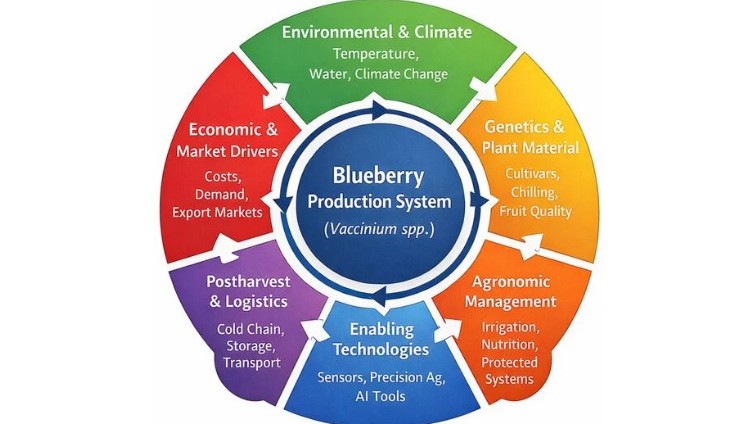
Picture is Fig. 3 of the original paper - Conceptual framework integrating the main components of modern blueberry (Vaccinium spp.) production systems.
Source
A Systematic Review of Integrated Management in Blueberry (Vaccinium spp.): Technological Innovation, Sustainability, and Practices in Propagation, Physiology, Agronomy, Harvest, and Postharvest
David Alejandro Pinzon, Gina Amado, Jader Rodriguez and Edwin Villagran
Crops 2026, 6(1), 15
https://doi.org/10.3390/crops6010015