News
Postharvest fungal diseases in peach - Sustainable management and emerging control strategies
Sahar El Maazouzi et al. review peach postharvest fungal diseases and control methods, emphasizing novel approaches including essential oils, microbial antagonists, induced resistance, and eco-friendly sanitizers
Postharvest fungal diseases represent a major constraint to the storage, transport, and marketability of peach (Prunus persica) fruits.
Pathogens such as Monilinia spp. (Brown rot), Penicillium expansum (Blue rot), Rhizopus stolonifera (Soft rot), Botrytis cinerea (Gray rot), and Geotrichum candidum (Acid rot) cause significant economic losses globally.
Traditional control methods primarily rely on chemical fungicides, which are increasingly challenged by issues of resistance development, consumer health concerns, and regulatory restrictions.
This review critically synthesizes the biology, infection mechanisms, and optimal environmental conditions of key fungal pathogens affecting postharvest peaches.
It further evaluates the current landscape of chemical, physical, and biological control methods, emphasizing novel approaches including essential oils, microbial antagonists, induced resistance, and eco-friendly sanitizers.
Comparative efficacy, sustainability, and practical implementation of these strategies are discussed. Integrated management approaches that combine multiple interventions under low-residue or residue-free systems are highlighted as the most promising direction.
This review concludes that the future of peach postharvest protection lies in tailor-made, multi-faceted integrated programs that are both effective and environmentally sound.
1. Introduction
Peach (Prunus persica), a member of the Rosaceae family, is renowned for its nutritional profile and high levels of bioactive compounds such as flavonoids, vitamin C, chlorogenic acid, neochlorogenic acid, and protocatechuic acid [1,2].
The global production of peaches and nectarines has markedly increased to meet rising consumer demand, with China accounting for over 17.5 Mt in 2023, followed by notable contributions from Spain, Türkiye, Italy, the USA, Iran, Greece, Chile, Mexico, and Morocco [3].
However, peaches are highly perishable and prone to postharvest decay, primarily due to fungal pathogens. Favorable environmental conditions, such as high humidity and warm temperatures during harvest and distribution, enhance the growth of fungi like Monilinia spp., Botrytis cinerea, Penicillium expansum, Rhizopus stolonifer, and Geotrichum candidum.
These pathogens often enter through wounds or lenticels and compromise fruit integrity via enzymatic degradation and mycotoxin production [4].
Conventional control relies on chemical fungicides such as fludioxonil, cyprodinil, pyrimethanil, and imazalil. However, growing concerns about fungal resistance, food safety, and environmental sustainability have encouraged the exploration of alternative approaches.
These include physical treatments (UV irradiation, heat), biological agents (antagonistic yeasts and bacteria), and natural compounds (essential oils and plant extracts) [5].
In the context of growing global concern over pesticide residues, environmental contamination, and the emergence of fungicide-resistant strains, the development of sustainable postharvest practices has become a key priority in modern horticulture. Regulatory frameworks such as the European Union’s “Farm to Fork” strategy and the Green Deal aim to reduce chemical pesticide use by 50% by 2030, pushing both researchers and producers to adopt eco-friendly alternatives [6].
Consumers are also increasingly demanding safer, residue-free fruits, thereby encouraging the transition toward integrated postharvest management systems that combine effectiveness with ecological responsibility.
These shifts emphasize the urgent need for innovative, scalable, and sustainable disease control strategies that minimize chemical inputs while maintaining fruit quality and safety.
The objective of this review is to provide a critical synthesis of the main fungal pathogens responsible for postharvest decay in peaches and to assess the comparative effectiveness of chemical, physical, and biological control methods.
This work aims to inform future research and support the development of sustainable strategies for managing postharvest diseases in peaches.
Contents
2. Postharvest Rot of Peaches
2.1. Brown Rot, Monilinia laxa, Monilinia fructicola, and Monilinia fructigena
2.2. Blue Rot, Penicillium expansum
2.3. Soft Rot, Rhizopus stolonifer
2.4. Gray Rot, Botrytis cinérea
2.5. Acid Rot, Geotrichum candidum
2.6. Comparative Overview of Major Postharvest Fungal Pathogens in Peach
3. Methods for Controlling Postharvest Rots of Peach
3.1. Chemical Controls
3.1.1. Fungicides Synthetic/Chemical Fungicides
3.1.2. Plant Defense Activators
- β-aminobutyric Acid
- 2,4-epibrassinolide and Methyl Jasmonate
- Benzothiadiazole
- 6-benzylaminopurine
- Nitric Oxide and Sodium Metasilicate
- Essential oils treatments
3.1.3. Sanitizers
- Neutral electrolyzed water
- Hydrogen peroxide
- Ozone
- Peracetic Acid
- Acetic Acid
- Calcium Chloride and Sodium Hypochlorite
3.2. Physical Controls
3.2.1. Heat Treatments
- Hot water Treatments
- Hot Air Treatments
- UV Treatments
3.2.3. Other Physical Techniques
- Plasma based technologies: Plasma-processed air (PPA), Plasma-activated water (PAW)
- High-voltage electrostatic fields (HVEF)
- Pulsed light (PL)
3.3. Biological Controls
- Antagonists Treatment
- Bacterial treatment
- Yeast Treatment
3.4. Comparative Evaluation of Postharvest Rot Control Methods
4. Conclusions and Research Gaps
Postharvest fungal diseases remain one of the most significant challenges in peach production and supply chains, often leading to substantial economic losses, reduced fruit quality, and shortened shelf life.
As this review highlights, major fungal pathogens such as Monilinia spp. (brown rot), Penicillium expansum (blue mold), Rhizopus stolonifer (soft rot), Botrytis cinerea (gray mold), and Geotrichum candidum (sour rot) are responsible for the most common and destructive postharvest rots in peaches.
These fungi differ in terms of infection mechanisms, environmental preferences, and susceptibility to control measures, making their management complex and multifactorial.
For decades, chemical fungicides have served as the primary line of defense against postharvest decay. However, the emergence of fungicide-resistant strains, growing regulatory restrictions, and increasing consumer demand for residue-free products have pushed researchers and industry stakeholders to explore alternative and more sustainable control methods.
Recent developments in biological control (using antagonistic yeasts and bacteria), physical approaches (such as UV-C and controlled atmospheres), and natural products (essential oils, plant extracts, and biopolymers) have demonstrated promising results both in laboratory and semi-commercial settings.
Nonetheless, few of these solutions have achieved large-scale industrial adoption due to challenges related to cost, stability, reproducibility, or regulatory approval.
Despite the progress made, several important knowledge gaps and unresolved issues still limit the effectiveness of postharvest rot management in peaches.
There is still a lack of predictive modeling tools simulating pathogen dynamics under real-world cold chain logistics and fluctuating environmental conditions, as well as an incomplete understanding of the fruit microbiome and its role in enhancing or inhibiting fungal colonization during storage.
Furthermore, standardization of biocontrol agents remains limited, particularly regarding formulation stability, compatibility with other treatments, and efficacy across different peach cultivars and environments.
The exploration of synergistic combinations, such as biocontrol agents with UV or EOs, is still insufficient, and data on consumer perception, sensory impact, and the nutritional implications of alternative treatments over extended storage periods remain scarce.
Addressing these challenges requires integrated efforts across plant pathology, microbiology, postharvest technology, food safety, and supply chain logistics.
Looking ahead, several avenues appear particularly promising.
These include
- the development of multi-strain or microbiome-based biocontrol products that are more resilient and effective under variable conditions,
- the application of nanotechnology for controlled release and targeted delivery of antifungal agents, and
- the use of artificial intelligence and machine learning for early detection, monitoring, and prediction of rot outbreaks.
The integration of “omics” tools such as genomics, metabolomics, and transcriptomics could help identify molecular targets of resistance and provide a deeper understanding of host–pathogen interactions.
Furthermore, emerging approaches such as the following all point to clear technological breakthroughs:
- metagenomics to study the fruit microbiome for the development of next-generation probiotic preparations,
- the use of CRISPR technology to edit fruit disease resistance genes, and
- the development of real-time disease early warning systems based on the Internet of Things (IoT).
The design of sustainable packaging systems incorporating antimicrobial materials or sensors to prolong shelf life and monitor fruit status also represents a significant opportunity.
Ultimately, the goal is not only to reduce rot incidence but also to ensure fruit safety, maintain high quality, reduce postharvest losses, and comply with international standards for sustainable and responsible agriculture.
To achieve this, bridging the gap between experimental research and commercial application will be essential, supported by policy, innovation, and interdisciplinary collaboration.
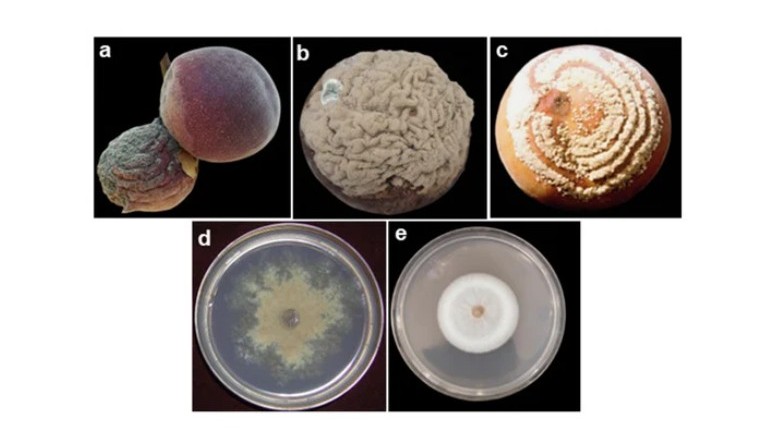
Picture is Fig. 1 of the original paper - Macroscopic images of Monilinia spp.:
(a) Monilinia laxa on a peach fruit (own photo, taken at the Training and Research Center Louata, Sefrou, Morocco, 21 June 2019);
(b) Monilinia fructicola on a peach fruit (own photo, taken at the Training and Research Center Louata, Sefrou, Morocco, 28 July 2019);
(c) Monilinia fructigena on a peach fruit, adapted from [9];
(d) M. fructicola on a PDA medium (own photo, taken Department of Plant Biology (Plant Physiology), Murcia, Spain, 23 December 2002);
(e) M. fructigena on a PDA medium (own photo, taken Department of Plant Biology (Plant Physiology), Murcia, Spain, 8 September 2002)
Source
Peach Postharvest Fungal Diseases: Sustainable Management and an Integrative Review of Emerging Strategies
Sahar El Maazouzi, Adil Asfers, Antonio Cano, Josefa Hernández-Ruiz, Ahlem Hamdache, Abdelhadi Ait Houssa, Mohammed Ezziyyani and Marino B. Arnao
Crops 2025, 5(6), 84
https://doi.org/10.3390/crops5060084
This article belongs to the Special Issue Molecular Mechanisms and Integrated Control of Pathogen Crops
https://www.mdpi.com/2673-7655/5/6/84