News
Effects of mechanical damage on postharvest of fruits and vegetables
The review by Fanyi Liu et al. analyzes the mechanisms by which mechanical damage affects the preservability of produce
Fruits and vegetables are highly perishable, with postharvest losses ranging from 20 % to 60 % of total production. Mechanical damage, which accounts for 30–40 % of these losses, occurs at various stages of the supply chain, including harvesting, postharvest handling, storage, processing, distribution, and consumption.
This damage is a composite result of multiple stresses such as impact, compression, puncture, vibration, and friction.
Different levels of mechanical damage exhibit varying manifestation on fruits and vegetables, such as bruise, collapse, perforation, cracking, breaking, or invisible damage.
It is well known that mechanical damage reduces the commodity value of fruits and vegetables, however its impact on preservability is less clear.
This article reviews how factors, including external factors (e.g., environmental conditions, handling) and internal factors (e.g., cultivar, maturity), influence mechanical damage.
It systematically explores the effect of mechanical damage on quality deterioration of fruits and vegetables, including water, texture, color, nutrition, flavor, and senescence.
It reviews the relationship of mechanical damage-microbial loads-produce decay, disclosing the mechanisms by which mechanical damage promotes pathogen infection. This article provides a deep understanding of the impact of mechanical damage on the physiological quality deterioration and microbial decay of fruits and vegetables, offering theoretical guidance for developing preservative methods based on physiological quality and microbial parameters.
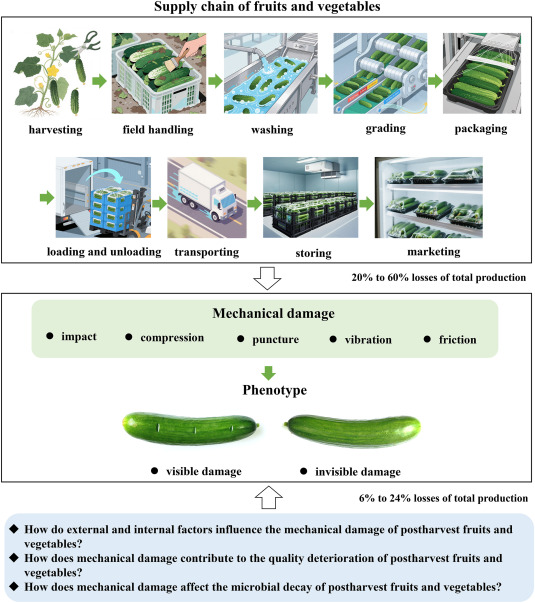
Fig. 1 - Route and questions addressed in this review
1. Introduction
Fruits and vegetables are important parts of human diet and nutrition, providing carbohydrates, vitamins, minerals, lipids, proteins, and amino acids. Consuming fruits and vegetables can reduce the risk of human chronic diseases (DeBenedictis et al., 2024) and depression (Matison et al., 2024).
The demand for fruits and vegetables is steadily increasing. Global fruits and vegetables market has passed US$ 720 billion since 2023, and keeps rapid growth in recent years (Al-Dairi et al., 2022).
The cultivation of fruits and vegetables relies on specific climatic conditions, and Asian countries are the primary producers.
The global consumption of fruits and vegetables depends on the flow of the supply chain. However, losses occur at various stages of the supply chain, reaching 20 %–60 % of total production.
Mechanical damage, primary cause of losses
Mechanical damage is the primary cause of the supply chain losses, estimated to be 30–40 % of total postharvest losses (Xu et al., 2020).
Fruits and vegetables are highly perishable and susceptible to mechanical damage, which can occur along the whole supply chain, including harvesting, field handling, sorting, trimming, washing, grading, packaging, loading and unloading, transporting, storage, and marketing (Al-Dairi et al., 2022).
Mechanical damage breaks the cell structure of fruits and vegetables, creating favorable conditions for pathogen invasion. Mechanical damage accelerates postharvest deterioration of fruits and vegetables, resulting in significant alterations in color, texture, nutrition, water, flavor, and microbial load (Sousa et al., 2024).
Mechanical damage affects product quality, which in turn impacts preservability and processability of fruits and vegetables. The more severe the mechanical damage, the lower the market value of products.
Visible mechanical damage
Generally, the damage level is evaluated by physical evidence (like damage area, damage volume) using methods such as
- direct measurement,
- spectral imaging detection,
- nuclear magnetic resonance imaging,
- near infrared detection, and
- other optical detection (Lu et al., 2019).
Li and Thomas (2014) have reviewed sources of mechanical damage and damage mechanisms, focused on quantitative measurement using physical methods, such as digital caliper measurement, hyperspectral and thermal imaging technology, 3-CCD camera, logistic regression modeling based on visual evaluation score, multiple liner regression based on drop height threshold, power function regression analysis based on visual evaluation score, etc. However, not all mechanical damage is visible.
Not visible damage
Minor mechanical damage (such as internal bruise and subtle cell wall damage) is not visible but can still cause significant metabolic changes in fruits and vegetables (Du et al., 2020; Spricigo et al., 2021). Therefore, researchers have started using physicochemical indicators to reflect the degree of mechanical damage (Sharbati et al., 2025; Tian, Chen, & Li, 2024; Yang, Lin, et al., 2023), such as respiratory intensity, total soluble solids, titratable acid, microRNA.
Additionally, microbial load also can reflect the degree of mechanical damage.
Aims of this paper
In this paper, the relationship between mechanical damage and storage quality of fruits and vegetables is systematically organized (Fig. 1). It aims to:
- clearly identify different types of mechanical damage that occur in the supply chain;
- reveal the phenotypes of mechanical damage on fruits and vegetables;
- analyze the factors affecting the degree of mechanical damage;
- elucidate the variation patterns of quality deterioration under mechanical damage; and
- illustrate the mechanism of mechanical damage promoting microbial decay.
This paper can provide guidance for the quantitative evaluation of mechanical damage according to physicochemical parameters and microorganism growth. Fresh-cut fruits and vegetables are not included in this review because mechanical damage in fresh-cut products is not an accidental byproduct of the supply chain but an inherent and intentional step of processing.
However, the fundamental mechanisms of mechanical injury detailed here provide the essential physiological foundation for the faster deterioration seen in fresh-cut products.
Therefore, the mechanisms of mechanical damage compromising preservability discussed herein, particularly those related to quality deterioration and microbial decay, may offer valuable insights and potential practical applications for researchers and technologists in the fresh-cut industry.
Index
2. Stress types of mechanical damage
2.1. Impact
2.2. Compression
2.3. Puncture
2.4. Vibration
2.5. Friction
3. Phenotype types of mechanical damage
3.1. Bruise
3.2. Visible collapse, perforation, cracking, and breaking
4. How do external and internal factors influence the mechanical damage of postharvest fruits and vegetables?
4.1. External factors
4.2. Internal factors
5. How does mechanical damage contribute to the quality deterioration of postharvest fruits and vegetables?
5.1. Accelerating water migration
5.2. Accelerating texture softening
5.3. Accelerating discoloration
5.4. Accelerating nutrition losing
5.5. Accelerating flavor change
5.6. Accelerating aging
6. How does mechanical damage affect the microbial decay of postharvest fruits and vegetables?
6.1. Mechanical damage promoting microbial decay
6.2. Mechanisms of mechanical damage promoting pathogen infection
6.2.1. Establishing physical channels and providing favorable micro-environment for pathogens
6.2.2. Increasing the susceptibility to pathogens
6.2.3. Suppressing plant immune responses
7. Future directions: guiding preservation method development
Understanding how mechanical damage accelerates quality deterioration and pathogen infection reveals critical intervention points for preservation technologies. Future postharvest management must develop integrated, targeted, and adaptive strategies applied throughout the handling chain.
7.1. Precision damage monitoring and early warning system
Future research should focus on integrating advanced non-destructive sensing technologies for early damage identification and classification, such as multispectral imaging, hyperspectral imaging, and optical coherence tomography.
AI-based image recognition algorithms can automatically detect and quantify damage, while IoT technology enables real-time monitoring across the supply chain. Developing early warning models that track metabolic changes can predict damage progression and creating a vital window for intervention.
7.2. Multi-dimensional preservation technology
The preservation of fruits and vegetables should follow a graded, "On-Demand Treatment" approach. Preservation intensity must correspond to damage severity:
- intact produce requires only baseline treatment (e.g., cold storage),
- minimally damaged items need enhanced care (e.g., antagonistic microorganisms),
- while seriously damaged produce warrants intensive interventions (e.g., plant defense elicitors).
Since no single method counteracts all damage-induced deterioration mechanisms, the most effective strategies will involve "Multi-Target Synergy"—combinatorial therapies working additively or synergistically across multiple physiological pathways.
A promising combination includes
- physical methods (e.g., controlled mild cold stress, controlled atmosphere),
- chemical methods (e.g., calcium, ethylene inhibitors), and
- biological agents (e.g., antagonistic microorganisms, bacteriocins).
7.3. Bionic packaging and smart cushioning materials
Bionic packaging and smart cushioning materials offer innovative protection.
Inspired by plant cell wall structures, biomimetic materials with shape memory and self-healing properties can be developed to adapt to variable stress conditions during transport.
Designing anisotropic cushioning structures based on produce-specific mechanical properties provides optimal, directional protection. Smart packaging integrated with sensors can monitor mechanical stresses in real-time and provide visual warnings when damage approaches critical thresholds.
7.4. Intelligent logistics and dynamic optimization
Intelligent logistics and dynamic optimization systems can significantly reduce postharvest damage.
Utilizing big data and machine learning, adaptive logistics systems can optimize transportation routes and modes in real-time, minimizing unnecessary handling.
Dynamic warehousing systems should automatically adjust stacking pressure and environmental parameters based on product physiological state and damage sensitivity.
Establishing quality traceability models that integrate handling history and physiological responses enables accurate shelf-life prediction, facilitating quality-based pricing.
These systematic approaches can reduce economic losses from mechanical damage.
8. Conclusions and perspectives
Mechanical injury occurs when stress exceeds the tissue's tolerance threshold during the supply chain of fruits and vegetables. Stress types of mechanical damage include impact, compression, vibration, puncture, and friction. Both visible and invisible damages, such as bruising, collapse, perforation, cracking, or breaking, diminish the preservability of fruits and vegetables. This reduced preservability results from quality deterioration and microbial rot.
Key physicochemical changes of quality deterioration include water loss, texture softening, discoloration, nutrition loss, flavor change, and senescence. Under weakened defense, pathogens can invade and grow within plant tissues, leading to further decay. The level of mechanical injury is closely linked to physicochemical and microbial parameters. Therefore, these parameters are used for developing preservation techniques.
However, different fruits and vegetables exhibit varied physicochemical and microbial parameters. More systematic studies on these parameters in the supply chain after mechanical injury are needed, including metabolome, transcriptome, and microbiome.
Collaboration among researchers in mechanical engineering, food science, phytology, and microbiology is essential to gather extensive data on mechanical injury and its effects on physicochemical and microbial parameters in fruits and vegetables. These large-scale data will help make decisions to minimize supply chain losses based on artificial intelligence (AI).
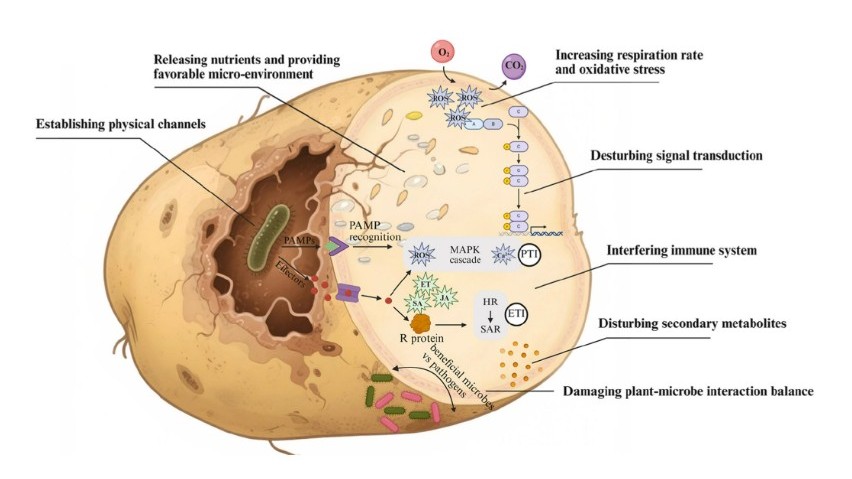
Main figure is Fig. 5 of the original paper showing mechanisms of mechanical damage promoting pathogen infection.
Source
How does mechanical damage affect the preservability of postharvest fruits and vegetables?
Fanyi Liu, Ming Hai, Baitong Mei, Lanhua Yi, Shouyong Xie
LWT, Volume 237, 1 December 2025, 118781
https://www.sciencedirect.com/science/article/pii/S0023643825014665
https://doi.org/10.1016/j.lwt.2025.118781