Processing
Three spectral techniques for monitoring guava quality
Hyperspectral, near-infrared, and Raman imaging were integrated into a model that predicts color changes and soluble solids during storage.
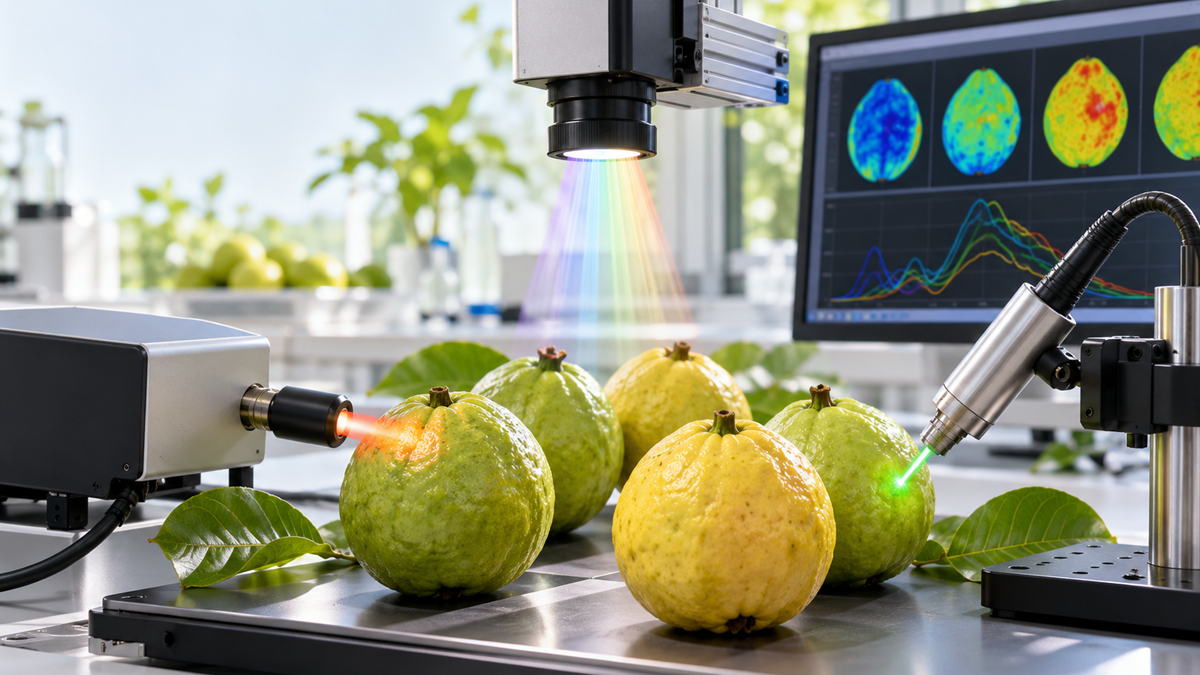
An international team of researchers has succeeded in integrating NIR spectroscopy, hyperspectral imaging, and Raman scattering to predict with millimeter-level precision the ripening, sugar content, and color changes in tropical fruits, without the need to destroy them.
The postharvest challenge for highly perishable fruits
Guava (*Psidium guajava* L.) is one of the most highly valued tropical fruits globally, prized for its organoleptic profile and high content of vitamin C and antioxidants. However, its climacteric nature combined with a thin skin and low mechanical resistance leads to an accelerated respiration rate after harvest. In producing regions, postharvest losses can reach between 10% and 24% due to rapid cell wall degradation, pulp softening, and temperature fluctuations during transport.
To date, quality control in fruit and vegetable packing facilities has relied on subjective visual inspections or destructive laboratory analyses, such as refractometry and chromatography. While individual spectroscopic technologies (such as near-infrared spectroscopy) represented an advancement, they have shown limitations when used in isolation: hyperspectral imaging offers excellent spatial resolution but lacks sensitivity to certain molecular bonds; near-infrared (NIR) spectroscopy is subject to interference from water; and Raman spectroscopy is susceptible to fluorescence effects.
A triple spectral perspective: HSI + NIR + Raman
To overcome these bottlenecks, the new study has designed a data fusion architecture across three levels (low, intermediate, and high), fed by three complementary analytical sensors:
- Hyperspectral Imaging (HSI, 392–1011 nm): Captures the spatial distribution of chlorophyll and carotenoids in the peel, identifying color gradients imperceptible to the human eye.
- Near-Infrared Spectroscopy (NIR, 908–1676 nm): Evaluates the response of C-H and O-H bonds, enabling the estimation of water content and internal carbohydrate concentration.
- Raman Spectroscopy (46–2002 cm⁻¹): Provides a vibrational "fingerprint" of the molecular structure, recording the accumulation of fatty acids and flavonoids, as well as the degradation of anthocyanins.
Key results and model performance
After evaluating algorithms such as Random Forest (RFR), Partial Least Squares (PLSR) and Support Vector Regression (SVR) over a 26-day storage trace, the SVR-based combination with variable selection using the Successive Projection Algorithm (SPA) in mid-level fusion demonstrated unprecedented accuracy:
- Total Soluble Solids (TSS / °Brix): Model accuracy with an R^2 of 0.8808 and a root mean square prediction error (RMSE) of only 0.53 °Brix.
- Color Coordinate a* (Green-Red): R^2 of 0.8413 (RMSE = 2.17), accurately reflecting the loss of green pigmentation in the epidermis.
- Color Coordinate b* (Blue-Yellow): R^2 of 0.7537 (RMSE = 2.90), correlated with carotenoid synthesis.
Furthermore, pseudo-color maps generated by pixel-by-pixel prediction revealed that the accumulation of sugars and carotenoids does not occur uniformly, but rather begins with a strong gradient in the central zone of the pulp before spreading towards the edges.
Impact on the fruit and vegetable industry
The integration of these three optical signatures paves the way for the development of in-line inspection systems for automated grading and sorting lines. This tool not only enables fruit to be classified according to its remaining shelf life before being sent to the export market, but also lays the foundation for the digitalization and non-destructive traceability of tropical fruits within smart cold chains.
Source:
Yu, J., Liu, Z., Pu, H., & Sun, D.-W. (2026). Novel multimodal data fusion strategies for nondestructive real-time monitoring of guava quality during storage. Postharvest Biology and Technology, 240, 114417.
https://doi.org/10.1016/j.postharvbio.2026.114417
Related news
.jpg)