Processing
New Energy Solutions for More Efficient Food Drying
This technical publication reviews advances in solar drying, biomass energy, waste heat recovery, artificial intelligence and process modelling to reduce energy use while preserving food quality
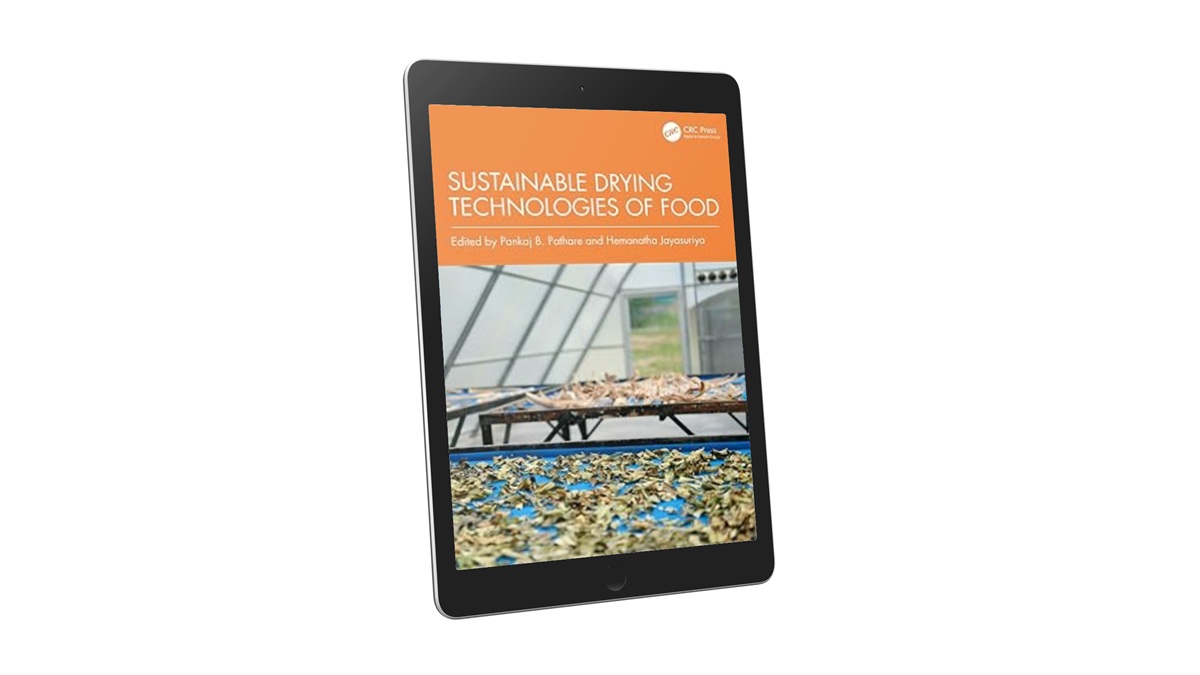
Drying remains one of the most widely used techniques for extending the shelf life of fruit, vegetables and other food products. Even so, many of the systems currently in use require high energy consumption and still depend heavily on fossil fuels.
The book Sustainable Drying Technologies of Food, edited by Pankaj B. Pathare and Hemanatha Jayasuriya and published by CRC Press in 2026, reviews a range of drying technologies designed to reduce this impact. It covers the fundamentals of these systems, their applications, modelling approaches and economic feasibility, while also addressing product quality and food safety.
Renewable energy for drying
The solutions reviewed include solar dryers, biomass-powered systems, waste heat recovery, geothermal energy and hybrid installations with thermal energy storage.
The book also covers other technologies, such as heat pump drying, vacuum drying, superheated steam drying, fluidised-bed drying, ultrasound-assisted drying and electrohydrodynamic drying. All of them aim to improve process efficiency and reduce energy consumption.
Fruit and vegetable quality
Reducing the moisture content of food helps limit microbial growth and makes products easier to preserve, store and transport. However, the final result depends largely on how the process is controlled.
Excessive temperatures or unsuitable drying times can affect colour, texture, aroma and nutritional value. For this reason, the publication pays particular attention to controlling temperature, humidity, airflow and treatment time.
Artificial intelligence and modelling
Another section of the book focuses on the use of digital tools in food drying.
Mathematical modelling and computational fluid dynamics make it possible to study how air, temperature and moisture are distributed during the process. Artificial intelligence is also used to predict drying times, energy consumption and final product quality.
The book also examines digital twins, which create a virtual representation of a dryer using data collected by sensors. This technology can support process monitoring and real-time adjustments.
Towards more efficient food processing
The combination of renewable energy, heat recovery and digital tools opens up new opportunities to reduce costs and improve the efficiency of food processing.
However, the publication notes that challenges remain, particularly in relation to initial investment, industrial scale-up and the availability of sensors and control systems.
Sustainable Drying Technologies of Food is aimed at researchers and professionals working in food engineering, agri-food processing and agriculture.
Access the book: "Sustainable Drying Technologies of Food"
Related news