Decco Ibérica

Decco Ibérica

Phytosanitaries

PostharvestTALKS Murcia Addresses Citrus Quality Challenges from Field to Packinghouse

PostharvestTALKS Murcia brought together industry experts to address citrus quality from a comprehensive perspective, connecting production, plant health, postharvest handling, sorting, and packinghouse planning
postharvesttalks-murcia-calidad-citricos.jpg
15 May, 2026
Postharvest Talks

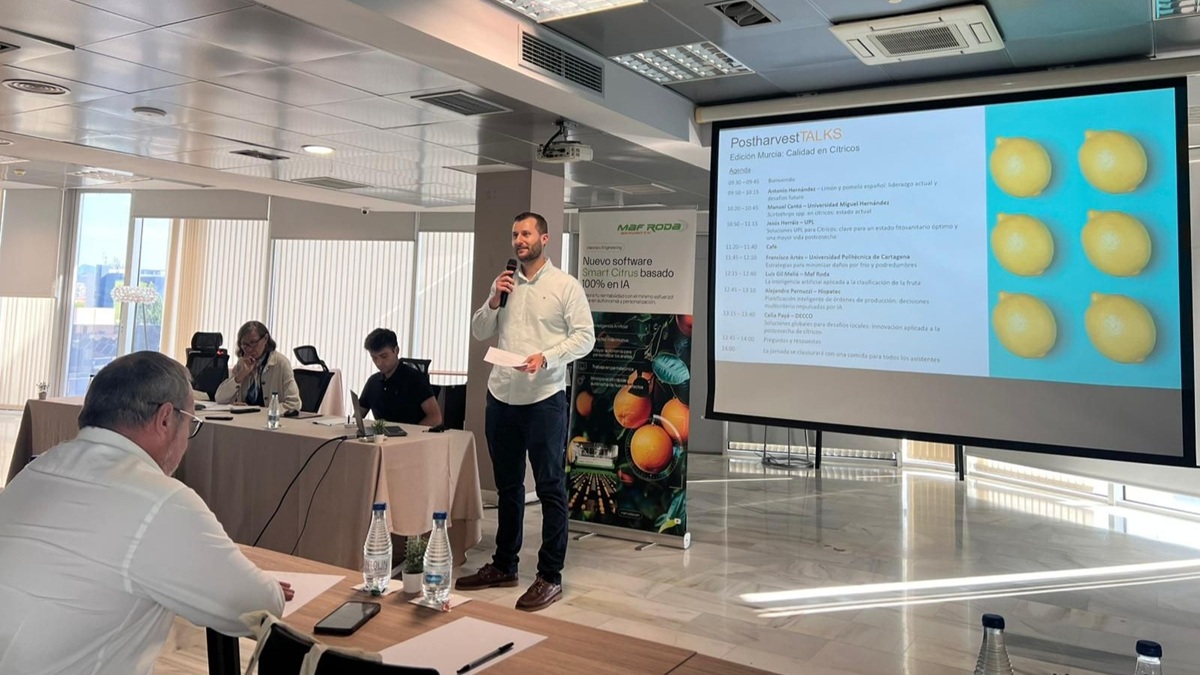
On May 14, Murcia hosted a new edition of PostharvestTALKS, organized by DECCO under the theme “Quality in Citrus”. The event brought together professionals and companies from the citrus sector to discuss the main challenges affecting fruit quality, from the field to the marketplace.

The session was opened by Alejandro Nicolás, Area Sales Manager for Murcia and Almería at DECCO Ibérica, who welcomed attendees and introduced the event’s focus on technical knowledge exchange among industry professionals. The conference concluded with closing remarks by Julio Marín, General Manager of DECCO Ibérica.


Held at Marla Center, the meeting featured specialists from AILIMPO, Miguel Hernández University, UPL, the Polytechnic University of Cartagena, MAF RODA, Hispatec, and DECCO, in a morning dedicated to plant health, physiology, preservation, automation, artificial intelligence, and postharvest innovation.

Postharvest.biz participated as the event’s media partner, helping promote an initiative focused on sharing technical expertise and encouraging collaboration among professionals across the sector.


A competitive sector that must stay ahead

The conference began with a presentation by Antonio Hernández, Technical Manager at AILIMPO, who provided an overview of Spain’s leadership in lemon production and the challenges currently facing the sector. His presentation highlighted that leadership is not static, and that international competition, changing consumer trends, regulatory requirements, water availability, climate change, and digitalization are reshaping both production and commercial strategies.

Spain continues to hold a strong position in lemons and grapefruit, but the global context requires greater differentiation, improved efficiency, and the ability to anticipate market trends. In this framework, quality can no longer be understood solely as appearance or shelf life, but rather as the result of a technical strategy that begins long before the fruit enters the packinghouse.

During his presentation, Hernández also explained the role of AGEFIS, sustainable phytosanitary management groups for lemons and grapefruit, through which 100 farms covering around 2,500 hectares are monitored.

Sustainability, plant health, and adaptability to increasingly demanding markets emerged as key themes during the first part of the event.


Plant health and physiology to protect quality from the field

One of the central topics was the situation of Scirtothrips spp. in citrus, presented by Manuel Cantó from Miguel Hernández University. His talk reviewed the current status of the pest, its distribution, the damage it can cause, and the importance of proper technical monitoring to support more accurate control decisions.

Speakers emphasized that citrus quality is built in the field, and that pressure from emerging pests requires monitoring tools, knowledge of population dynamics, and well-adjusted intervention strategies. Early-stage damage can compromise commercial quality later in the supply chain, making phytosanitary management directly linked to postharvest performance.

In the same session, Jesús Herráiz from UPL focused on solutions to achieve optimal phytosanitary conditions and extend postharvest life. His presentation reinforced the idea that the sector is moving toward a more integrated approach, combining crop protection, biostimulation, and physiological management to respond to increasingly complex production scenarios.

The overall message was clear: final fruit quality does not depend on a single tool, but on the combination of agronomic, phytosanitary, and postharvest decisions that allow fruit to arrive at the packinghouse in better condition.


Cold management, decay control, and storage at the heart of citrus postharvest

The section most directly related to preservation featured Francisco Artés from the Polytechnic University of Cartagena, who analyzed strategies to minimize chilling injuries and decay in citrus fruit. His presentation covered key factors such as temperature, relative humidity, dehydration, varietal sensitivity, and pathogen development during storage.

Cold management remains an essential tool, but also a potential source of problems if it is not properly adapted to the product’s characteristics and storage conditions. Chilling injuries, weight loss, and postharvest decay continue to drive the search for strategies that balance food safety, commercial quality, and shelf life.

The conference reviewed both conventional solutions and alternative approaches aimed at more sustainable postharvest management, in a context marked by increasing regulatory and commercial demands. Pathogen control, especially against decay-related diseases, remains one of the major challenges for maintaining citrus quality during storage, transport, and commercialization.


Artificial intelligence for better sorting and smarter decision-making

Automation and artificial intelligence also played a major role during the second half of the event. Luis Gil Meliá from MAF RODA explained the role of AI in fruit sorting, where machine vision, image analysis, and learning systems are improving defect detection and enabling more objective and efficient processes.

Fruit sorting influences not only product presentation, but also the ability to segment quality categories, optimize commercial destinations, and reduce errors along the packing line. In a market where each batch must meet specific requirements, having precise information about the fruit becomes a competitive advantage.

Alejandro Pernuzzi from Hispatec then addressed intelligent production order planning using AI-driven multicriteria decision-making systems. His presentation showed how digitalization is becoming part of daily operations in fruit packinghouses, where decisions must integrate variables such as orders, product availability, quality, timing, costs, and operational capacity.

Artificial intelligence is therefore emerging not only as a tool for better sorting, but also for faster and more agile planning in environments where variability is constant and decision-making under pressure forms part of everyday operations.


Postharvest innovation adapted to local challenges

The final technical presentation was delivered by Celia Payá from DECCO, who introduced global solutions for local challenges in citrus postharvest innovation. Her presentation covered tools for protection and preservation, including fungicide treatments, coatings, and waxes adapted to different market demands.

In an increasingly dynamic commercial environment, packinghouses need a wide range of alternatives to meet the specific requirements of customers, supermarkets, and destination markets. Demand for vegan waxes, organic solutions, and formulations with different characteristics is pushing companies to expand their portfolio of solutions without compromising performance in areas such as shine, weight-loss control, and quality maintenance.

DECCO also highlighted the development of solutions applied during the preharvest stages, aimed at improving fruit quality before arrival at the packinghouse. This idea reinforced one of the event’s key messages: postharvest management begins before fruit enters storage facilities, and final quality depends on a comprehensive view of the entire supply chain.


A comprehensive vision to face industry changes

The event concluded with a Q&A session and closing remarks emphasizing the importance of continuing to create spaces for technical exchange between companies, researchers, and industry professionals. Today’s challenges in the citrus sector cannot be addressed from a single perspective; they require agronomic expertise, phytosanitary solutions, postharvest management, automation, data analysis, and commercial adaptability.

PostharvestTALKS Murcia conveyed a common message throughout all presentations: citrus quality is built across the entire supply chain. From sector leadership and the management of emerging pests to cold control, decay reduction, AI-based sorting, and packinghouse planning, every decision influences the ability to deliver higher-quality fruit with longer shelf life and a better response to current market demands.

 
whatsapp
Plan de Recuperación, Transformación y Resiliencia Financiado por la Unión Europea