
Maf Roda
Conditioning
Maf Roda presents AI innovations for citrus grading
The Smart Citrus software combines patented multispectral cameras and neural networks to automate the detection of rots and external defects
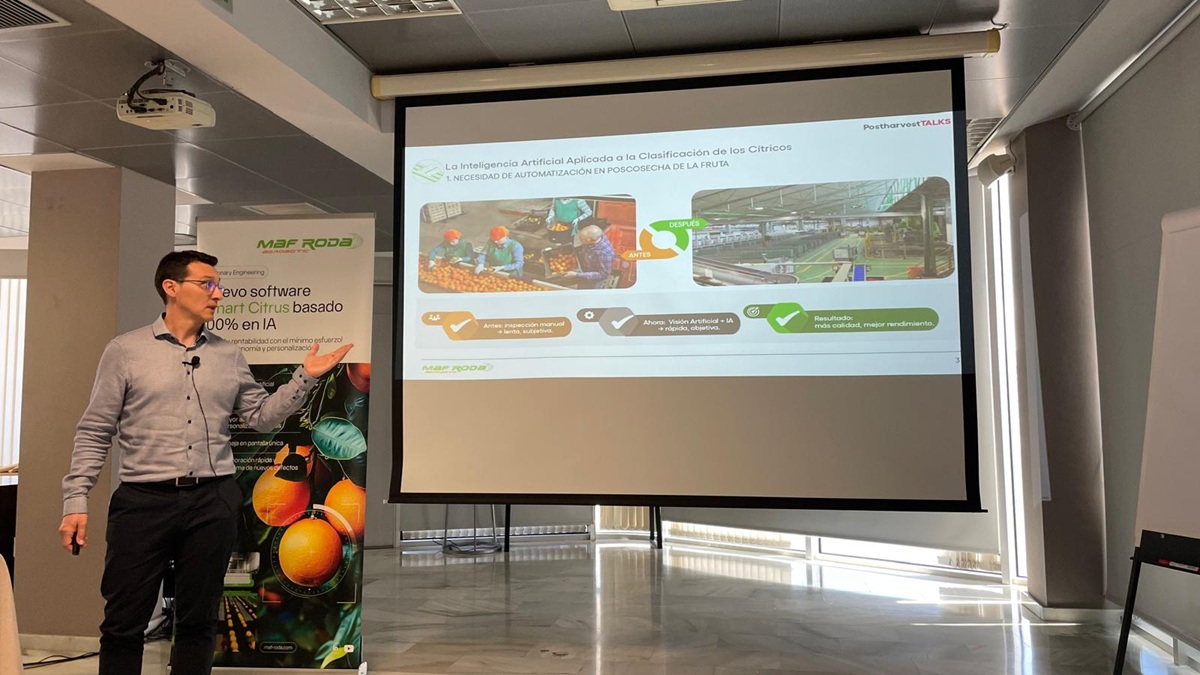
Within the framework of the recent edition of PostharvestTALKS, the technical meeting organized by DECCO focusing on the challenges of the citrus value chain, Luis Gil Meliá, an electronics department specialist at Maf Roda, presented the latest innovations in applying Artificial Intelligence (AI) to the citrus sorting and grading process. Early defect detection is a critical factor in minimizing economic losses and ensuring the commercial standards demanded by the market. Compared to traditional manual inspection, characterized by being slow, subjective, and dependent on the changing criteria of operatorsthe integration of computer vision and AI offers objective, fast, and highly accurate categorization.
Technological Foundation: Patented Multispectral Cameras
Maf Roda’s technology is backed by a mechanical and electronic foundation designed to achieve proper fruit singulation and rotation. Operating on this structure is the Globalscan 7 vision system, which stands out for incorporating patented multispectral cameras.
Unlike other complex systems that require multiple lenses, a single Maf Roda camera is capable of simultaneously capturing different wavelengths of the fruit within a single block. The system utilizes three cameras per line (one central vertical and two lateral) to record 100% of the surface of the moving fruit, obtaining from each piece:
- A conventional color image (RGB).
- Three spectral images in different infrared (IR) ranges, ideal for categorizing defect severity.
- A fluorescence image via ultraviolet (UV) light emission.
The Evolution of AI: From Machine Learning to Deep Learning
The presentation detailed the technological leap in image processing to identify anomalies in the packing house:
- Classical Vision: Relied exclusively on the programmer to define rigid filtering rules, forcing technicians or operators to perform complex parametric adjustments.
- Machine Learning: Introduced the algorithm's ability to learn classification rules from previous examples. Under this model, if a new defect appears during the season (such as "spider" damage), the operator can introduce images of the damage almost automatically so the system learns to recognize it.
- Deep Learning: Represents the most advanced standard through the use of neural networks. The system trains autonomously to identify complex patterns directly from the images without intermediate steps. This technology is successfully applied to the sector's main challenge: the precise detection of rots and early wounds, avoiding the erroneous sorting of commercial fruit.
Smart Citrus: Autonomy and Control in Real Time
As the culmination of this development, the new Smart Citrus software was introduced, a solution compatible with Globalscan 7 Biotech, currently available for oranges and mandarins. This program provides the packing house with greater autonomy thanks to an intuitive interface centralized on a single screen.
Among its main features, Smart Citrus allows users to add new defects with a single click, perform simplified tracking of commercial categories, and use the "undo changes" function to return to previous configurations. By processing external and internal quality data (such as Brix degrees and acidity) via Big Data, the platform offers continuous algorithm improvement through supervised image reintroduction, consistently optimizing packing house throughput.
News of Maf Roda