Measurements
AI and digital twins help anticipate postharvest deterioration
Artificial intelligence and digital twins open new possibilities for more predictive postharvest management based on real-time data, with applications in quality, shelf-life, cold chain and food loss reduction
Postharvest food losses remain one of the major challenges for the agri-food system. A review published in Frontiers in Sustainable Food Systems analyses the role of artificial intelligence and digital twins in quality prediction, dynamic shelf-life management, cold-chain optimisation and food loss reduction.
The article notes that 13 to 14% of global food production is lost between harvest and retail, representing nearly USD 400 billion annually. In perishable products such as fruit, vegetables, dairy, meat and seafood, these losses are aggravated by changes in temperature and humidity, handling operations, mechanical damage, microbial contamination and packaging conditions.
From reactive inspection to real-time prediction
The review highlights that conventional postharvest management remains largely reactive. Periodic inspection, manual quality assessment and fixed shelf-life dates do not always reflect the real storage history of each lot.
In contrast, artificial intelligence makes it possible to develop systems that combine sensors, environmental data and predictive models to anticipate quality deviations before deterioration becomes irreversible. Technologies such as machine learning, deep learning, computer vision, hyperspectral imaging, electronic nose and electronic tongue systems are already being applied to non-destructive quality assessment, defect detection, freshness classification and shelf-life prediction.
Four stages for digital postharvest management
The article presents these systems as a workflow that connects the physical product with digital models able to support decision-making.
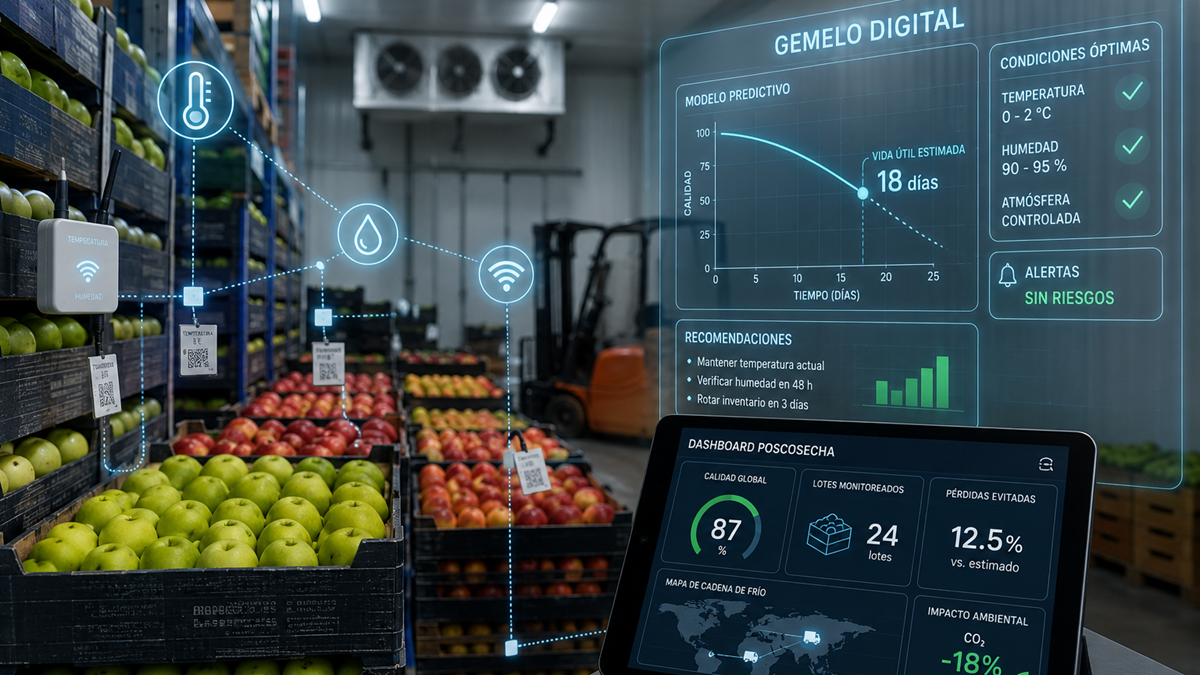
The first stage is data acquisition. Imaging sensors, spectroscopy, electronic nose and tongue systems, environmental sensors, RFID tags, QR codes and traceability data collect information on quality, temperature, humidity, gases, handling and logistics conditions.
The second stage is data processing and modelling. The data are cleaned, normalised and combined to feed artificial intelligence models, such as machine learning, neural networks, hybrid models or explainable AI systems, capable of interpreting product evolution.
The third stage is quality and shelf-life prediction. Based on the data collected, these systems can estimate freshness, ripeness, defects, deterioration risk, remaining shelf-life or optimal storage conditions.
The fourth stage is decision-making and feedback. Model outputs are translated into practical recommendations, such as adjusting temperature, modifying storage atmosphere, rerouting a lot, rotating inventory or generating early alerts. In digital twins, this information flows back to the physical system, creating a continuous learning and improvement loop.
Digital twins to act before quality is lost
Digital twins are virtual representations of products, processes or supply chains that are continuously updated with real sensor data. In postharvest, they can help simulate the evolution of a lot, predict its remaining shelf-life and support decisions such as adjusting storage conditions, rerouting products or updating quality information.
The article stresses that not all digital systems are true digital twins. Systems that only visualise data are closer to “digital shadows”. A digital twin requires a bidirectional connection between the physical system and the virtual model, able to turn data into predictive, adaptive and, in some cases, autonomous decisions.
Dynamic shelf-life and food loss reduction
One of the central ideas of the review is that shelf-life can shift from a fixed date to a dynamic variable managed according to the real conditions of each product or lot.
The integration of artificial intelligence and digital twins enables product-specific shelf-life estimation, better inventory optimisation, reduced waste, improved resource use and lower carbon footprints. According to the authors, this approach can support more sustainable and resilient postharvest management, especially in increasingly complex supply chains.
Applications and remaining challenges
The review covers applications across fruit, vegetables, dairy products, meat and seafood. Examples include automated optical sorting systems in apple, citrus and tomato packing; IoT-based cold-chain platforms for fresh produce; digital twins in refrigerated citrus transport; and sensor-coupled controlled-atmosphere systems for apple and pear storage.
Even so, large-scale adoption still requires overcoming important barriers. These include the lack of standardised datasets, the need for explainable AI models, interoperability between digital infrastructures, product-specific validation and testing under real commercial conditions beyond the laboratory.
The authors conclude that technological readiness should not be measured only by model accuracy, but by robustness to biological variability across cultivars, seasons, production conditions and commercial environments. Field validation, uncertainty quantification and model transparency will be key for these technologies to become part of future postharvest management.
Source: Jayavigneshwaran MK and Dishri M (2026) Artificial intelligence and digital twins in postharvest food systems: transforming quality prediction, shelf-life management, and food loss reduction. Frontiers in Sustainable Food Systems 10:1932749. doi: 10.3389/fsufs.2026.1932749.