Conditioning
Environmental and external factors shaping postharvest storage
The article “Environmental and external determinants of postharvest storage: Impacts, challenges, and sustainable mitigation strategies”, by M.J. Gidado, Ahmad Anas Nagoor Gunny, Asgar Ali, Lise Korsten and Monisha Devi, reviews how temperature, humidity, gases, light, microbial contamination, mechanical stress and climate change affect the storage of fresh produce
Postharvest storage is a decisive stage for preserving the quality, safety and economic value of fresh produce. However, losses remain high and are linked to environmental and external factors such as temperature fluctuations, relative humidity, atmospheric gases, light exposure, microbial contamination, mechanical stress, socioeconomic constraints and climate change.
The article “Environmental and external determinants of postharvest storage: Impacts, challenges, and sustainable mitigation strategies”, published in Food Chemistry Advances, reviews how these factors influence postharvest stability and what strategies can help reduce losses. The review is open access and published under a Creative Commons licence.
Temperature, humidity and storage atmosphere
Temperature is presented as one of the most decisive factors in postharvest deterioration, as it regulates respiration, ethylene biosynthesis, enzymatic activity, membrane stability, transpiration and microbial development. The article recalls that a 10 ºC increase can double or triple the rate of metabolic processes in living tissues, shortening the shelf life of fresh produce.
Relative humidity also plays a key role by affecting water loss, firmness and susceptibility to damage and pathogens. Low humidity accelerates dehydration and loss of turgor, while excessive humidity, especially when combined with temperature fluctuations, favours condensation and the development of fungi and bacteria.
Gas composition in the storage environment also influences respiration, ripening and the appearance of physiological disorders. Control of oxygen, carbon dioxide and ethylene is therefore an essential tool for extending shelf life, although it must be adapted to the requirements of each commodity.
Light, mechanical damage and microbial pressure
The review also highlights light exposure as a factor that has often received less attention in postharvest management. Light can act as a stressor, increasing surface temperature, accelerating water loss and promoting photooxidative processes that affect colour, gloss and nutritional quality. However, the article also notes that advances in photobiology and LED technology are opening new possibilities for using light as a postharvest tool.
Mechanical damage during harvesting, transport, packaging or storage is another critical factor. Bruising, cuts, microcracks and compression injuries not only reduce the commercial value of produce, but also increase respiration, ethylene production and pathogen entry.
This is compounded by microbial pressure, particularly under high humidity, warm temperatures or poor hygiene conditions. The article stresses that contamination control requires the integration of suitable environmental conditions, good handling practices and cleaning of facilities, packaging and vehicles.
Sustainable mitigation strategies
To address these challenges, the review analyses different mitigation strategies, ranging from traditional low-cost solutions to advanced technologies. These include controlled and modified atmosphere storage, active and intelligent packaging, bio-based edible coatings, renewable energy-powered cold chains and real-time digital monitoring systems.
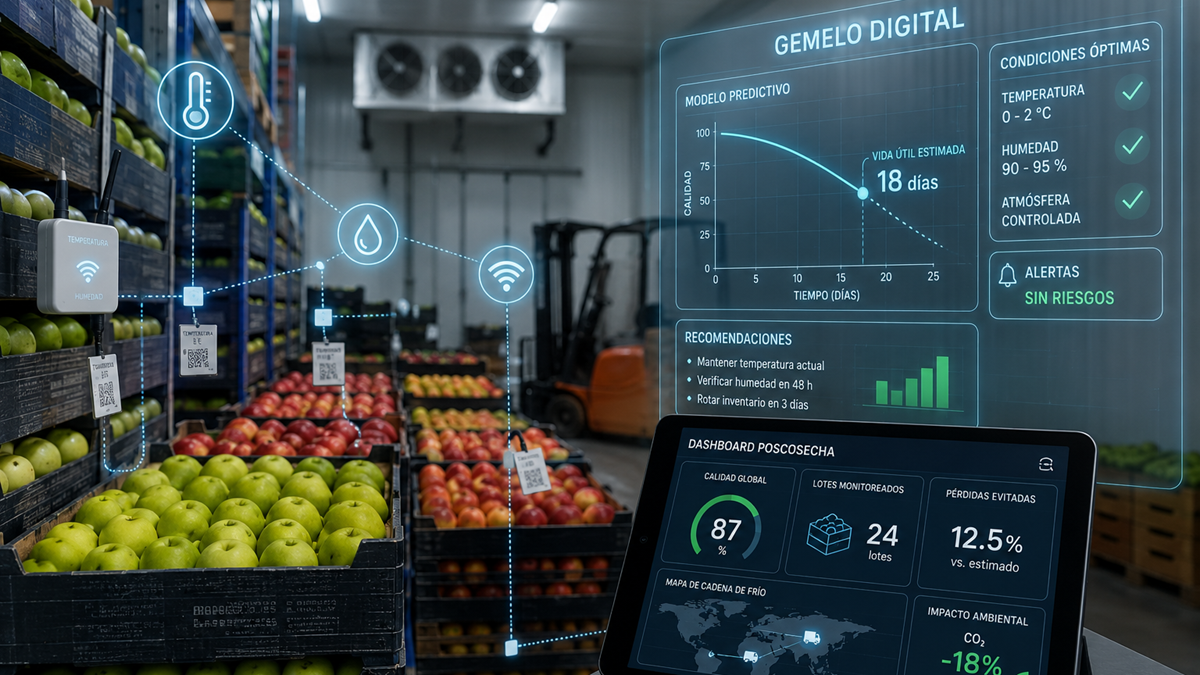
The article also highlights the potential of artificial intelligence, machine learning and connected sensors to anticipate quality problems, detect deviations in the cold chain and support more precise decision-making during storage and distribution. However, adoption depends on factors such as cost, available infrastructure, data interoperability and technical training.
Solutions adapted to each region
One of the central ideas of the review is that there is no single solution for all contexts. Postharvest strategies must be adapted to agroecological conditions, energy access, infrastructure, regulatory frameworks and supply chain type. In tropical or resource-limited regions, low-cost solutions, bioactive coatings, evaporative cooling or passive modified atmospheres may be more feasible, while in regions with more developed cold chains, sensors, hyperspectral imaging and precision atmosphere control gain prominence.
The review concludes that postharvest deterioration is a complex process driven by the interaction between pathogen activity, physiological degradation, environmental stress and supply chain constraints. Effective management therefore requires integrated approaches combining biological preservation, optimised storage conditions, intelligent monitoring and context-sensitive solutions.
Source
M.J. Gidado, Ahmad Anas Nagoor Gunny, Asgar Ali, Lise Korsten, Monisha Devi, Environmental and external determinants of postharvest storage: Impacts, challenges, and sustainable mitigation strategies, Food Chemistry Advances, Volume 11, 2026, 101290, ISSN 2772-753X, https://doi.org/10.1016/j.focha.2026.101290.