News
Polymeric biocoatings for quality preservation of fruits
Deep Review, by Culqui-Arce et al., about Polymeric Biocoatings for Postharvest Fruit Preservation: Advances, Challenges, and Future Perspectives
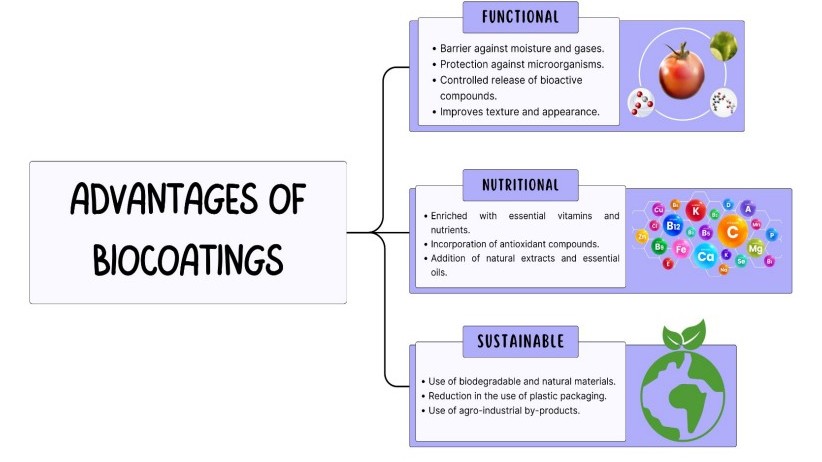
The growing demand for fresh fruit, coupled with high postharvest losses, highlights the need for sustainable and effective preservation technologies.
In this context, polymeric biocoatings are emerging as a promising alternative to conventional synthetic packaging, thanks to their biodegradability, film-forming capacity, and potential to incorporate bioactive compounds.
This review article summarizes recent advances in the development of coatings based on polysaccharides, proteins, and nanomaterials, analyzing their physicochemical, functional, and sensory properties, and the main conventional and emerging application methods used in fresh fruit.
It also highlights the role of phenolic compounds and essential oils as antioxidant and antimicrobial agents, along with the valorization of agro-industrial by-products under circular economy schemes. Finally, it discusses the challenges associated with standardization, industrial scaling, and consumer acceptance, proposing future perspectives aimed at designing multifunctional systems that extend the shelf life and improve the quality of fresh products, in line with environmental sustainability objectives.
Unlike recent reviews, this work unifies structure–function relationships with quantitative comparisons of coating performance across fruits. It further contributes a critical evaluation of emerging application technologies and their technological and regulatory readiness, offering a distinctly more integrated perspective
1. Introduction
Global fruit production is increasing due to rising demand driven by improved living standards, favorable public policies, and growing global awareness about the benefits of fruit consumption. According to the Food and Agriculture Organization [1] and official data [2], global fruit production reached approximately 908 million tons in 2023, representing a nearly 68% increase compared to 2000.
These figures are derived from consolidated historical records and reflect a sustained upward trend driven by rising global demand and the agricultural expansion of tropical and subtropical regions. However, post-harvest losses remain a major challenge, with an estimated 40% to 50% of fruit lost due to inadequate harvesting and storage and adverse environmental conditions [3].
In this context, postharvest losses are reduced to the quantity and quality of the fruit, mainly due to metabolic processes such as respiration and transpiration, as well as physical damage and unwanted chemical reactions [4]. These processes release CO2 and ethylene, which accelerate ripening and, consequently, deterioration [5]. In addition, their high water content (70–90%) increases their susceptibility to microbial growth, mechanical damage, and moisture loss.
These effects are exacerbated by poor handling, lack of pre-cooling, and inadequate storage temperature control [6,7]. Therefore, reducing postharvest losses becomes an urgent concern that requires attention. The approach of preserving fruit by slowing down internal metabolism and limiting the penetration of external agents through the use of packaging demonstrates a practical approach [8,9].
There are different types of materials used for fruit packaging, which are classified as biodegradable and non-biodegradable. Currently, it is common to use nonbiodegradable packaging made from plastics and chemical compounds [10]. In this regard, non-biodegradable packaging has a significant environmental impact, affecting both terrestrial and marine ecosystems [11].
On the other hand, biodegradable packaging materials offer advantages over synthetic plastics, such as biodegradability, compostability, and the use of renewable resources [12]. Therefore, biodegradable packaging, especially edible coatings for fruit preservation, is considered a sustainable green approach that is receiving a lot of attention [6].
Biocoating is a preservation technique that involves applying a polymer layer to the surface of fruit and other foods. Its purpose is to inhibit microbial activity, reduce oxidation, and protect against external contaminants [13].
Biopolymers are often chosen because they are biodegradable. In this regard, biocoating technology for fruit packaging allows the use of biopolymers derived from polysaccharides, proteins, lipids, and their derivatives, originating from plant and animal sources [14]. Some natural polymer components used for biocoating technology include alginate, carrageenan, chitosan, collagen, pectin, cellulose, starches, lignin, and waxes, among others [15].
However, the efficiency of edible coatings depends on the type of biopolymers in their composition and the interaction these compounds may have with packaged foods [16].
It should be noted that one of the important characteristics of packaging biocoatings is their ability to serve as carriers of active substances such as antimicrobial compounds, which can extend the post-harvest shelf life of fresh produce. In this regard, essential oils are one of the most widely used active compounds in packaging films for fruit preservation [16].
However, compared to synthetic plastic-based biocoatings and films, polysaccharide-based biocoatings and films have certain limitations, including high hydrophilicity and poor mechanical properties [17].
To overcome these challenges, extensive efforts have been undertaken to enhance the physical performance of polysaccharide-based biocoatings and films through various strategies, including polysaccharide modification, the use of layer-by-layer (LBL) assembly, and the incorporation of reinforcing fillers [18–20].
In addition to strengthening mechanical properties and reducing hydrophilicity, the use of polysaccharides to produce active and intelligent packaging has become a prominent area of research. One approach involves adding bioactive compounds, such as phenolic compounds or extracts rich in polyphenols, to formulate multifunctional films and coatings [21], producing active and/or smart packaging.
Phenolic compounds are widely distributed in various plant sources, such as fruits, vegetables, cereal grains, and legumes, and exhibit considerable functional and structural diversity [22]. Given their unique functional groups, phenolic compounds can be incorporated into polysaccharide films and coatings to improve their functional and mechanical properties [23].
Furthermore, the incorporation of phenolic compounds into polysaccharide-based coatings and films has been shown to enhance their antimicrobial activities, as these compounds exhibit a pronounced capacity to inhibit microbial growth and delay fruit spoilage.
This article aims to summarize recent advances in the development and application of polymeric biocoatings for the postharvest preservation of fruits, with particular emphasis on the main types of polymers employed, the incorporation of bioactive compounds, and the existing challenges associated with their implementation.
In addition, prospects are discussed with the aim of contributing to the design of sustainable and effective solutions capable of reducing postharvest losses and improving the quality of fresh produce.
Although the number of review studies dedicated to edible coatings has increased between 2024 and 2025, several aspects remain insufficiently explored in the current literature.
Analyses directly addressing the structure-function relationship of polysaccharides in postharvest applications are still scarce, as are quantitative comparisons assessing how different formulations influence the physiological responses of specific fruits such as citrus, berries, and tropical species.
Similarly, the discussion of emerging application technologies, such as nanoemulsions, layer-by-layer assembly, and electrospinning, remains limited, particularly about their technological maturity and associated regulatory constraints.
References related to non-fruit food matrices, such as meat or indicator-based systems, are cited exclusively for contextual or methodological comparison and are not discussed as direct applications.
All analyses and conclusions in this review are strictly framed within the context of postharvest fruit preservation. Therefore, this review seeks to bridge these knowledge gaps through a functional and comparative approach supported by quantitative data, with the aim of elucidating their implications for industrial scalability and practical implementation.
Contents
2. Search Methodology
3. Properties of Biocoatings
3.1. Materials Key in Biocoatings
3.2. Physico-Mechanical and Barrier Properties
3.2.1. Mechanical Properties
3.2.2. Water Vapor Permeability
3.2.3. Solubility
3.2.4. Viscosity
3.2.4. Viscosity
3.3. Functional Properties
3.3.1. Antimicrobial Activity
3.3.2. Antifungal Activity
3.3.3. Emulsifying Properties
3.3.4. Sensory and Optical Properties (includes Table 1**)
4. Natural Polymers Used in Biocoatings (includes Table 2 **)
5. Methods of Applying Biocoatings to Fruit
5.1. Conventional Methods
5.2. Emerging Methods (includes Table 3**)
5.3. Selection Criteria by Fruit Type and TRLs, Technology Readiness Levels
6. Regulatory Section and Industrialization
7. Incorporation of Bioactive Compounds
8. Reinforced Quantitative Examples and Sensory Implications (Including Table 4**)
9. Future Prospects
The development of polymeric biocoatings for fresh fruit still faces challenges that limit their scalability and industrial adoption.
These include the variability in the properties of natural biopolymers, the need to standardize evaluation methodologies under real post-harvest conditions, and the costs associated with emerging technologies such as electrospinning or nanoemulsification.
Likewise, strengthening the compatibility between bioactive compounds and polymer matrices is a priority, as inadequate interactions can compromise the functionality and structural stability of the coating.
In the short and medium term, opportunities are emerging in the integration of green extraction technologies (such as natural eutectic solvents, ultrasound, or microwaves) for the sustainable production of phenolic compounds and essential oils from agro-industrial by-products, which is in line with the principles of the circular economy.
Similarly, the incorporation of nanomaterials such as nanocellulose, metal nanoparticles, or hybrid biocomposites opens up the possibility of designing smart coatings with the ability to respond to environmental changes (pH, temperature, or presence of pathogens).
In view of the escalation, it will be essential to establish clear regulatory protocols that guarantee food safety and consumer acceptance.
At the same time, research must move toward multifunctional systems that, in addition to extending shelf life, provide nutritional benefits, improve sensory appearance, and reduce the environmental footprint throughout the supply chain.
Together, these approaches will consolidate biocoatings as a competitive alternative to conventional plastics in the food industry.
Furthermore, based on the authors’ analysis, future progress in this field will require:
- developing cost-effective and scalable production processes for natural biopolymers;
- standardizing physicochemical, microbiological, and shelf-life evaluation methods under real storage and distribution conditions;
- optimizing encapsulation and controlled release systems for bioactive compounds to ensure their stability and functionality;
- integrating circular economy strategies to obtain functional compounds from agro-industrial waste; and
- establishing regulatory frameworks that support the use of edible biocoatings while ensuring food safety and transparency for consumers.
These aspects will be fundamental to accelerating technology transfer and enhancing the commercial viability of polymeric biocoatings as a sustainable alternative to conventional plastic packaging.
10. Conclusions
Polymeric biocoatings represent a sustainable and effective tool for mitigating postharvest fruit losses by combining the action of natural polymers with the incorporation of bioactive compounds of plant origin. Recent evidence shows that these technologies help preserve quality parameters such as firmness, color, flavor, and nutritional content, in addition to conferring antimicrobial and antioxidant properties.
Although the results obtained in laboratory conditions are encouraging, large-scale implementation requires overcoming limitations associated with production costs, formulation standardization, consumer acceptance, and regulatory validation.
Despite this, advances in nanotechnology, green encapsulation, and agro-industrial waste recovery allow us to project a favorable scenario for its consolidation in the food industry.
In conclusion, polymeric biocoatings are not only an innovative strategy for extending the shelf life of fresh fruit, but also promote the transition to healthier, biodegradable packaging systems that are aligned with global sustainability goals.
To complement these conclusions, the key insights and actionable research priorities derived from this review can be summarized as follows:
I. Polymeric biocoatings show strong potential to extend the shelf life of fresh fruits by integrating natural polymers with antimicrobial, antioxidant, and barrier-active compounds.
II. The performance of these systems depends heavily on polymer type, formulation strategy, and application method, which determines coating uniformity, controlled release, and overall fruit quality.
III. Emerging approaches, including nanoemulsions, nanocellulose-based systems, and electrohydrodynamic technologies, offer promising functional advantages but still require optimization for industrial scalability.
IV. Standardizing postharvest evaluation protocols under realistic storage, distribution, and retail conditions is essential to ensure comparable datasets and accelerate technological adoption.
V. Developing scalable controlled-release systems (such as nanoemulsions or polymer–phenolic complexes) remains a priority to maintain stability, reduce the required load of active compounds, and preserve sensory quality.
VI. Advancing the use of circular economy inputs such as phenolics, essential oils, and polysaccharides extracted from agro-industrial by-products through green and lowenergy extraction techniques will be critical for reducing formulation costs and strengthening sustainability
** Content of the Tables
Table 1 - Properties of films and coatings applied to fruit, summarizes Mechanical properties, Water vapour permeability, Antimicrobial, Antifungal, Optical, Antioxidants, Solubility, Viscosity, Emulsification, Adhesion / coverage, Enzymatic, and Biodegradability of the following Raw Material /Systems: Soy protein + epoxidized castor oil, Starch + chitosan, Sodium caseinate + beeswax, Starch + gluten + carnauba wax, Chitosan + olive oil, Gelatin, Chitosan + oregano essential oil, Tea extract (polyphenols), Natural antioxidants, Chitosan + rosemary extract, Breadfruit starch, Starch + chitosan, 1% chitosan solutions, Pickering with nanocellulose, Nanoemulsions with essential oils, Chitosan + glycerol, Alginate + green tea extract, and Starch films + PLA (poly lactic acid)
Table 2 - Natural polymers used in biocoatings for fruit, explains Origin/Nature, Key Properties, Applications, and Key Limitations of Chitosan, Starch, Pectin, Hydroxypropyl methylcellulose, Carboxymethyl cellulose, Alginate, Carragenan (kappa), Pullulan, Gellan gum, Xanthan gum, Gelatin, Zein, Whey proteins, Nanocellulose, Arabic gum)
Table 3 - Technological approaches for biocoating applications on fruits, telling about Main advantages, Main limitations, and Application on Fruit for the following methods: Dip coating, Spraying,, Brushing / manual, Electro-spinning, Electro-Spraying, Fluidized bed, and Nanoemulsification / Atomization)
Table 4 - Representative polysaccharide-based edible coatings applied to major fruit groups and their quantitative effects on postharvest quality.)
Source
Polymeric Biocoatings for Postharvest Fruit Preservation: Advances, Challenges, and Future Perspectives
Carlos Culqui-Arce 1,2 , Luz Maria Paucar-Menacho 3, Efraín M. Castro-Alayo 1, Diner Mori-Mestanza 1, Marleni Medina-Mendoza 1, Roberto Carlos Mori-Zabarburú 1, Robert J. Cruzalegui 1, Alex J. Vergara 1, William Vera 2,4 , César Samaniego-Rafaele 2,5 , César R. Balcázar-Zumaeta 1 and Marcio Schmiele 2,6,*
Polysaccharides 2026, 7, 12https://www.researchgate.net/profile/Cesar-Balcazar-Zumaeta/publication/400024683_Polymeric_Biocoatings_for_Postharvest_Fruit_Preservation_Advances_Challenges_and_Future_Perspectives/links/6973795052773b62239cee7d/Polymeric-Biocoatings-for-Postharvest-Fruit-Preservation-Advances-Challenges-and-Future-Perspectives.pdf
Picture is Fig. 1 of the original paper, Advantages of biocoatings
1 Instituto de Investigación, Innovación y Desarrollo para el Sector Agrario y Agroindustrial (IIDAA), Facultad de Ingeniería y Ciencias Agrarias, Universidad Nacional Toribio Rodríguez de Mendoza de Amazonas, Chachapoyas 01000, Peru; carlos.culqui@untrm.edu.pe (C.C.-A.); efrain.castro@untrm.edu.pe (E.M.C.-A.); diner.mori@untrm.edu.pe (D.M.-M.); marleni.medina@untrm.edu.pe (M.M.-M.); roberto.mori@untrm.edu.pe (R.C.M.-Z.); robert.cruzalegui@untrm.edu.pe (R.J.C.); alex.vergara@untrm.edu.pe (A.J.V.); cesar.balcazar@untrm.edu.pe (C.R.B.-Z.)
2 Programa de Doctorado en Ingeniería Agroindustrial Mención Transformación Avanzada de Granos y Tubérculos Andinos, Universidad Nacional del Santa, Nuevo Chimbote 02712, Peru; wveraj@unf.edu.pe (W.V.); 2025818007@uns.edu.pe (C.S.-R.)
3 Departamento Académico de Agroindustria y Agronomía, Facultad de Ingeniería, Universidad Nacional del Santa, Chimbote 02712, Peru; luzpaucar@uns.edu.pe
4 Grupo de Investigación en Desarrollo e Innovación en Industrias Alimentarias (GIDIIA), Universidad Nacional de Frontera, Sullana 20100, Peru
5 Escuela Profesional de Ingeniería Agroindustrial, Facultad de Ciencias Aplicadas, Universidad Nacional del Centro del Perú, Tarma 12650, Peru
6 Institute of Science and Technology, Federal University of Jequitinhonha and Mucuri Valleys, Diamantina 39100-000, Brazil
* Correspondence: marcio.sc@ict.ufvjm.edu.br

.jpg)