
TOMRA Food
Conditioning
Precision and efficiency in almond sorting
High precision, hygienic design and ease of adjustment define the performance of the TOMRA 4C in almond sorting applications
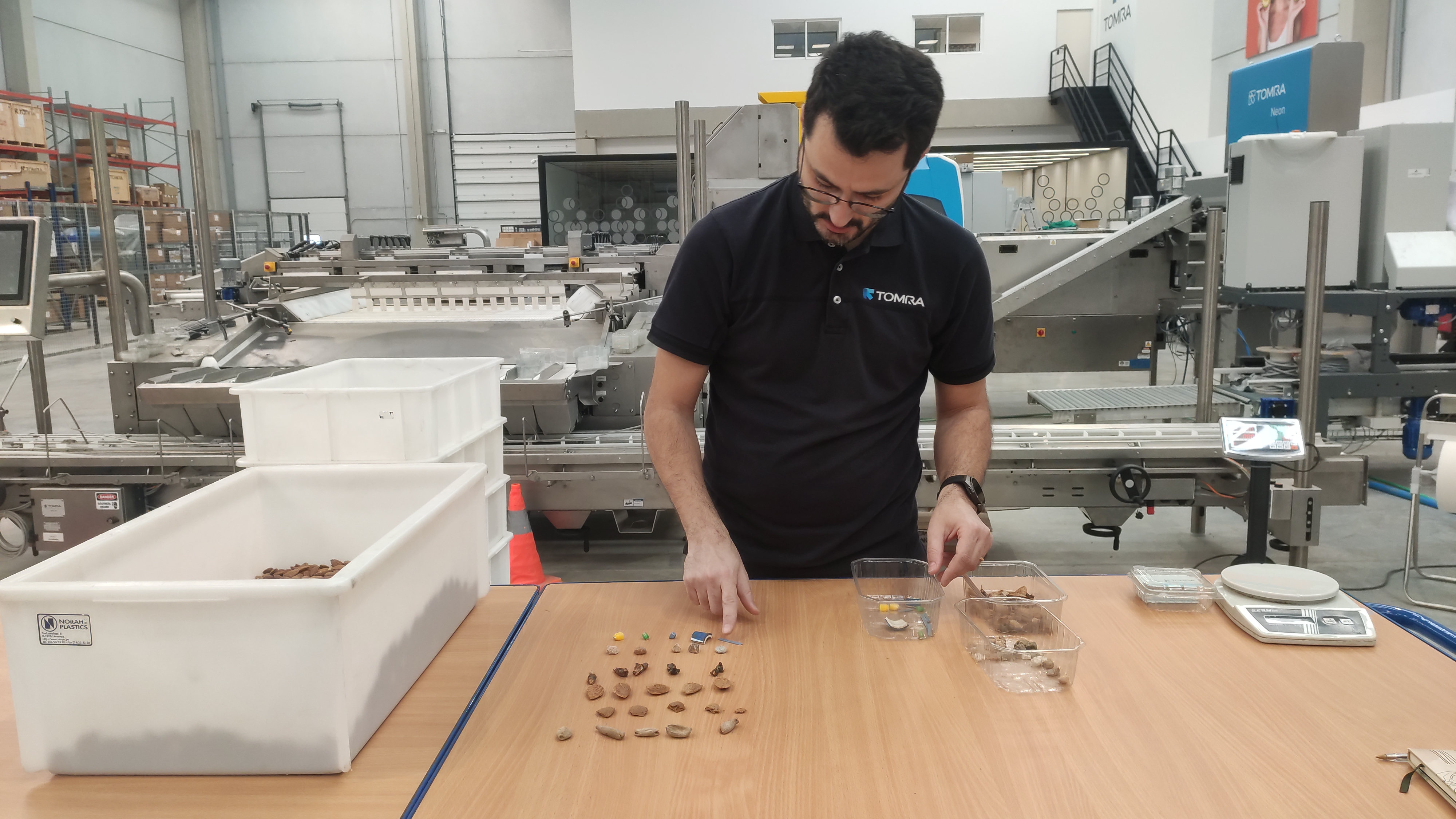
During the Demo Week organised by TOMRA Food at its facilities in Massanassa (Valencia, Spain), the company showcased the live operation of its new optical sorter, the TOMRA 4C, designed for processing nuts and IQF products. The event allowed attendees to observe the machine’s application in almond sorting, analysing its behaviour under practical test conditions and the results achieved in the separation of product, defects and foreign materials.
A test under real operating conditions
The session was led by Ender Elmas, Presales Engineer at TOMRA Food, who explained the operation of the machine before starting the demonstration. A 5 kg batch of almonds was prepared, to which plastics, stones, twigs, shells, shell fragments and almond skins were added, simulating the presence of contaminants commonly found in processing lines. Once the mixture was ready, it was fed into the sorter, and the machine carried out the separation in a single pass.
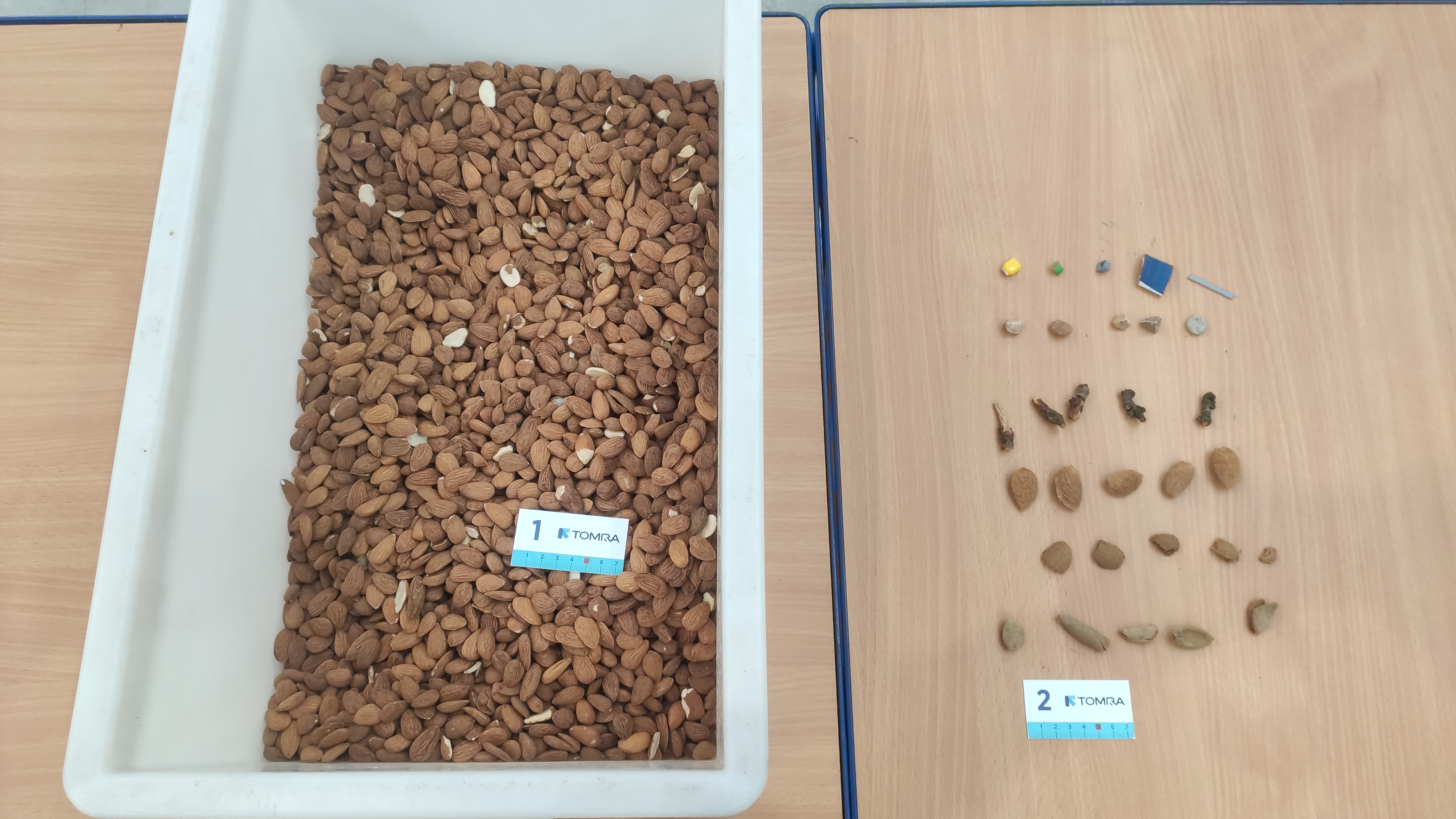
Prepared batches for the test: almonds and different foreign materials used in the demonstration
During the demonstration, Elmas showed how the multichannel detection zone, equipped with RGBi and SWIR cameras, analyses each product in free fall. The cameras capture colour and material composition, and the software determines whether the item is accepted or rejected. The decision is executed by air nozzles acting within milliseconds, ensuring that good product continues along the line while defects are removed.
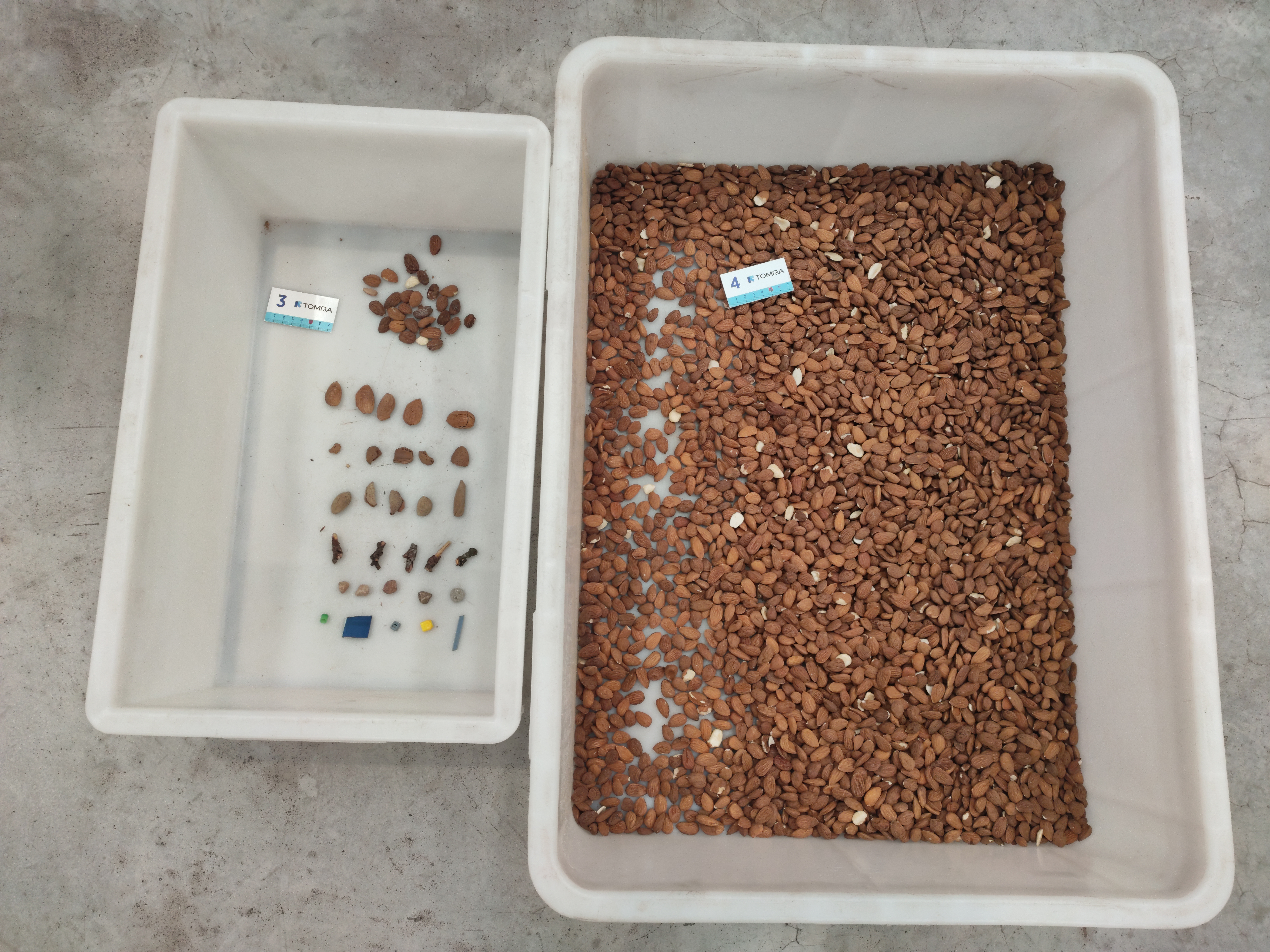
Result after processing through the TOMRA 4C: accepted product and rejected material separated
After the pass, the rejected material was weighed to calculate false rejects, defined as the amount of good almonds removed together with defects. The result was 16.3 grams out of 5 kg, equivalent to 0.33%, a very low value and consistent with the performance figures reported by the company for nut applications, with accuracies above 97% and false reject rates below 1%.
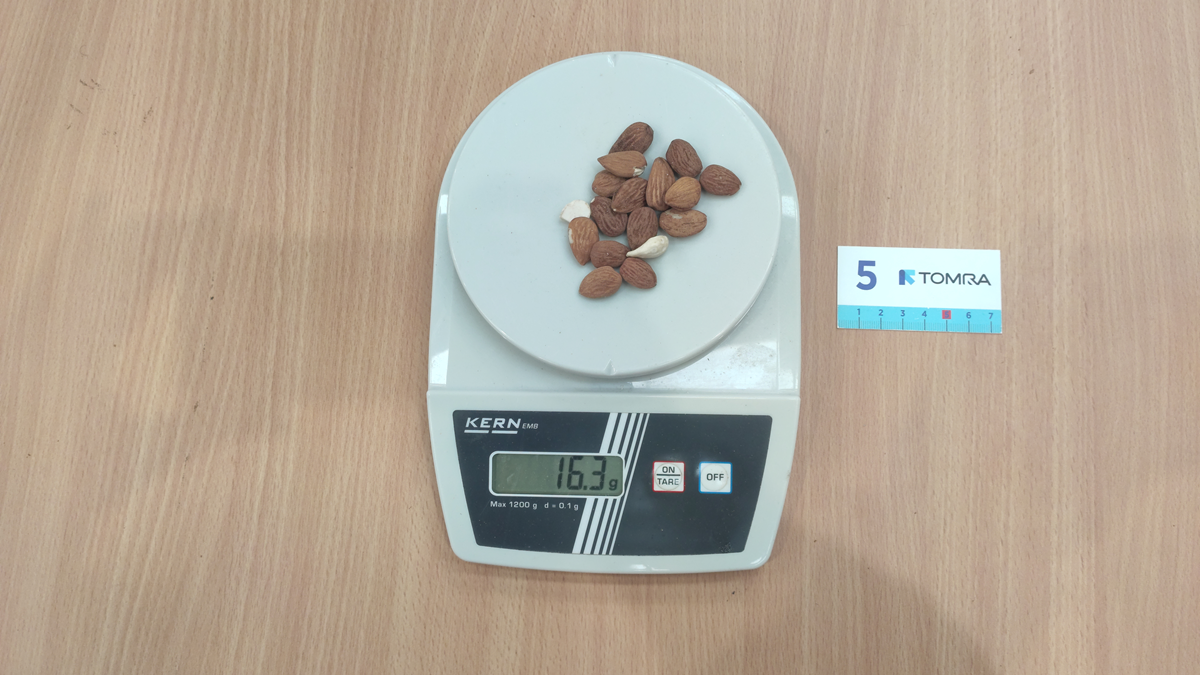
False reject recorded after the test: 16.3 g out of 5 kg of almonds (0.33%)
Technology and design focused on efficiency
The TOMRA 4C combines traditional machine learning with LUCAi™, TOMRA’s artificial intelligence system, developed to improve the detection of complex defects and increase process stability. This combination of algorithms allows the machine to learn from thousands of images and adapt to different raw materials, enabling finer parameter control and consistent performance even when product quality varies. As a result, operators can work with optimised settings that reduce reliance on prior experience and shorten adjustment times.
The machine’s design also responds to operational efficiency and hygienic maintenance requirements. Its structure avoids right angles, preventing the accumulation of dust or product residues and simplifying cleaning tasks. Large doors and easy access to inspection areas facilitate maintenance, while calibration can be carried out in just a few minutes. The system is designed for easy integration into both new and existing lines, with different widths and configurations available to suit customer requirements.
Results under real conditions
The demonstration in Valencia confirmed the stable performance of the TOMRA 4C in almond sorting, maintaining a clean and continuous product flow with minimal loss of marketable product. Attendees were able to verify how foreign materials and defects are removed accurately even in complex mixed conditions, without the need for reprocessing. The 0.33% false reject rate demonstrates that, with a well-adjusted recipe, it is possible to achieve high product purity while maximising yield.
In addition to precision, the machine stands out for its versatility. It can be installed at different points along the line, either as a pre-sorting stage or as a final control, and allows the level of sorting “aggressiveness” to be adjusted according to customer standards. This flexibility, combined with its compact design and ease of maintenance, makes the TOMRA 4C a valuable tool for processors seeking to optimise efficiency and reduce waste. With large-scale trials carried out in different plants, the TOMRA 4C positions itself as a reliable and durable solution for the nut processing industry.
News of TOMRA Food
.jpg)
TOMRA places sustainability and the circular economy at the heart of its strategy
.jpg)
TOMRA Food