News
Lifelong training in horticultural postharvest: the voice of experts
Roundtable at the IX Postharvest Technology Course at UPV
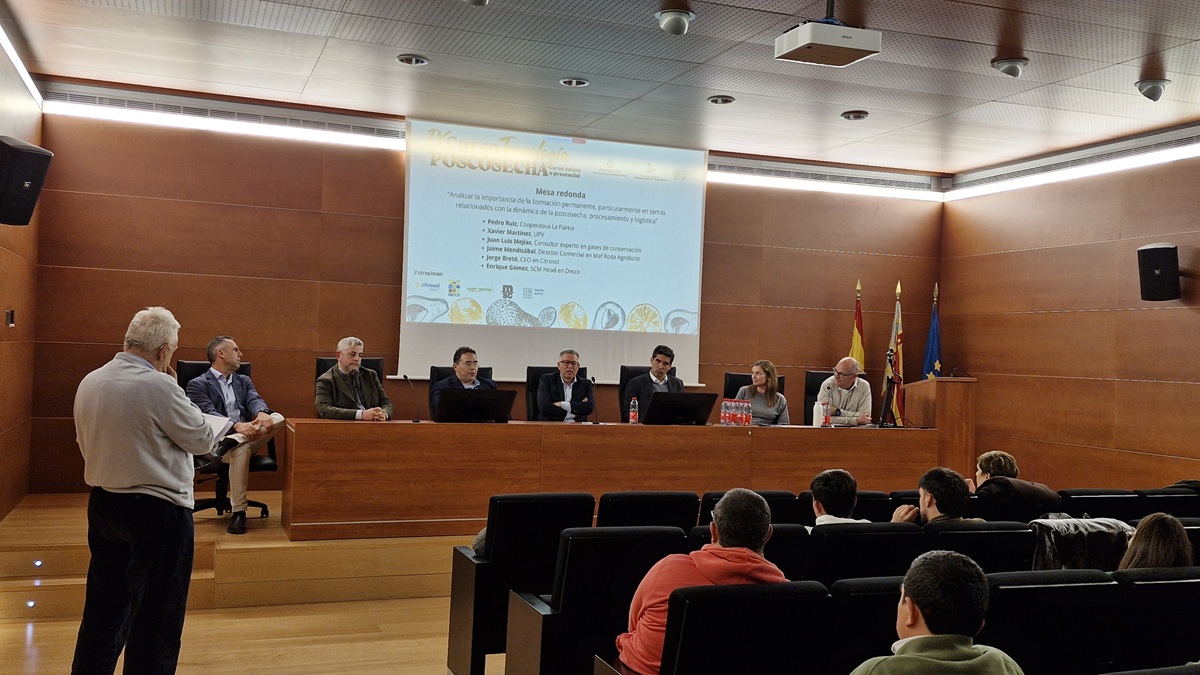
The roundtable held on 5 March 2026 during the IX Postharvest Technology Course at the Universitat Politècnica de València (UPV) highlighted lifelong training as a key competitiveness factor for fruit and vegetable packinghouses. In an increasingly complex technical environment, continuous knowledge updating directly influences final quality, reduces losses and shortens response times when operational issues arise.
The discussion connected technology, people and knowledge management around a practical idea: postharvest systems perform effectively when technical expertise is kept up to date and applied with discipline.
Technical insights that shaped the debate
The debate emphasized the need for continuous training built on verifiable content and focused on real operational challenges, since the abundance of information does not always translate into correct decisions. Postharvest management integrates physiology, maturity assessment, precooling, storage, postharvest disease control and logistics. This combination makes continuous learning within organisations essential.
Speakers also stressed that quality and shelf life begin in the field, where crop management, nutrition and harvest timing strongly influence storage performance and tolerance to physiological disorders.
Enrique Gómez, SCM Head at Decco, linked improvements in postharvest performance to the availability of professionals capable of providing continuous technical support to companies, particularly when variables such as temperature, relative humidity, ethylene and pathogen risk interact. In this context, ongoing training within packinghouses becomes an internal capability that supports diagnosis and effective technical communication with suppliers and specialists.
The roundtable also included insights from Jaime Mendizábal, Commercial Director at Maf Roda Agrobotic, who addressed the transformation taking place in grading and sorting operations. Increasing automation and data use are raising the level of expertise required to operate, interpret and optimise processing lines.
Jorge Bretó, CEO of Citrosol, shifted the discussion towards talent development and highlighted the value of industry internships as a pathway to train professionals capable of contributing from the first day on the job. This approach aligns with a well-known sector reality: the learning curve accelerates when staff experience real processes, manage incidents and understand how each decision affects final product quality.
Overall, the speakers agreed that technology and skills development must progress at the same pace, since investment without training often leads to underutilised equipment, quality deviations and inconsistent commercial results.
Practical implications for packinghouses and technical teams
The first practical recommendation is to turn lifelong training into a structured work process. This requires an annual training plan prioritising operational risks and critical control points, from precooling to storage and dispatch. Such plans should include topics such as physiology and maturity, ethylene management, prevention of physiological disorders, postharvest pathogen control and verification of cold chain parameters through monitoring and internal audits.
The second recommendation focuses on strengthening technical support and specialised advisory services, ensuring that incidents are addressed through clear protocols, defined responsibilities and response times compatible with the product’s shelf life.
The third recommendation relates to grading and sorting operations, where teams should be trained to interpret data, adjust parameters and manage variability, avoiding decisions based solely on perception or inherited routines. When grading systems rely on automation and data analytics, value emerges when staff understand what the system measures, how maturity affects results and how these factors influence batch consistency, claims and commercial performance.
The fourth recommendation prioritises learning in real operational environments through company internships and internal rotations. This approach improves coordination between quality, production, maintenance and logistics teams while reducing errors caused by limited operational context.
The roundtable concluded with a clear message for the sector: lifelong training has become a key indicator of resilience in the face of technological change and evolving market demands. The next operational step is to audit knowledge gaps by process and product and translate them into measurable training actions linked to indicators such as losses, claims and shelf-life stability. Immediate attention should focus on ensuring consistency between field decisions, precooling conditions and storage parameters, as this continuity ultimately defines the quality that reaches customers and consumers.