News
Multilayered endogenous defense systems by fruits and vegetables
The paper by Linxiang Qiao et al. review physical and chemical barriers that provide the first line of resistance and the defense signaling, coordinated by Ca2+, SA, JA, ET, and phenylpropanoids
Postharvest fungal diseases are major drivers of losses, quality deterioration, and food safety risks in fruits and vegetables worldwide. Although synthetic fungicides have long been used for disease control, their extensive application has led to increasing problems of fungicide resistance, chemical residues, and environmental contamination, creating an urgent need for safer and more sustainable alternatives.
Recent studies have shown that harvested horticultural products are not passive substrates for infection, but possess a complex endogenous defense system that can restrict pathogen invasion and colonization.
This review synthesizes recent advances in the endogenous defense of fruits and vegetables against postharvest fungal pathogens, with emphasis on physical barriers, constitutive antimicrobial metabolites, induced resistance (IR), Ca2+ signaling, salicylic acid (SA), jasmonic acid (JA), ethylene (ET), hormonal crosstalk, and the phenylpropanoid pathway.
Recent progress in omics-assisted analysis is also discussed, including transcriptomics, proteomics, metabolomics, microbiome profiling, and multi-omics integration for biomarker discovery and mechanism-guided treatment design.
Finally, advances in natural products, antagonistic microorganisms, edible coatings, nano- and responsive delivery systems, and intelligent disease monitoring are evaluated in relation to their direct antifungal activity and their ability to activate host defense.
An integrated framework linking endogenous defense networks with green control technologies is proposed to support the development of efficient, low-residue, and sustainable postharvest disease management strategies.
Introduction
Fruits and vegetables are indispensable components of the human diet, providing essential vitamins, minerals, dietary fiber, and antioxidant compounds that are critical for human health (Ling et al., 2023). Postharvest losses of fruits and vegetables vary substantially according to commodity, region, and supply-chain conditions.
In developing countries, annual losses have been reported to range from 35% to 50%, particularly where storage, cooling, transportation, and packaging infrastructure are inadequate (Bagherzadeh et al., 2014). These losses not only cause substantial economic damage but also reduce food availability and place additional pressure on food security and sustainable agricultural production.
Among the various causes of harv deterioration, fungal diseases are among the major causes of postharvest deterioration (Parafati et al., 2015). Pathogens such as Botrytis cinerea (B. cinerea), Penicillium spp. (P. digitatum and P. italicum), Alternaria spp., Rhizopus stolonifer, Colletotrichum spp., and Fusarium spp. commonly invade fruit and vegetable tissues through wounds generated during harvesting, packaging, transportation, and storage (Taghavi et al., 2018).
Among them, B. cinerea is ranked as the one of the most economically important postharvest fungal pathogens. worldwide because of its broad host range and the enormous economic losses it causes annually, and it has become a representative model for dissecting the molecular basis of postharvest fungal pathogenicity (Dean et al., 2012).
In addition, several postharvest fungal genera, particularly Penicillium, Alternaria, and Fusarium, are able to produce mycotoxins with genotoxic, nephrotoxic, carcinogenic, and teratogenic effects, thereby extending the impact of postharvest diseases beyond economic loss to a serious public health concern (Table 1 in the original paper; see Sources, below) (Huang et al., 2021; Li et al., 2015; Sanzani et al., 2016).
Conventional management of postharvest fungal diseases has long relied on synthetic fungicides, such as imazalil, thiabendazole, and prochloraz. Although these chemicals can provide effective disease suppression, their prolonged and intensive use has resulted in the widespread emergence of fungicide resistance, while residue accumulation on produce and in the environment has raised increasing concerns regarding food safety and ecological sustainability (Hernandez-Montiel et al., 2021; Huang et al., 2021).
Consequently, the development of efficient, low-toxicity, and environmentally friendly alternatives has become a major research priority in postharvest disease control.
Earlier views of postharvest fungal pathogenicity often described these pathogens as typical necrotrophs that kill host cells through the secretion of cell wall-degrading enzymes (CWDEs) and toxins, and subsequently derive nutrients from dead tissues (Tian et al., 2016). However, growing evidence indicates that postharvest host–pathogen interactions are far more sophisticated. Some pathogens, such as Alternaria and Colletotrichum, are capable of infecting fruit before harvest and remaining quiescent until ripening or senescence triggers disease development (Prusky et al., 2013).
Moreover, B. cinerea can promote infection not only by inducing programmed cell death in host tissues (Shlezinger et al., 2011), but also by exporting small RNAs into host cells to hijack the plant Argonaute (AGO) machinery and suppress host immunity (Weiberg et al., 2013).
These findings highlight that postharvest fungal infection is a highly coordinated molecular process rather than a simple consequence of tissue maceration (Zhang et al., 2021).
Importantly, fruits and vegetables are not passive targets of pathogen attack. Instead, they possess multilayered and dynamically regulated endogenous defense systems that can restrict fungal invasion and colonization.
Although several previous reviews have discussed fruit defense mechanisms, many have primarily focused on individual defense pathways, specific pathogens, or particular biochemical processes.
A comprehensive synthesis that connects the historical development of fruit defense research with current molecular, systems-level, and omics-based advances remains limited, especially in the context of postharvest pathology.
The present review therefore examines the progression of research from early descriptions of physical barriers and constitutive antimicrobial compounds to the current understanding of induced resistance (IR), Ca2+ signaling, hormonal crosstalk, phenylpropanoid metabolism, and integrated regulatory networks.
In addition, a dedicated section on omics technologies summarizes how transcriptomics, proteomics, metabolomics, and multi-omics approaches are being used to elucidate postharvest defense mechanisms and identify new targets for disease control.
By integrating these defense components within a unified postharvest framework and linking fundamental mechanisms with application-oriented strategies, this review provides a comprehensive perspective on the development of sustainable, multi-target approaches for controlling postharvest fungal diseases and reducing reliance on chemical fungicides.
Preformed and induced resistance
Defense against postharvest fungal diseases in fruits and vegetables does not rely on a single mechanism, but rather on a dynamic and coordinated network involving:
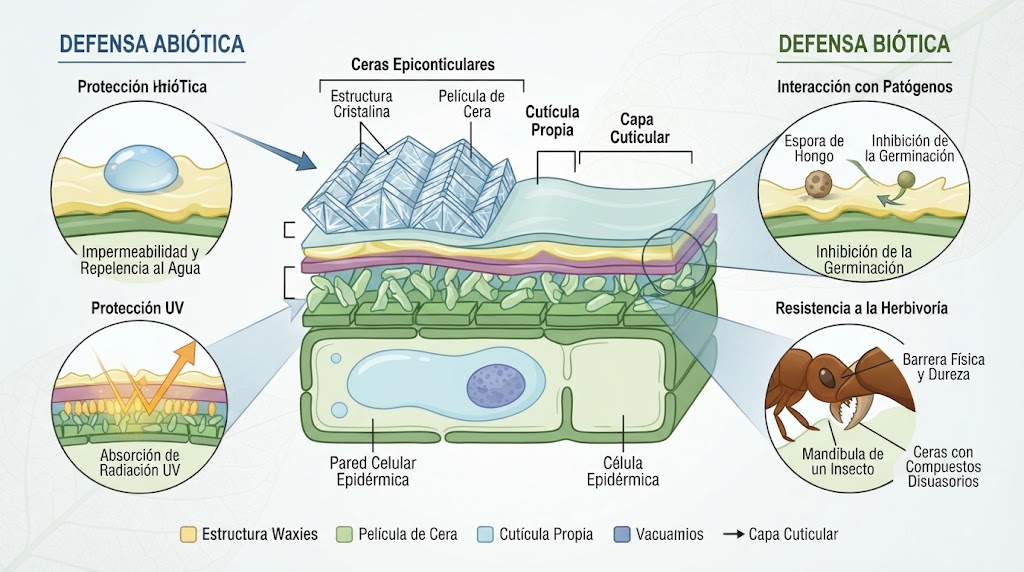
- Preformed defenses, such as the physical barriers of the fruit surface and constitutively present antimicrobial compounds in host tissues
- Induced resistance, ie, defined as a physiological state in which plants enhance their resistance to subsequent pathogen attack after exposure to specific biotic or abiotic stimuli through activation of their own defense systems. It includes:
- Ca2+ Signaling, a central hub of immune responses
- Hormonal signaling network, the regulatory center for defense responses
- Phenylpropanoid pathway, a central metabolic hub in plant defense
Omics
Omics enable better knowledge of posstharvest defense networks.
Green control strategies
Green control strategies are increasingly being developed as mechanism-based alternatives to intensive synthetic fungicide use. Rather than relying on a single antimicrobial action, current approaches combine direct pathogen inhibition, activation of endogenous fruit defenses, improvement of active-compound stability, and early disease detection.
Sources
Innate defense of fruits and vegetables against postharvest fungal pathogens: Contemporary advances in defense mechanisms and green control strategies
Linxiang Qiao, Sen Cao, Xiaoyang Zhao, Xiaohui Qi, Ziyan Qian, Caie Wu, Zhaohui Xue, Xiaohong Kou
Food Bioscience, available online 9 October 2026, article 110190
https://www.sciencedirect.com/science/article/abs/pii/S2212429226019656
DOI 10.1016/j.fbio.2026.110190
The image was created by Gemini, indicating that the summarized information is based on standard scientific principles regarding cuticle structure and its defensive functions against abiotic and biotic factors (as described in plant physiology literature—for example, in the classic works on plant cuticles by Markus Riederer and María-Cruz Matas).