News
Non-destructive evaluation of potato quality: linking pre- and post-harvest factors
The review indicates that pre-harvest factors affect potato quality and storage behavior, as well as post-harvest conditions. In addition, it highlights non-destructive techniques such as imaging and Near-Infrared Spectroscopy (NIR) for rapidly assessing quality
Potato (Solanum tuberosum) is a widely cultivated crop of global importance, serving as a starchy and energy-rich food that also contains various micronutrients and bioactive compounds. Ensuring food security for a growing population under the pressures of climate change remains a major global challenge. Due to its adaptability to different environments, potato plays a key role in supporting food security, particularly in vulnerable regions, while also holding strong commercial value.
Both pre-harvest and post-harvest factors have a significant influence on potato quality. Understanding the interaction between these factors is essential to reduce losses after harvest, guarantee food safety, and improve market value. This review examines how cultivation practices, environmental conditions, and biotic and abiotic stresses before harvest, as well as handling and storage conditions after harvest, affect microbial stability, physiological responses, nutritional and functional properties, and frying quality of potatoes.
Quality attributes such as moisture content, dry matter, starch, sugars, proteins, antioxidant levels, and color are commonly assessed using both conventional and modern techniques. In addition, non-destructive technologies like imaging and spectroscopy allow for fast and efficient quality evaluation from production in the field through to storage stages. The review also integrates recent research findings to identify key factors that either improve or degrade potato quality, while highlighting existing challenges. Finally, it explores the combined effects of pre- and post-harvest conditions and suggests future research directions to improve quality preservation and address current gaps in knowledge.
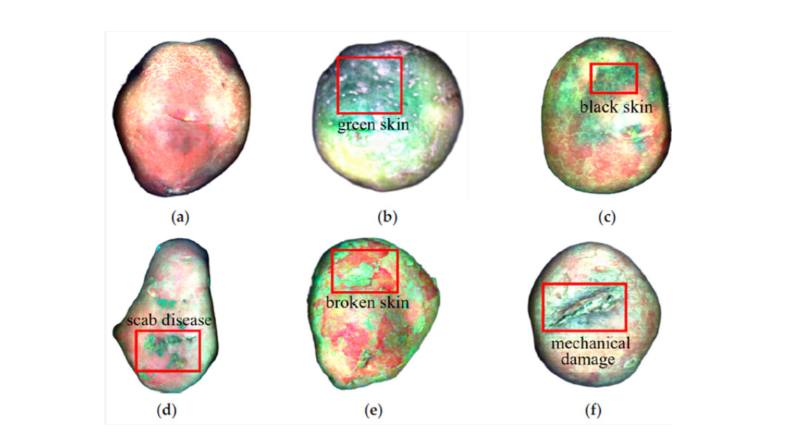
The main figure used in this work corresponds to Figure 3 of the referenced article:
Potato samples: (a) healthy skin, (b) green skin, (c) black skin, (d) scab-diseased skin, (e) broken skin, (f) mechanically damaged skin (open access)
Source
A Comprehensive Review on Pre- and Post-Harvest Perspectives of Potato Quality and Non-Destructive Assessment Approaches. Applied Sciences. MDPI.