News
Positive effects of MCPBag® bags, with Vidre+ technology, on pears and cherries
Vidre+, the technology on which MCPBag® is based, ensures the gradual release of the appropriate dose of 1-methylcyclopropene (1-MCP) according to the size of the packaging, maximizing the effectiveness of the treatment and simplifying its application during refrigerated storage
Vidre+, the technology behind MCPBag®, ensures the gradual release of the appropriate dose of 1-methylcyclopropene (1-MCP) according to the packaging size, maximizing treatment efficacy and simplifying its application during refrigerated storage.
Two studies conducted in Argentina examined the effect of applying 1-MCP using packaging that releases it gradually. One study focused on pears, a climacteric fruit, and the other on cherries, a fruit with two clearly differentiated structures in its behavior, as most varieties are marketed with the stem attached.
The Williams pear cultivar (Pyrus communis L.) exhibits a high respiration rate and rapid post-harvest ripening. The use of 1-MCP has proven effective in delaying these processes, although its traditional application requires treatment in entire chambers without the ability to differentiate between sizes, quality, or export destinations.
Cherries (Prunus avium L.), on the other hand, are non-climacteric fruits; their inclusion in the trial was motivated by recent studies suggesting that 1-MCP also promotes beneficial preservation effects in this species.
Vidre+, the technology on which MCPBag® is based, performs a programmed and gradual release of the ethylene inhibitor, simplifying its application during refrigerated storage. This technology is marketed by Janssen PMP and by the company Wassington in Argentina.
Summary of results in pears and cherries
The results obtained in the trials carried out in Argentina (please, find the summaries below) demonstrated that MCPBag® is an effective and innovative tool for extending the shelf life of Williams pears by preserving firmness and color and reducing ethylene synthesis without negatively affecting their suitability for consumption.
In cherries, these containers proved to be an effective strategy for preserving firmness and maintaining the green color of the stem, primarily in Lapins cherries.
Pear Research
Williams pears (Pyrus communis L.) exhibit a high respiration rate and rapid post-harvest ripening. The use of 1-MCP has proven effective in delaying these processes, although its traditional application requires treatment in entire storage chambers, without the ability to differentiate between sizes, quality, or export destinations.
MCPBag® is a new technology that releases 1-MCP from the packaging bag in a controlled manner, simplifying its application during refrigerated storage.
Objective and Treatments
The objective of this study was to evaluate the efficacy of MCPBag® on the ripening and quality preservation of Williams pears stored at 0±1°C and 95% RH for up to 120 days.
Two treatments (MCPBag® and conventional bags) were compared using a completely randomized design, with measurements of firmness, soluble solids, titratable acidity, Hue angle, and ethylene production during shelf life (SV) at 20°C. The internal conditions of the bags (85–90% RH and 0–1°C) after 4 days were sufficient to activate the release of 1-MCP.
Results
After 120 days of storage, the fruit packaged in MCPBag® showed a significant reduction in ethylene production. After 8 days of SV, the conventional bag reached 217.8 nl.g⁻¹.h⁻¹, while the fruit in MCPBag® reached 79.5 nl.g⁻¹.h⁻¹.
This resulted in less firmness loss: fruit in MCPBag® reached consumption maturity (≤5 lb.in⁻²) at 8 days, while fruit in conventional bags reached 9.0 lb.in⁻².
Likewise, at 8 days of shelf life, MCPBag® maintained a 23% greater Hue angle compared to the conventional bag, indicating less yellowing.
Regarding soluble solids, slight differences were observed in favor of MCPBag®, while titratable acidity showed no significant variations.
MCPBag® proved to be an effective and innovative tool for extending the shelf life of Williams pears by preserving firmness and color and reducing ethylene synthesis without negatively affecting their suitability for consumption.
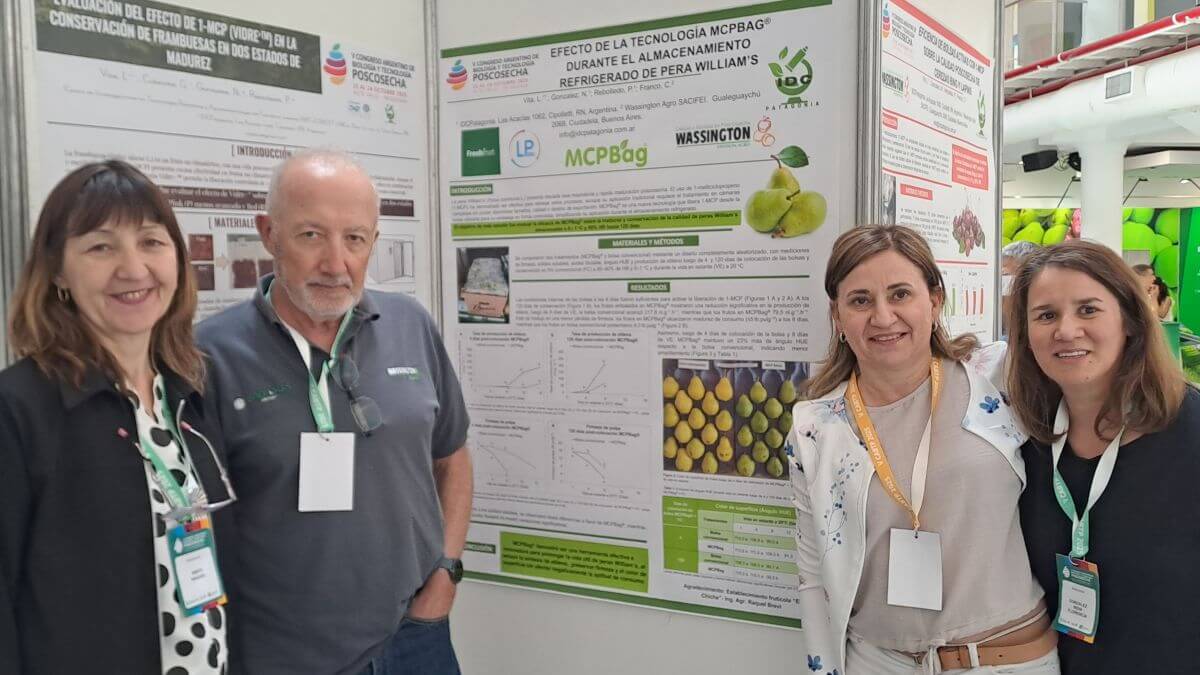
This work was carried out by Vita, L.; Gonzalez, N.; Rebolledo, P.; Franco, C., and presented the poster "Effect of MCPbag® technology during refrigerated storage of 'William's' pears"; in it, they thank the fruit farm "El Chiche" and Raquel Brevi.
Cherry Research
1-MCP is widely used in climacteric fruits to delay softening and senescence. Although cherries (Prunus avium L.) are non-climacteric fruits, recent studies suggest that 1-MCP promotes beneficial effects in postharvest preservation.
The use of active bags for sustained release of 1-MCP could constitute an innovative strategy for the refrigerated preservation of cherries.
Objective and Treatments
The objective of this study was to evaluate the effect of 1-MCP-releasing bags on two cherry varieties, Bing and Lapins, stored at 0±1°C and 95% RH. Three treatments were performed: T0 (conventional bag with 4 perforations), T1 (microperforated bag with 1000 ppb of 1-MCP), and T2 (unperforated bag with 1000 ppb of 1-MCP).
Pulp firmness, soluble solids, titratable acidity, color (hue and chroma), and stem condition were analyzed after 30 days of refrigerated storage.
Results
In Bing, firmness was significantly higher in T2, reaching 70.1 Durofel units, 9.4% higher than T0 and 4% higher than T1.
No statistically significant differences were observed in soluble solids or acidity between treatments, although T1 showed a slight reduction in °Brix (16.4) and T0 the lowest acidity (0.87%).
In Lapins, both T1 and T2 showed improved firmness compared to T0 (65.7 and 65.5 vs. 59.3), representing a 10% increase. No differences were found in soluble solids or acidity between treatments.
Color analysis showed no significant changes in Chroma in either variety. In Bing, T2 showed a significantly higher Hue value, indicating less advanced ripening.
Peduncle quality was the variable most sensitive to treatment. In both varieties, T2 maintained the highest percentage of green peduncles: 33.3% in Lapins and 19.4% in Bing, surpassing T0 and T1. Treatment T1 showed the highest incidence of necrosis (23.3% in Lapins cherries), highlighting the negative influence of microperforations on the efficacy of 1-MCP and on peduncle preservation.
These results suggest that using 1-MCP bags without perforations is an effective strategy for preserving peduncle firmness and visual quality in cherries, especially Lapins cherries.
Research conducted by Vita, L., Gonzalez, N., Rebolledo, P., and Franco, C., entitled "Efficiency of active bags with 1-mcp on the postharvest quality of 'Bing' and 'Lapins' cherries."
In the image, from left to right: Laura Vita, IDC Patagonia a consultancy company; Carlos Franco, Tech. Dept. Washington Agro SACIFE; Raquel Brevi, Establecimiento El Chicho; and Nidia González, IDC Patagonia.
More information
Both works were presented as posters at the V CABTP, V Congreso argentino de biología y tecnología poscosecha, October 2025. 21-24, Cipolletti, Neuquén, Argentina
Related news

New genomic techniques in plants: the EU agrees on a dedicated regulatory framework