News
Trichoderma and its Potential as a Tool Against Postharvest Diseases in Citrus
The antifungal efficacy of certain strains and their progressive effect open new avenues in integrated postharvest management
.jpg "The antifungal efficacy of certain strains and their progressive effect open new avenues in integrated postharvest management")
Postharvest diseases continue to be one of the main causes of economic losses in the citrus supply chain. In this context, interest in biological solutions such as Trichoderma spp. has increased, both due to their role in crop health management and their potential contribution to reducing decay during fruit storage.
The genus Trichoderma spp. comprises soil fungi that have been widely studied and used in agriculture as biological control agents and plant growth promoters. Their use is supported by a solid scientific basis and extensive practical experience across different production systems.
Trichoderma as an opportunistic symbiont
Trichoderma spp. acts as an opportunistic symbiont, colonizing the rhizosphere and, in some cases, root tissues without causing damage to the plant. This interaction allows the modulation of plant defense responses and improves stress tolerance, resulting in a better physiological status of the crop. This aspect is especially relevant in citrus, where fruit quality at harvest determines its behavior during storage and commercialization.
Antifungal role of Trichoderma
The antifungal effect of Trichoderma is based on multiple mechanisms, including competition for nutrients and space, mycoparasitism, and the production of antifungal enzymes and metabolites. These mechanisms have been widely documented against pathogens responsible for postharvest diseases in fruits and vegetables.
However, it is important to note that the efficacy observed under controlled conditions does not always translate directly to commercial scenarios, where factors such as initial pathogen load, environmental conditions, the physiological state of the fruit, or interactions with other treatments decisively influence the final outcome.
Experimental evidence in citrus
A recent study by Khuong et al. (2023) evaluated the antagonistic efficacy of different Trichoderma spp. strains against pathogens associated with postharvest diseases in citrus through direct confrontation assays.
This same study reveals the antagonistic efficacy of different have shown that at 48 hours after inoculation the strains exhibit similar antagonistic efficiency; however, at 72 hours the antifungal effect intensifies, and at 96 hours the highest levels of inhibition are achieved, with statistically significant differences observed among strains.

Antagonistic behavior of Trichoderma spp. against Colletotrichum gloeosporioides PCP-B02-A2, the causal agent of grapefruit fruit rot
These results confirm that the efficacy of Trichoderma spp. increases with interaction time and is clearly strain-dependent, which reinforces its potential as a complementary tool within integrated management programs. At the same time, they highlight a key limitation: the effect is not immediate, which reduces its ability to act as a curative treatment in situations of advanced postharvest infections.
Practical limitations in postharvest
From an operational perspective, Trichoderma spp. should not be considered a conventional postharvest treatment. Its efficacy may be influenced by factors such as:
-
Variability in the survival and activity of the microorganism on the fruit surface.
-
Interactions with fungicides, waxes, or disinfectants commonly used in packinghouses.
-
The difficulty of standardizing results under real commercial conditions, compared with the reproducibility observed in laboratory assays.
-
The need for appropriate formulations that ensure stability, viability, and compatibility with industrial processes.
Therefore, its isolated use in postharvest presents clear limitations and should not be considered a substitute for current chemical treatments.
An integrated field–postharvest approach
The available scientific evidence indicates that Trichoderma spp. should not be regarded as a conventional postharvest treatment, but rather as a tool that strengthens the link between crop health in the field and fruit performance after harvest. Experiences in other fruit crops support this approach, although results should not be directly extrapolated between species.
In a scenario marked by the reduction of chemical active ingredients and increasing market demands, the use of beneficial microorganisms such as Trichoderma spp. opens new opportunities to improve sustainability and reduce postharvest losses in citrus, always based on a solid scientific and technical foundation.
References
Harman, G. E., Howell, C. R., Viterbo, A., Chet, I., & Lorito, M. (2004). Trichoderma species—Opportunistic, avirulent plant symbionts. Nature Reviews Microbiology, 2(1), 43–56. https://doi.org/10.1038/nrmicro797
Woo, S. L., Ruocco, M., Vinale, F., Nigro, M., Marra, R., Lombardi, N., Pascale, A., Lanzuise, S., Manganiello, G., & Lorito, M. (2014). Trichoderma-based products and their widespread use in agriculture. The Open Mycology Journal, 8, 71–126. https://doi.org/10.2174/1874437001408010071
Hermosa, R., Viterbo, A., Chet, I., & Monte, E. (2012). Plant-beneficial effects of Trichoderma and of its genes. Microbiology, 158(1), 17–25. https://doi.org/10.1099/mic.0.052274-0
Zhang, H., Zheng, X., Fu, C., Xi, Y., & other authors. (2022). Biocontrol potential of Trichoderma harzianum against postharvest bitter rot of apples. Postharvest Biology and Technology, 190, Article 111961. https://doi.org/10.1016/j.postharvbio.2022.111961
Khuong, N. Q., Nguyen, T. T., Le, T. T. H., Pham, T. T. T., & Tran, T. T. H. (2023). Application of Trichoderma spp. to control Colletotrichum sp. and Pseudopestalotiopsis spp., causing agents of fruit rot in pomelo (Citrus maxima (Burm.) Merr.). Microorganisms, 11(3), Article 66. https://doi.org/10.3390/microorganisms11030066
Image source
Midgley, D. (2010). Trichoderma spp. under light microscope [Microphotograph]. Wikimedia Commons. https://commons.wikimedia.org/%E2%80%A6 Acceso en fecha 15/12/2025
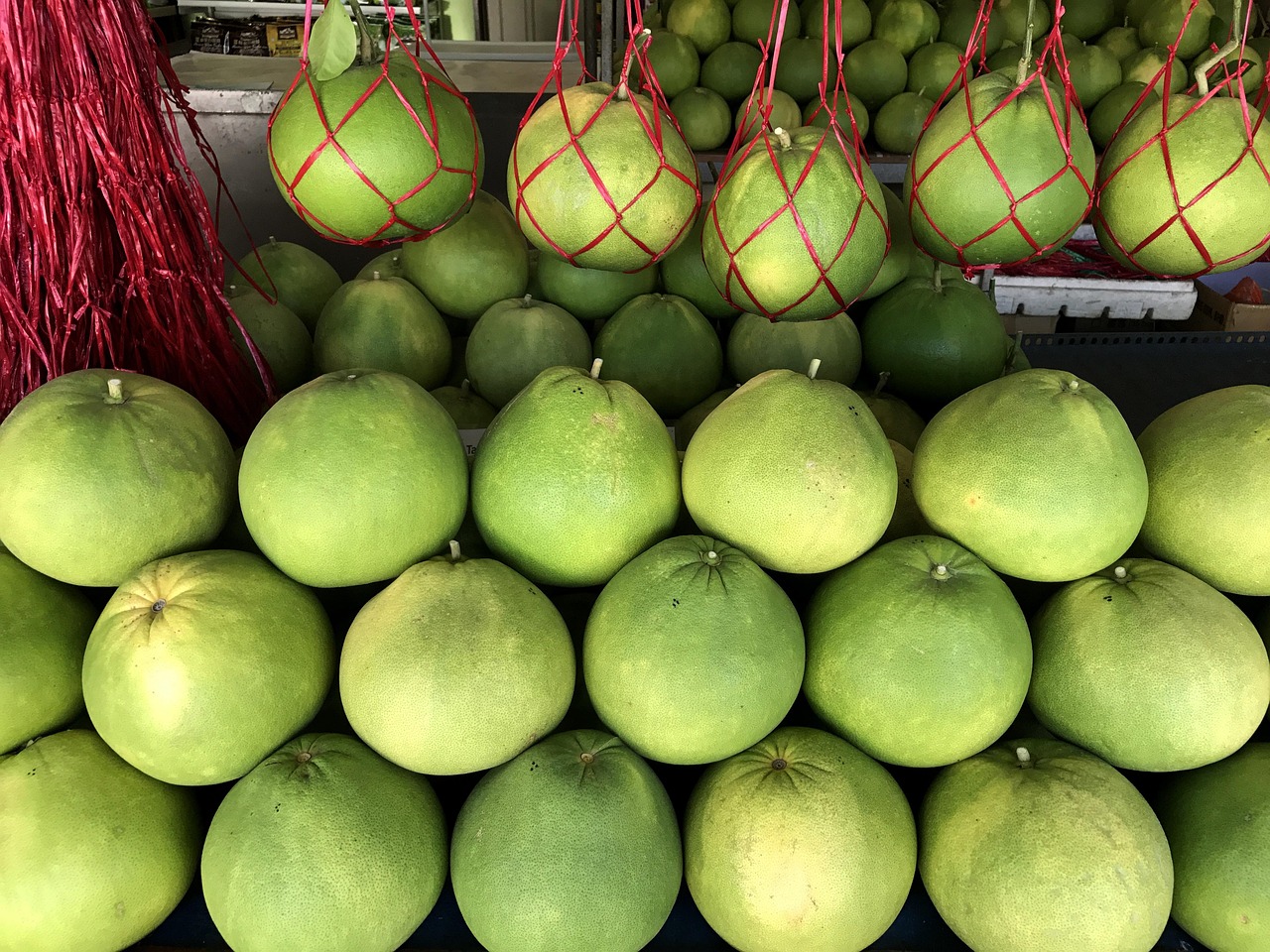
Citrus fruits (grapefruit, Citrus spp.) marketed in the local market. The image illustrates the postharvest condition of the fruits