
Xeda International
Phytosanitaries
Addressing fungicide resistance in citrus
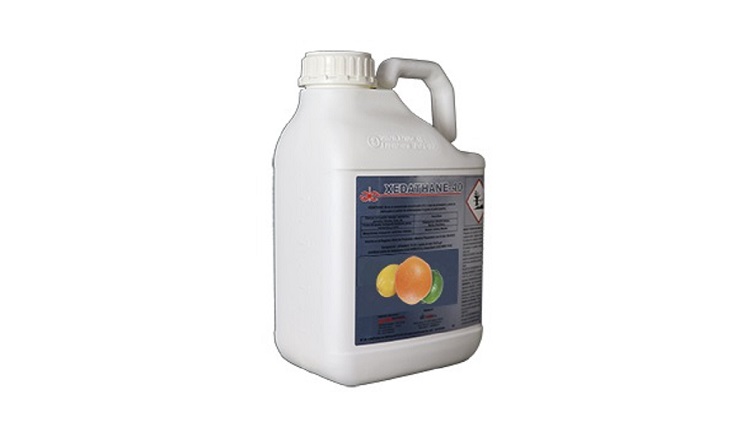
Xeda presents its brochure detailing the characteristics of its newly formulated, dual-action antifungal product: Xedathane 40
Fungi strains resistant to the benzimidazole and imidazole families of antifungals are already causing problems in the citrus postharvest industry. Thus, Xeda is presenting its brochure detailing information about its product, Xedathane 40.
Xedathane 40 is a concentrated emulsion, intended for application within the first 16 hours after citrus harvest, based on the active ingredient pyrimethanil. Pyrimethanil is a compound belonging to the anilipyrimidine family—a family separate from that of benzimidazoles and imidazoles, which are frequently used fungicides that have led to significant resistance problems among certain fungal strains.
An innovative formulation
The product’s formulation ensures its effectiveness upon application. Unlike most traditional fungicides, its formulated as a concentrated emulsion rather than a concentrated suspension. Concentrated suspensions consist of large solid particles of the active ingredient, which are suspended in the product’s liquid and tend to precipitate and sink to the bottom, sedimenting. Therefore, each application will have a different concentration of the active ingredient, which could be zero in the worst-case scenario.
In a concentrated emulsion, however, the consistency of application is much greater, since the product disperses very easily when mixed with water and sedimentation is less likely to occur. Additionally, the small particle size of the active ingredient allows it to penetrate all types of wounds susceptible to fungal infection, including micro-wounds.
Pyrimethanil: dual antifungal action
Pyrimethanil is a broad-spectrum fungicide, effective against strains that have already developed resistance to other antifungals on the market—those based on active ingredients other than pyrimethanil—as well as against a variety of fungi typical of citrus crops, such as green mold (Penicillium digitatum) and blue mold (Penicillium italicum).
Xedathane 40 differs from other fungicides in that it has two mechanisms of action. One is based on disrupting the secretion of enzymes critical for fruit infestation, such as proteases, cellulases, and pectinases—a distinctly preventive mechanism of action.
In addition, it has a mode of action based on the inhibition of methionine synthesis, an amino acid necessary for fungal growth and spore germination. This gives Xedathane 40 not only preventive, but also curative properties.
Xedathane 40 put to the test
The efficacy of Xedathane 40 was tested against that of Imazalil 500EC (500 ppm IMZ) on oranges and mandarins by inoculating the fruit with five strains of Penicillium digitallum common in Spain and allowing them to rest for 15 days at room temperature. The results were promising: the percentage of fruit with rot was lower for Xedathane 40 than for Imazalil, and, of course, well below that of the control.
A technically versatile product
Xedathane 40 is a versatile formulation that can be applied to fruit using various methods: immersion, drencher application, spraying with an aqueous solution, or direct incorporation into the wax. It is compatible with fungicides typically used in drencher systems or in-line spray applications, as well as with the most common coatings. It has established MRLs in the various consumer markets for Spanish citrus fruits, and when used according to label instructions, the average residue on the fruit is less than one-third of the MRL for the European Union.
Xeda will participate as a sponsor and speaker at the 5th Citrus Postharvest Conference, organized by Poscosecha.com, IVIA, and AgroBank, which will take place in Valencia on September 17 at AgroBank’s headquarters.
Source: Xeda Iberica
Image Source: Pixabay
News of Xeda International



Xeda International