News
Cold management in avocados determines postharvest quality
Storage temperature and cooling strategy influence ripening uniformity, internal defects and susceptibility to chilling injury
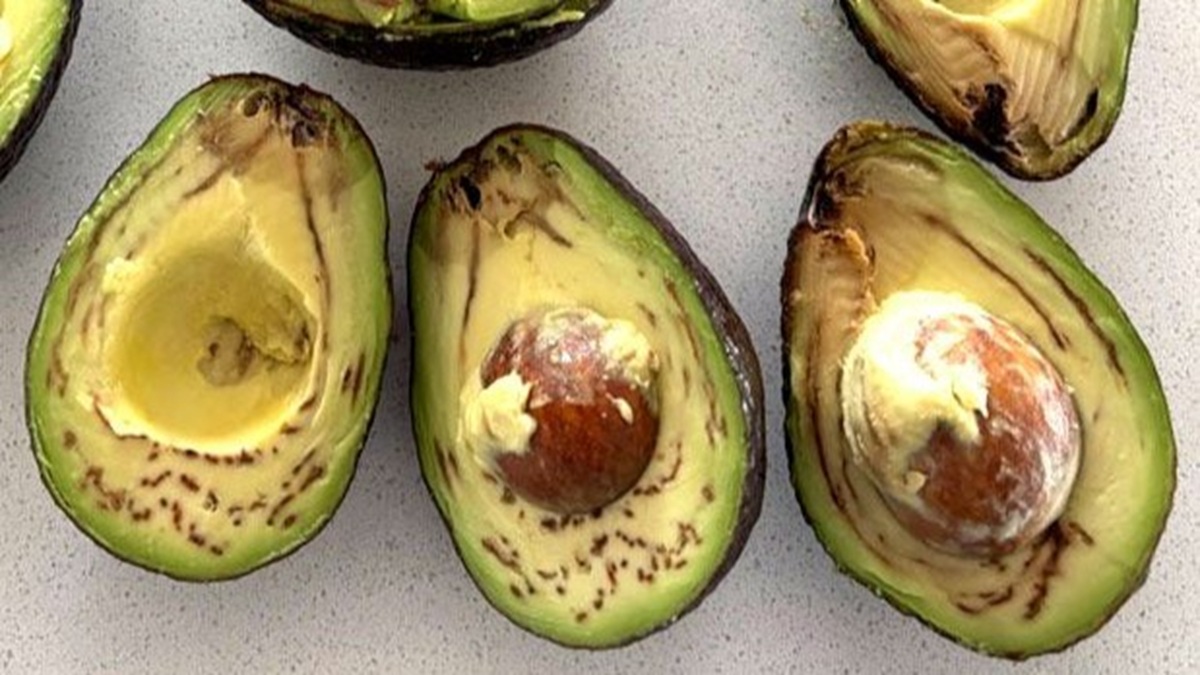
Cold storage is one of the most important tools in avocado postharvest handling, but lower temperatures do not always mean better preservation. In this fruit, the margin for error is narrow: refrigeration helps slow respiration and delay ripening, but excessive cold or prolonged exposure can lead to quality issues, often becoming visible only when the fruit leaves storage and enters the ripening phase.
According to the Postharvest Research and Extension Center at UC Davis, the optimal temperature for mature-green avocados ranges between 5 and 13 °C, depending on cultivar and storage duration, while fruit at the ready-to-eat stage should be stored at 2–4 °C with 90–95% relative humidity. The same source highlights that respiration rates increase rapidly with temperature, explaining why small disruptions in the cold chain can significantly shorten shelf life.
Cold slows ripening but may also cause damage
One of the main risks in avocado storage is chilling injury. UC Davis describes typical external symptoms such as skin pitting, scalding and blackening when mature-green fruit is held at 0–2 °C for more than seven days. With longer exposure at 3–5 °C, internal disorders may also develop, including flesh darkening, vascular browning, uneven ripening and increased susceptibility to pathogens.
This behaviour explains why avocado requires more precise temperature management than many other fruits. The objective is not simply to cool, but to do so within a narrow threshold where beneficial effects are maintained without triggering physiological damage. In practice, useful cooling and damaging cold are separated by only a few degrees and by cumulative exposure time.
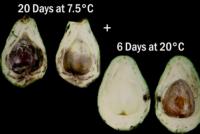
Cooling avocado damage
Cooling rate also matters
Thermal management does not begin in storage rooms but during precooling and in the time elapsed between harvest and the start of refrigeration. The FAO postharvest manual indicates that forced-air cooling can reduce cooling time to a quarter, or even a tenth, of that required under static conditions.
Similarly, the Hass Avocado Board Quality Manual states that fruit should not wait more than 24 hours before final cooling and recommends monitoring pulp temperature using sensors, ending the cooling process when at least 80% of the sensors reach the target temperature. This approach helps prevent both surface and internal tissues from dropping below safe thresholds and reduces the risk of chilling injury.
Insights from recent research
Beyond technical guidelines, experimental studies provide further insight into optimal management. Research published in Biotecnología en el Sector Agropecuario y Agroindustrial found that Hass avocados stored for 20 days at 7 °C and then ripened at 20 °C showed more uniform ripening, fewer internal defects and acceptable weight loss.
More recently, a 2024 study in Plant Physiology and Biochemistry evaluated storage at 25 °C, 5 °C, 2 °C and -1.2 °C. The results suggest that near-freezing temperatures can delay softening and reduce chilling injury symptoms. However, this strategy requires very precise control and is not directly applicable to standard commercial operations.
A matter of balance
In practice, cold management in avocados is a balance between slowing ripening and avoiding physiological disorders. Technical literature also indicates that controlled atmosphere storage may help: UC Davis reports that conditions of 2–5% oxygen and 3–10% CO₂ can delay softening and reduce chilling injury, although excessive CO₂ levels may lead to browning and off-flavours.
For this reason, rather than defining a single optimal temperature, avocado management should be understood as a cooling strategy. Factors such as cultivar, maturity stage, storage duration and cooling uniformity all influence the final outcome. In such a sensitive product, a difference of only a few degrees can determine whether fruit ripens properly at destination or develops internal defects that are not visible externally.
Sources
Postharvest Research and Extension Center, UC Davis. Avocado. Produce Facts. https://postharvest.ucdavis.edu/produce-facts-sheets/avocado Accessed 17/03/2026.
Hass Avocado Board. Avocado Quality Manual. https://hassavocadoboard.com/wp-content/uploads/Hass-Avocado-Board-Quality-Manual-Spanish.pdf Accessed 17/03/2026.
FAO. Handling and marketing of fruits and vegetables: from farm to market. https://www.fao.org/4/y4893s/y4893s06.htm Accessed 17/03/2026.
Martínez, W.; Balois, R.; Alia, I.; Cortes, H.; Palomino, R.; López, M. Physicochemical changes in Hass avocado during storage and ripening. Biotecnología en el Sector Agropecuario y Agroindustrial. https://dialnet.unirioja.es/descarga/articulo/8009487.pdf Accessed 17/03/2026.
Qin, Y.; et al. (2024). Near-freezing temperature suppresses avocado fruit softening and chilling injury. Plant Physiology and Biochemistry. https://doi.org/10.1016/j.plaphy.2024.108883 Accessed 17/03/2026.
Related news